A belief is just a choice you made in the past. And you can always choose again.
Old internal stories—the ones asking "Who are you to think you can do this?"—don't disappear on their own. They linger in the background, especially when you step up to lead or take on a bigger challenge.
The real inner work of leadership isn't hoping self-doubt vanishes. It's catching the pattern in the moment and consciously choosing differently.
People are predicting the end of coaching as we know it. I think AI is showing us what real coaching is ns where our real value lies.
Here are three ways AI is changing our work, and how to use each one to your advantage. https://t.co/j40KR1b1Yl
For years I lived with disguised fear—the kind that looks sensible and masquerades as caution.
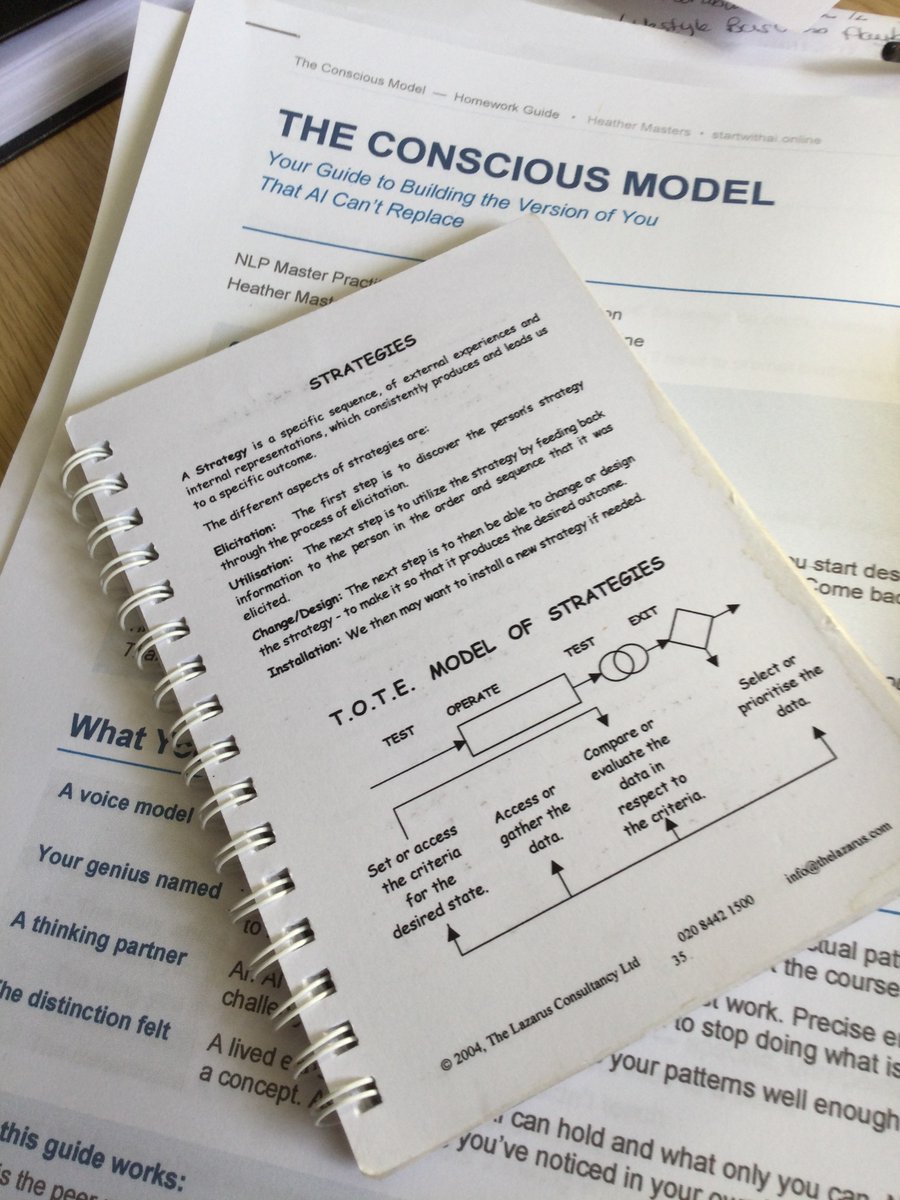
Then I adopted the TOTE loop from programming:
Test. Operate. Test. Exit.
In practical leadership: Try it. See what happens. Adjust. Go again.
When every business iteration is treated as a test, there's no ego on the line and no proof of worth riding on the outcome. Fear of failure disappears—not because risk vanished, but because you stop needing it to. There is no failure, only feedback.
To sharpen your taste in an era of automated content, study your own responses:
Where do you lean in? What makes you skip a paragraph, lose interest, or stay up all night to finish?
Pick a passage that moved you and examine the mechanics. Is it the dialogue, the sensory detail, the rhythm, or what the writer leaves unsaid?
Use what you discover to sharpen your own discernment.
People are predicting the end of coaching as we know it. I think AI is showing us what real coaching is ns where our real value lies.
Here are three ways AI is changing our work, and how to use each one to your advantage. https://t.co/j40KR1b1Yl
Like any tool, AI's real value depends entirely on the human directing it.
When you learn to be the controller rather than a passive recipient of outputs, it becomes priceless.
Futureproofing your practice doesn't come from adopting every new platform. It comes from mastering the oversight that steers them.
AI can replicate a finished result.
It cannot model the full spectrum of the human process that produced it—the physiology, the perceptual filters, the unspoken values, and the subtle cues operating beneath the surface.
That isn't a limitation AI will simply outgrow with more compute.
That is precisely what makes an experienced human practitioner irreplaceable.
To help you explore these questions before committing time or money, I've put together a free Before You Build AI Decision Checklist and prompt: https://t.co/AClmMjoB41
The AI landscape moves so quickly that pre-recorded playbooks are obsolete before they are published.
If you lead a professional practice, build implementation around live realities rather than static theories:
1. Identify bottlenecks by auditing what actually consumes your client delivery time.
2. Define the process and specify what finished looks like before touching a tool.
3. Hand over repetitive administrative tasks to free yourself for high-value strategic work.
In professional advisory and transformational work, you must become the director of AI, not its assistant.
AI can research, draft, and organize. But it cannot:
• Hold space for transformation
• Read energy and subtle shifts
• Feel into what a client really needs
• Create the psychological safety required for deep change
The question isn't whether AI will replace you. It's whether you use it to amplify your discernment or give your authority away to it.
If you want to start documenting before you delegate, I put together a free Before You Build AI Decision Checklist and prompt to help you explore these questions: https://t.co/AClmMjoB41
Nine in ten professionals are now handing everyday tasks over to AI.
It sounds like AI got easier. What actually got easier is delegation. And delegation requires something that prompting never did:
You cannot hand over work you have never documented and specified.
You might have 25 years of method and hard-won experience living in your mind. But if none of it is written down, the one thing AI cannot commoditise is also the one thing you cannot delegate or scale.
I've put together a free Before You Build AI Decision Checklist and prompt to help you explore these questions before committing time or money.
You can get it here: https://t.co/AClmMjoB41
3 Questions to ask before buying another AI subscription
Before buying another AI subscription or starting a development project, try answering three questions.
1. What specific result am I trying to achieve?
2. Can the software I'm already using help me achieve it?
3. What would happen if I simplified the process before introducing any technology?
These sound like straightforward questions, but they're surprisingly easy to overlook when a new tool promises to transform the way we work.
@jeffbullas I have been learning and researching AI for the past 18 months - giving myself permission to share what I've learned - I'm older than you 😉
The first training was a failure—but testing the offer before building the program changed everything. The audience response was so strong, they had to make a payment link on the spot.
Choosing Happy Podcast Episode 81 - Throwback Thursday
#Entrepreneurship#ProductMarketFit
The Technology Kept Overtaking What I Was Learning
Why knowing what not to build could save you weeks of work, unnecessary expense and a great deal of frustration. https://t.co/dZWqXScgPv