Dear @KemiBadenoch
Peter Bone. Nob flasher.
Don't remember any comments regarding this disgrace. The Conservatives took SIX YEARS to suspend him.
At the time as Minister for Women and Equalities where was your noise condeming this appalling individual?
#PMQs
The famous 1936 anti-war editorial cartoon "Come on in, I'll treat you right. I used to know your daddy." created by artist C. D. Batchelor (Clarence Daniel Batchelor), warned that Europe was heading toward another major war, which was published in the New York Daily News on April 25, 1936, and won the Pulitzer Prize for Editorial Cartooning in 1937...
War seductively calls out to the new generation ("I used to know your daddy"), implying that the sons are walking into the exact same fatal trap that killed or ruined their fathers during World War I, driven by the same cycle of European militarism and dictatorships.
Published in the spring of 1936—shortly after Nazi Germany remilitarized the Rhineland and as tensions mounted across Europe—the cartoon reflects strong American isolationist sentiments of the 1930s, warning Europe's youth not to repeat the slaughter of the Great War.
. . .
It depicts War as a seductive, ghoulish, skeleton-like woman wearing glamorous flapper-style jewelry and a shroud/dress. She smokes a cigarette and lurks in the doorway of a house labeled "Furnished Rooms To Let", luring young men inside, reminding him that she knew his father during WW1 (1914–1918).
A clean-cut young man is labeled "Any European Youth." His belt or vest bears references to the rising militarism and fascist regimes of the era, including "Starkism, Hitler, Mussolini" and the looming marquee sign reading "Follies of 1936" (a dark play on Ziegfeld Follies and the tragic folly of another war).
. . .
At the time, Germany's military power was expanding, while tensions across Europe were rising. The cartoon warned that a new generation was being drawn toward the same catastrophe its fathers had experienced.
Just three years later, WWII began in Europe in September 1939.
The cartoon won the 1937 Pulitzer Prize for Editorial Cartooning.
#drthehistories
Finished work so just catching the end of the superlative 'Dunkirk' (1958) on BBC2, with this moment that always gets to me, particularly as my grandfather was at Dunkirk and was one of the lucky ones to be taken off. Good choice of film for today, BBC.
The man who took Germany into the First World War spent his childhood with his arm pushed inside freshly killed hares on the orders of Prussia's best doctors. He came to the throne at 29, after the most famous throat specialist in London assured his father that the growth in his throat was harmless.
Wilhelm was born in Berlin in January 1859, Queen Victoria's first grandchild. He came out feet first, and to deliver him the obstetrician hauled on his arm and tore the nerves in his shoulder. The left arm never grew properly.
The royal physicians set about fixing it. Twice a week, for half an hour, the infant prince's arm was pushed into the body of a freshly slaughtered hare, so that the warmth of the dead animal might bring the limb to life. They called these animal baths. His good arm was strapped to his side to force the bad one to work, and they ran electric current through the bad one. When his head began to tilt, they cut a muscle in his neck. From the age of four he spent an hour a day in a contraption of belts, iron bars and screws, which his mother sketched in horror in a letter to her own mother. Later came an arm-stretching machine, twice a day, during his lessons.
Queen Victoria thought the animal baths revolting and idiotic. The doctors carried on. His leading biographer, John Röhl, judged that it amounted to child abuse.
None of it worked. The arm stayed short, and the boy grew up furious, desperate to prove himself and contemptuous of his liberal English mother.
His father Frederick was the hope of liberal Germany, married to Victoria's daughter and set on a parliamentary monarchy and friendship with Britain. In 1887, as Crown Prince, he went hoarse. The German surgeons saw cancer and wanted to operate. Morell Mackenzie, the most celebrated throat specialist in the world, was brought in from London. He took pieces of the growth and sent them to Rudolf Virchow, the greatest pathologist alive, and Virchow found nothing. Mackenzie declared the growth benign and the operation unnecessary. Queen Victoria knighted him for it.
The tumour kept growing. By February 1888 Frederick needed a tube in his throat to breathe, and he never spoke again. He became Kaiser that March and ruled by writing notes. He died after 99 days. At the post-mortem, Virchow found the cancer.
His son took the throne at 29. Within two years he had sacked Bismarck and let the treaty with Russia lapse. Twenty-six years later he took Germany to war.
Europe went to war in 1914 under a man the finest doctors of his age had failed twice, once in the nursery and once at his father's bedside.
🇬🇧🇮🇹 TARANTO NIGHT: THE STRIKE THAT FORESHADOWED PEARL HARBOR!
On the night of November 11–12, 1940, British biplanes attacked the Italian battle fleet at anchor, and showed how vulnerable battleships could be inside their own naval base.
Their weapon was the Fairey Swordfish.
Nicknamed the "Stringbag", it had fabric-covered wings, an open cockpit, and a decidedly old-fashioned appearance. Yet this slow biplane could deliver a devastating blow.
HMS Illustrious launched 21 Swordfish. Twenty reached Taranto, attacking in two waves. Some carried bombs and flares; eleven carried torpedoes.
Below them lay six Italian battleships.
Flying low through antiaircraft fire, the crews pressed home their attacks. By morning, three battleships (Littorio, Caio Duilio, and Conte di Cavour) had been put out of action.
Two would return to service. Cavour never did. The British lost two aircraft. Two airmen were killed and two became prisoners.
Across the world, naval officers studied the implications. Among them were the Japanese, who showed particular interest in the torpedo attack. Taranto demonstrated that shallow harbor waters offered no guarantee of protection.
Just over a year later, on December 7, 1941, Japan struck Pearl Harbor.
The scale was vastly greater: six carriers and hundreds of aircraft attacking in daylight. Japanese crews had developed their own equipment and techniques through intensive testing and training.
But the central lesson was the same.
A fleet did not have to leave port to face destruction from carrier aircraft. At Taranto, the men flying the humble Stringbag had delivered that warning in the darkness.
Follow @Vanguard_WW2 for the stories behind the battles you know, and the ones you should.
Poland regained its independence on November 11, 1918, ending 123 years of partitions by Russia, Prussia (Germany) and Austria-Hungary that had wiped the country off the map in 1795....
World War I shattered the three partitioning powers—Russia collapsed into revolution (1917), while Germany and Austria-Hungary were defeated by the Allied Powers in late 1918. Polish leaders like Roman Dmowski and pianist-turned-statesman Ignacy Jan Paderewski lobbied Western Allies, winning key support from U.S. President Woodrow Wilson, who made a free Poland part of his Fourteen Points peace plan. As occupiers weakened, local Poles took control. On October 7, 1918, the Regency Council in Warsaw proclaimed independence, and local committees seized power in regions like Galicia.
. . . .
On November 11, 1918, the armistice silenced the guns on the Western Front. That same day, Poland emerged as an independent nation after 123 years of partition, though its borders remained unsettled. Across Eastern Europe, the collapse of empires opened a new struggle over borders and political power.
And from Russia came another danger: Lenin’s Bolshevik regime, determined to carry its revolution westward.
In a deep way, this very fact of a new Marxist regime in Russia was illogical. Marx and Engels had envisioned revolution in the industrial West, not the agrarian East. Russia, with its peasant majority and decaying aristocracy, did not fit the theory. But Lenin had no patience for theory. He declared that Russia was the “weakest link” in the capitalist chain—and breaking it, he believed, would set off a world revolution.
If he could push westward into Europe and link up with uprisings in Germany, the old world order would crumble. The fire of Bolshevism, he was sure, would sweep the continent.
When Lenin signed the humiliating Treaty of Brest-Litovsk with Germany in early 1918 to end Russia’s part in the Great War, he dismissed it as a temporary measure. Once Germany fell, he promised, the treaty would be a scrap of paper. True to his word, as soon as the Central Powers collapsed, the Red Army began to march again—first into the Baltic states, then into Ukraine, then toward the plains of Poland. Everywhere, they carried the same gospel: revolution by bayonet. Across the continent, the map of Europe was still bleeding from the war, and to Lenin, that instability was a divine invitation.
In the summer of 1920, he saw his chance at last: the Red Army would sweep through Poland, take Warsaw, and march into Germany. Europe would be red by Christmas.
Few imagined that the ones to stop them would be the Poles themselves, a nation reborn only two years earlier after a century of partition. Their leader was Józef Piłsudski, a wiry, intense former exile who had spent years in Tsarist prisons dreaming of a free Poland. He was no theoretician but a man of iron will, driven by a hatred of Russian domination and a faith in Polish destiny. When Lenin’s forces surged west, Piłsudski rallied every man he could find: veterans, students, priests, farmers. They came barefoot and half-trained, armed with mismatched rifles, yet they came by the tens of thousands.
Behind them lay Warsaw—the beating heart of their newborn nation. Before them stretched the Red Army of Mikhail Tukhachevsky, 160,000 strong, veterans of WWI and the Russian Civil War, fanatical in purpose and confident of victory. “Over the corpse of White Poland,” Tukhachevsky had vowed, “lies the road to world conflagration.”
It was in August, 1920, that the Soviet tide reached the gates of Warsaw. The city trembled under artillery fire; Red cavalry swarmed the outskirts like wolves. Yet inside the capital, the Catholic churches were filled. The people prayed for a miracle and it came.
#archaeohistories
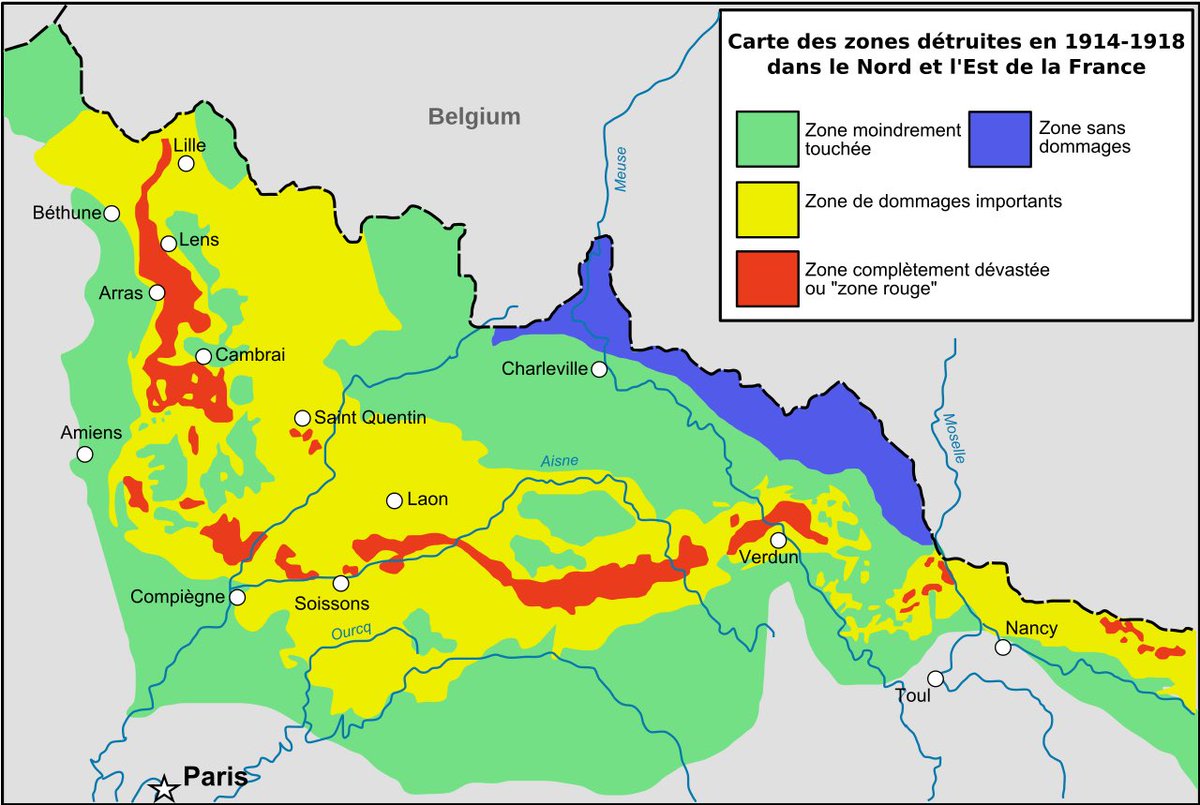
On continue de diaboliser la France pour le Traité de Versailles.
Or les réparations demandées à l’Allemagne ne couvraient même pas les destructions subies, et l’Allemagne a moins payé après 1919 que la France après 1814 et 1871.
La position française était dure, mais légitime.
In 1980, a Soviet Mi-8 helicopter flew past one of the giant Buddhas of Bamiyan, two ancient monuments that had watched over central Afghanistan for about 1,400 years.
The statues were carved directly into a sandstone cliff in the Bamiyan Valley around the 6th and 7th centuries. The taller one stood about 180 feet high, and the smaller one about 125 feet. At the time, Bamiyan was a thriving Buddhist center along the Silk Road. Monks lived in hundreds of caves dug into the surrounding cliffs, many decorated with colorful murals.
When this photo was taken, the Soviet Union had invaded Afghanistan just months earlier, in December 1979. The Mi-8 became a workhorse of the war, ferrying troops and supplies across the country’s rugged terrain. The conflict dragged on for nearly a decade, killing hundreds of thousands of Afghans before Soviet forces withdrew in 1989.
The Buddhas survived the Soviet war, but not what came after. In March 2001, the Taliban declared the statues idolatrous and destroyed them with artillery and explosives, ignoring pleas from governments and museums around the world.
Today, only two empty niches remain in the cliff where the giant Buddhas once stood.
Look at more amazing historical photos: https://t.co/FRrL4hIDpN
11. listopadu 1940 🇮🇹🇬🇧 Operace Cinzano.
Deset bombardérů Fiat BR.20M s doprovodem stíhaček CR.42 zaútočilo na přístav Harwich. Proti Italům vzlétly Hurricany RAF.
Boje se zúčastnil i Čech P/O Karel Mrázek od 46. perutě.
Italové ztratili 3 bombardéry a 3 stíhačky.
#RAF
Nazi war criminals on the defense bench during the Nuremberg Trials in late 1945, showing prominent defendants including Hermann Göring and Rudolf Hess reacting with laughter or amusement....
In one well-documented instance during the early proceedings, a prosecutor mistakenly described Rudolf Hess as Hitler's second-in-command. Driven by his intense vanity and ego, Hermann Göring loudly interrupted and protested, shouting that he not Hess was Hitler's true second-in-command. That absurd display of narcissism among the defendants drew amused reactions from those sitting in the dock.
The trials were a pioneering real-time test of simultaneous multilingual translation (English, French, Russian, and German) via headphones, which occasionally led to minor slips, though high-profile ego clashes and tension breaks accounted for moments like this.
. . .
Simultaneous translation technology was being used on a large scale for one of the first times in history, with participants listening through headphones in English, German, French, and Russian.
Translation delays, occasional errors, and awkward exchanges did happen, and some courtroom observers recalled defendants reacting with amusement.
At other times, they laughed at private comments, interactions among themselves, or what they viewed as weak testimony from witnesses.
Because photographers captured only a split second, it’s usually impossible to determine the exact reason behind any individual photograph.
Göring, in particular, often tried to project confidence throughout the trial. He viewed the proceedings as an opportunity to defend himself publicly and frequently appeared relaxed or even smug despite facing charges of crimes against humanity, war crimes, and crimes against peace.
That confidence ultimately did not change the verdict. On October 1, 1946, Göring was sentenced to death but committed suicide with a cyanide capsule just hours before his scheduled execution. Hess received a life sentence and remained imprisoned at Spandau Prison until his death in 1987.
The Nuremberg Trials pioneered modern simultaneous interpretation. Teams of interpreters translated proceedings in real time into four languages using IBM-designed headset technology, allowing the multinational trial to proceed far more efficiently than consecutive translation would have permitted. That system became the model for international courts and organizations such as the United Nations.
(Colorized)
#archaeohistories
In 1982, inside the massive assembly hall at the Sevmash shipyard in Severodvinsk, Soviet workers were building one of the largest submarines ever made: a Project 941 Akula, known to NATO as the Typhoon class.
The scale was staggering. A Typhoon stretched about 575 feet long and displaced roughly 48,000 tons submerged. That made it bigger than many surface warships. Instead of a single hull, it held two main pressure hulls side by side inside an outer casing, plus smaller pressurized compartments for the control room, torpedoes, and steering gear.
Its purpose was deterrence on a terrifying scale. Each submarine carried 20 R-39 ballistic missiles, and each missile could hold up to 10 nuclear warheads. The Typhoons were designed to hide beneath the Arctic ice, punch through it when ordered, and launch a retaliatory strike against the United States.
Sevmash completed six of them between 1981 and 1989. For a crew of around 160, life aboard was unusually comfortable by submarine standards, with a sauna, a small swimming pool, and a gym.
The Soviet Union collapsed before the Typhoons ever had to fight. Most were scrapped, and the last of them, the Dmitry Donskoy, was retired in 2023.
More iconic historical photos: https://t.co/dQjceOPkrz
Mollie Maggia's jaw came away in pieces in her dentist's hands in 1922, and when she died that September, aged 24, her death certificate said syphilis.
She had been a dial painter at the United States Radium Corporation in Orange, New Jersey, one of hundreds of young women, most in their teens and early twenties, painting glowing numbers onto watch faces with a paint called Undark. To keep a fine point on the camel-hair brush they were taught to shape it between their lips. Lip, dip, paint, hundreds of dials a day. The supervisors told them radium was harmless, good for them even. The girls painted their nails and teeth with it for fun and walked home glowing in the dark.
Then their teeth began falling out. Jaws rotted and snapped. Spines crumbled. Doctors had no name for it, and the company did not offer one.
It had one. In 1924, under pressure, it paid Harvard specialists to study the factory, and they reported that radium was the cause. The company sat on the report and let it be known that its workers were in good health. Its own examiner told sick women they were well. When the deaths kept coming, the whispering started that dial painters were loose girls, and that it was syphilis.
Grace Fryer began losing her teeth in 1922 and spent two years looking for a lawyer brave enough to take on the company. In 1927 she sued, with four other women, and the papers named them the Radium Girls. That autumn Mollie was dug up to settle the syphilis question. Her bones were radioactive. The company stalled, knowing its accusers were dying, and by the first hearing in January 1928 two of the five could not raise their arms to take the oath.
They settled that June for $10,000 each and $600 a year. The judge who brokered the deal turned out to own shares in the company. The man who had invented the paint died of radium poisoning that November.
In Illinois, at the Radium Dial Company, Catherine Donohue gave her evidence in 1938 from her sickbed, weighing about five stone, and was dead within months. Her case helped win American workers the right to sue over the diseases their jobs gave them.
The women were told they were young and healthy and had nothing to fear, and when they started dying, the company found it easier to attack their virtue than admit what was in its paint.
Their graves in New Jersey still set off a Geiger counter.
The Brothers in Arms Memorial in Zonnebeke, Belgium, which honors Australian World War I soldiers and brothers John "Jack" Hunter and James "Jim" Hunter of the 49th Battalion AIF....
During the Battle of Polygon Wood on September 26, 1917, 20-year-old Jack Hunter was mortally wounded by artillery fire. His younger brother Jim Hunter cradled him as he died and buried him in a makeshift grave wrapped in an army groundsheet. Heavy shellfire later obliterated the landscape, and Jim was never able to locate his brother's resting place after the war. In 2006, road construction workers near Westhoek and Polygon Wood uncovered the remains of five Australian soldiers. Through DNA testing matched with their niece Mollie Millis, Jack Hunter was officially identified and reburied with full military honors at the Buttes New British Cemetery.
. . . .
When war came to Australia, two brothers from the small Queensland town of Nanango answered the call together. John “Jack” Hunter, the eldest of seven children, enlisted in Brisbane in 1916 with his younger brother Jim. They trained in Egypt and were then sent to the Western Front with the 49th Battalion of the Australian Imperial Force. By September 1917 they were in Belgium, in the mud and shattered forests of the Ypres salient, as Australian troops prepared for the attack on Polygon Wood.
In the early hours of 26 September 1917, as the men moved into position, sunlight glinting off a piece of metal on the battlefield was reflecting into the soldiers’ eyes. Jack went out into no man’s land to remove it and was badly wounded. He managed to crawl back to the trenches, where he died in his brother’s arms. Jim wrapped Jack’s body in a groundsheet, bound it with wire, and buried him in a temporary grave, vowing to come back for him. But days of shelling churned the ground beyond recognition, and Jim could never find the grave again, not during the war and not afterwards. According to a family story, as Jim lay dying in the 1970s, he opened his eyes and called out for Jack.
Nearly ninety years later, in 2006, a pipeline excavation near Zonnebeke turned up human remains. Amateur archaeologist Johan Vandewalle persuaded the workers to pause so he could investigate, and five soldiers were recovered. One, an Australian, was still wrapped in a groundsheet. With no personal items to identify him, researchers turned to DNA, and a sample from Jack’s niece, Mollie Millis, confirmed it was Jack Hunter. In 2007 he was reburied with full military honours at Buttes New British Cemetery at Polygon Wood. On 25 September 2022, the “Brothers in Arms” memorial was unveiled less than a kilometre away. Its centrepiece, a bronze by Australian sculptor Louis Laumen, shows Jim cradling Jack, and its plaque carries the words “reuniting their souls”.
Few people know that the Hunter brothers were reunited largely because of one stubborn Belgian. When the excavator struck human remains near Zonnebeke in 2006, amateur archaeologist Johan Vandewalle begged the workers to stop, reportedly telling them, “Don’t kill them again!” The body wrapped in the groundsheet was so well preserved that Vandewalle later said seeing the soldier’s eye “was like a message in a bottle.” Jack became one of the first soldiers from that battlefield to be identified by DNA.
Vandewalle then spent years campaigning for a memorial. In 2016 he travelled to Nanango to meet the Hunter family and share his dream of a statue showing Jim cradling Jack. It was cast in Melbourne and shipped to Belgium, where it now stands less than a kilometre from Jack’s grave.
#archaeohistories
On this day in 1944, an American submarine fired its torpedoes into a German U-boat in the Java Sea and sent it to the bottom with every man aboard. The submarine it killed, U-537, had already earned a strange place in history, as the only U-boat ever to land an armed party on the soil of North America. This is the end of U-537.
A little over a year earlier, this same submarine had done something no other German vessel managed in the entire war. In October 1943, U-537 had crossed the Atlantic to the lonely, frozen coast of Labrador in Canada, landed a party of men, and set up an automatic weather station on a windswept hill to secretly radio back weather data to Germany. It was the only known armed German military operation on the mainland of North America during the whole war, and remarkably, it went completely undiscovered for decades. The weather station sat forgotten in the Canadian wilderness until the 1980s.
But the submarine that pulled off that secret mission did not survive the war. After her Labrador adventure, U-537 was eventually sent to the far side of the world, to operate out of Japanese held bases in the Far East, part of the small force of German submarines that worked the Indian Ocean and the waters of Southeast Asia in the later years of the war.
It was there, in November 1944, that her luck ran out. In the Java Sea, east of the port of Surabaya, the American submarine USS Flounder was on patrol, hunting. The Flounder detected U-537 and worked into an attack position. She fired her torpedoes, and they struck home. The German submarine was destroyed and sank, taking her entire crew of around fifty eight officers and men down with her. There were no survivors.
So the U-boat that had crept up to the coast of Canada and planted a secret weather station on North American soil, a feat unique in the war, met its end on the other side of the planet, torpedoed by an American submarine in the warm waters of the Java Sea. The men who had once shivered on a frozen Labrador hilltop died far away in the tropics, and U-537 passed into history as one of the strangest and most well traveled submarines of the war, sunk with all hands on this day in 1944.
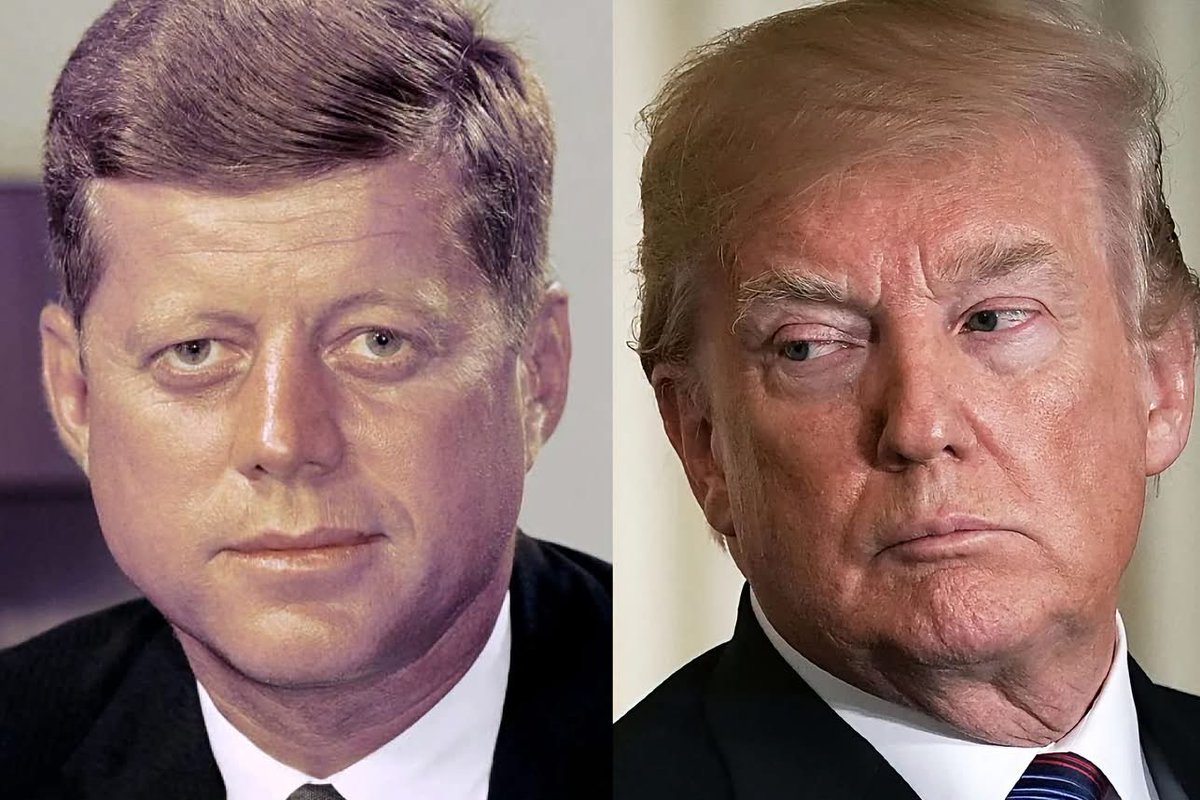
BREAKING: OUTRAGE! Nine Kennedy family members join lawsuit to STOP Trump's towering monument from overshadowing JFK's grave.
The giant golden monumental arch that Donald Trump wants to build to celebrate himself just got another prominent set of opponents seeking to ensure that it never actually sees the light of day.
According to The New York Times, nine members of the Kennedy family moved Tuesday to join a lawsuit trying to block Trump’s planned 250-foot triumphal arch, the one that critics call the “Arc de Trump.” The plaintiffs are children and grandchildren of Sens. Robert F. Kennedy and Edward M. Kennedy, who are buried near their brother, President John F. Kennedy, at Arlington National Cemetery.
The move comes after the family successfully fought against adding Trump’s name to the John F. Kennedy Center for the Performing Arts.
The arch, topped with golden angels and a flame, would stand between the Lincoln Memorial and Arlington. The family’s filing says it would “permanently cast a shadow over plaintiffs’ parents’ graves and the graves of servicemen and -women who made the ultimate sacrifice for this country.”
It would also block the view from JFK’s eternal flame across the Memorial Bridge to the Lincoln Memorial. The filing says that sightline was “designed to represent the unification of the nation following the Civil War” and has existed for nearly a century. Blocking it would destroy “an essential element of the gravesite’s design.”
Rory and Maxwell Kennedy, children of Robert and Ethel Kennedy, said: “A towering arch casting shadows across the graves of our father, mother and uncles, as well as the graves of so many who have served our country, would also cast a shadow over our democratic principles.”
Remember who else is a child of Robert F. Kennedy: Trump’s Health Secretary, RFK Jr. His own siblings are now in court fighting his boss over their parents’ graves.
The Kennedys are joining a crowded fight. Veterans, a historian, the District of Columbia, Virginia, and Arlington County are already suing. Last Thursday, the National Capital Planning Commission, which is run by Trump allies, gave the arch final approval. Almost immediately, Judge Tanya Chutkan blocked construction for 14 days. In a 33-page opinion, she said the arch needs approval from Congress, could be costly to Virginia and D.C., and would disrupt traffic at one of the region’s most-visited sites.
That’s the same Congress Democrats just won.
“Only Congress has the constitutional power to authorize an intrusion of this magnitude,” said the family’s lawyers, Norman Eisen and Steve Jonas of the Democracy Defenders Fund.
Look at the pattern. Trump tore down the East Wing for a ballroom. He cut down 400 trees to remake a public golf course. He has tried to put his name on the Kennedy Center. Now he wants a 25-story arch overshadowing one of the most sacred places in the country, the cemetery where America buries its war dead.
Arlington belongs to the people buried there and to the families who mourn them. It is not — and should never be — a backdrop for Trump’s ego.
Please like and share if you agree!