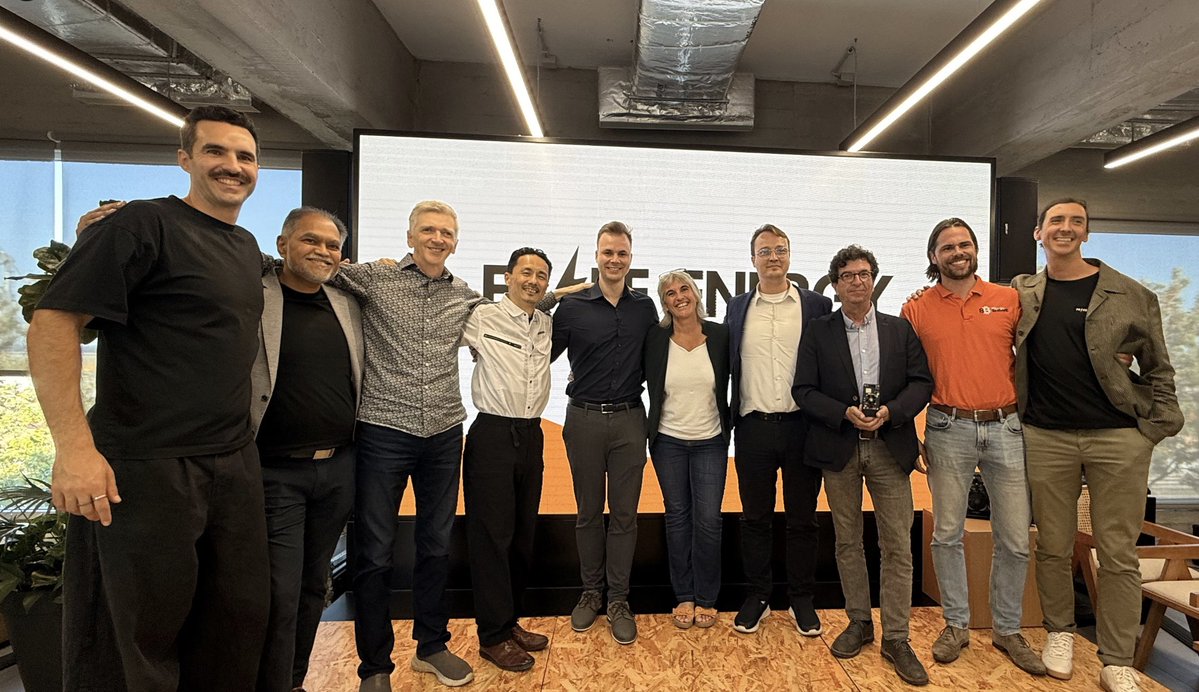
Special shoutout to @NZBitcoiners for his endless contributions and putting together an epic quiz for us, which was a lot of fun and something we'll have to do more often :)
If anyone has suggestions for how to make our meetups even better, they are always welcome! DM me ✌️
@paperX_Art@THORSwap It’s so degenerate to have your own token, I really don’t like this being shilled in the https://t.co/h53eGAtXoD chats.
Do not post links again.
@DSBatten I was asked to speak if I was nice about crypto, I got cancelled when the organisers buddy shilled a meme coin and invited me to a trading group, I didn’t respond with love…
I've been meaning to do this for some time.
It's a compilation of free resources for anyone who is looking to
- start a business
- improve their influence skills (honestly and authentically)
- break through habits
- pitch better than the templated way of doing it
Some of the links in the ebooks may be a little old, as I wrote them over a decade ago, but the concepts are still fresh. The ebooks are products that I used to sell, so they are written to a good standard and have proven useful to people.
The pitching video contains a lot of things that I learn raising capital for my own startiup, as well as seeing hundreds of pitches as an investor, and hundreds more as a coach.
Enjoy ... and put the ideas to use to help Bitcoin!
https://t.co/jRk6gzMzCn
One year ago Financial Times columnist Katie Martin criticized Bitcoin, saying that while her teeth are scarce, they aren't worth billions.
The argument was so hilarious, so remarkably uninformed, and so meme-worthy that no-one took the time to explain why it is is also fundamentally flawed.
So on the one-year anniversary of this take - as a fun exercise I thought I'd unpick the logic so we could see how this FUD stands up to other FUD
TL;DR: equally badly.
The first flaw is a false equivalence between two completely different types of scarcity.
Her teeth are scarce to her.
There are roughly 7 billion mouths on the planet, each containing up to 32 teeth. Global supply: hundreds of billions. Hardly scarce.
The second flaw is that sharing of one attribute does not make two things interchangeable.
They're also not fungible. Her molar is not interchangeable with yours !
They are certainly not divisible, not portable as a unit of exchange, not durable in the monetary sense, and not verifiable by a third party. They can also be replaced by implants or dentures.
Bitcoin's scarcity is absolute, mathematically enforced, globally verifiable, and immutable.
21 million for every person on the planet, forever. No one can produce more. Anyone can verify the cap independently.
The argument smuggles in the assumption that scarcity alone is Bitcoin's value proposition, then disproves that straw man.
Scarcity is necessary but not sufficient.
What makes Bitcoin valuable is scarcity combined with fungibility, divisibility, portability, durability, verifiability, and censorship resistance.
Her teeth have one of those properties (and even then, only to one person on the planet, Katie herself).
Bitcoin has all of them.
It's the same category error as saying "my kitchen table is also a flat rectangle, but nobody calls it a tennis court."
True.
But a tennis court also has a net, regulation dimensions, a standardised bounce surface, and an agreed-upon set of rules.
Sharing one property doesn't make two things equivalent.
@JasonFindlay78@Davo_TCD@nzcryptocon@AusCryptoCon Like a goon bag on a rotary washing line? Or chop bongs 😅
The sound of your dumbest person in the room is a great way to roll, I can get a bit upset when when there’s people that are obviously ignorant, dumb or a scammer when they’re trying to be an authority.
I just got back from the Bitcoin Energy Summit in Lisbon and I have a question that won't leave me alone.
First some context: Bitcoin mining is now stabilizing the grids of 7 nations, 4 agencies (including the Spanish Govt and the World's largest energy policy association) just called for more flexible demand being critical to the resilience of the grids of the future - and Bitcoin mining is the world's most flexible load resource by an order of magnitude.
So in light of this my question is this: why is 95% of the Bitcoin adoption conversation about Bitcoin-as-money when Bitcoin-as-energy is already deployed on grids across 3 continents?
Is it possible that energy is the Bitcoin usecase that paves the road for mainstream acceptance of Bitcoin in the West?
I've been in this space for four years now. When I started, the conversation was "bitcoin mining wastes energy." A group of Bitcoiners including @thetrocro, @jyn_urso and others changed that. Then it became "ok maybe it doesn't waste energy, but it's not useful." @gladstein, @jack and others changed that too.
But here's what I noticed in Lisbon. Three separate European organisations - the European Bitcoin Energy Association, Free Madeira, and the Institut National de Bitcoin in France - are all independently converging on the same conclusion.
@geyer_rachel, Chair of EBEA said energy is what will move the needle for Bitcoin in Europe. @andreloja at @FREEMadeiraOrg said energy is the most topical issue in Europe right now. Bastien Desteuque (@Proxy18387764), directeur général at @BitcoinPolicyFr said they're focusing on mining because France has spare nuclear capacity and that's where the biggest opportunity is.
Three organisations. Same conclusion.
And that's before you get to what's actually being built. In Sweden, a man I coach runs ASIC hardware that earns almost two-thirds of its revenue from frequency regulation - keeping the lights on, responding in seconds to the need of the grid operator, and helping to stabilize the grid an incredible 11,247 times last year alone. (Yes, you read that sentence right).
In Lisbon, I watched Kenji Tateiwa present a circular economy where bitcoin mining heat grows tropical fish and the CO2 gets converted to charcoal and micro diamonds. Bastian outlined how France's surplus nuclear energy could be absorbed by bitcoin mining by 2027.
And outside the West, from stabilizing the economy of Bhutan post-covid to helping save Virunga National Park in Africa - Bitcoin mining was behind both events and many more. This phenomenon is a global one.
The conversation has quietly moved from "does bitcoin mining help grids?" to "how many services can one machine provide?"
We've been thinking about this like monoculture - one machine, one function.
What I saw in Lisbon is permaculture. The same hardware doing frequency regulation, heat capture, Sats-minting ... and potentially in the near future - voltage regulation (something that would have prevented the 28 April 2025 Iberian Peninsular Blackout).
I talked to Bitcoin founders after the keynote who told me the energy thesis had opened their eyes. These are people who worked to advance Bitcoin payment infrastructure, and they hadn't fully grasped this.
Bitcoin solves a monetary problem the world is only beginning to understand. I'm more convinced of that than ever.
And ... as we wait for that revolution to be fully grasped, the energy revolution is already here - deployed, generating revenue, stabilizing grids. It might just be the thing that opens the door for everything else. What other Bitcoin use case is this far along ... at least in the West?