During a MSc project back in early 2025 @N_Midavaine did some great work with @GrigoryBartosh in this space where we learn noising paths and embeddings jointly. Later published at a #EurIPS2025 workshop:
Towards Latent Diffusion Suitable For Text
https://t.co/QuqgpMU68D
This is the first paper from the Large Commerce Model work at Prosus: pretrain on commerce behaviour once, specialise into small task models that are cheap to serve. Presenting Thursday in Naples. Come say hi.
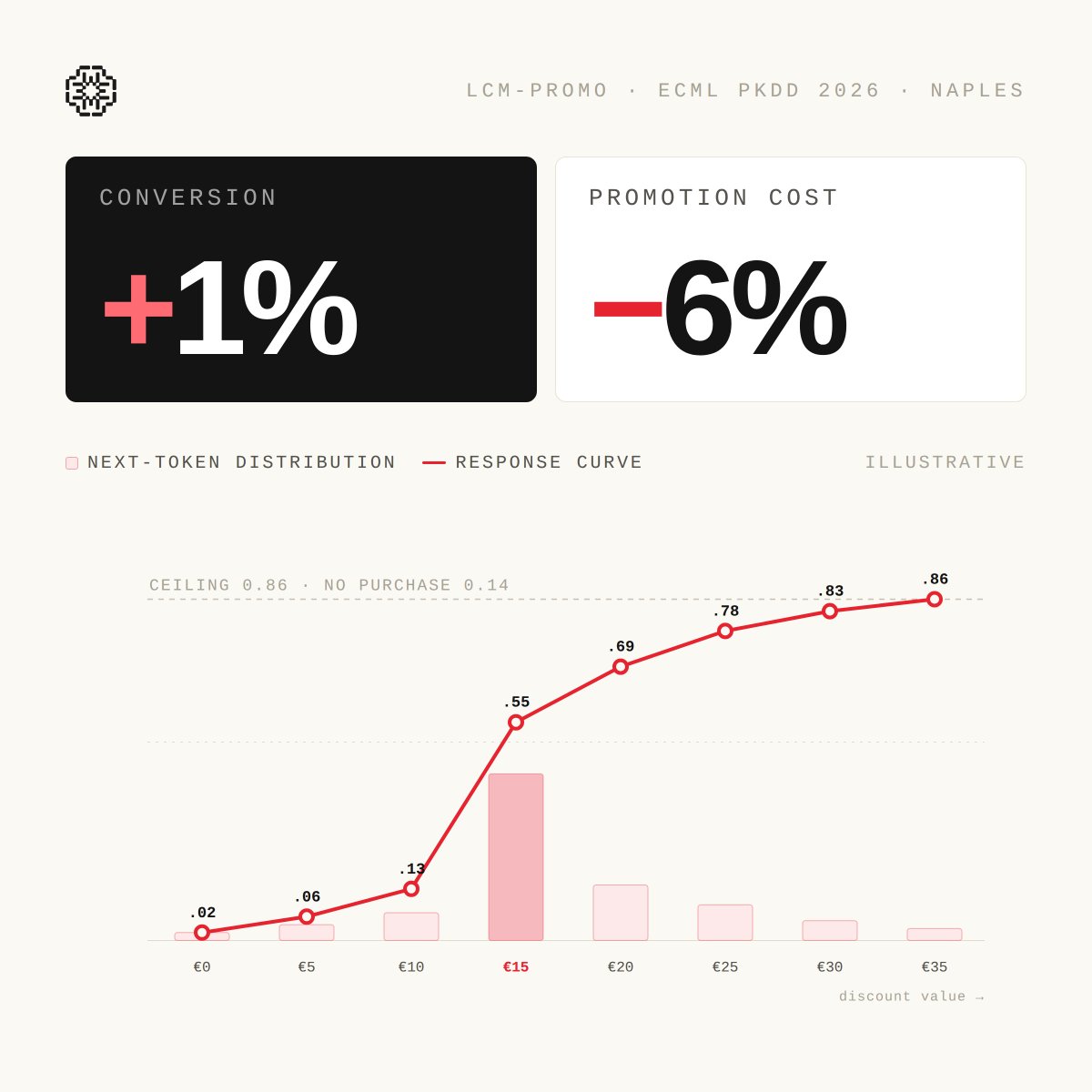
We taught a 4B LLM to hand out food-delivery discounts. One month in production at iFood: +1% conversion, −6% promotion cost vs the existing system. Paper accepted at ECML PKDD 2026 (Industry Track). How it works 🧵
Why it beat the baseline: the old policy forecast orders per segment × discount cell, and every new cell needed exploration traffic. 50 segments × 10 discounts was the ceiling. With context in the prompt, the same weights price all promotion combinations. Twice a day, in 30 mins.
My first blog post in over a year is a deep dive on flow maps🗺️, or how to learn the integral of a diffusion model to enable faster sampling and several other cool tricks.
It's the longest one yet👀 Let me know what you think!
https://t.co/O8bBGZ9qjC
Result: 1.1163 bpb, -0.0031 over last Friday's top score. All under ~16MB with 10 minutes of eval time. Code + writeup: https://t.co/hQpLY1M6lr
More information coming later in a @Prosusgroup
tech blog.
I brought depth recurrence back in @OpenAI's #ParameterGolf challenge.
Last week an analysis showed why recurrence doesn't work under the 16MB/10min constraints — compounding quantization errors + fewer training steps. +0.025 bpb worse.
Two ideas to fix it: 🧵
Second fix: a cheap Jacobian proxy loss that keeps hidden states from exploding across passes. I used a finite-difference approximation, and measured the impact by tracking the growth ratio across several depths.
I managed to keep it stable even up to 6x and 8x recurrence.
Adding nvtx.push/pop calls just to profile GPU code is such unnecessary friction
Built a VSCode extension that lets you mark profiling ranges visually, no more modifying your source code
🧵
[1/4]
Diffusion Language Models have the potential to break the AR LLM paradigm. Models like Gemini Diffusion have already shown incredible token/s.
I just finished the last couple months of work on Latent Diffusion Models for language. We found competitive likelihood results and reasonable sample quality for latent diffusion. This example shows 32-step generation of 64 tokens.
Also, if you mess with the way you destroy information, you can do fun stuff like autoregressive latent diffusion (see 🧵),
Autoregressive Latent Diffusion. Generation derails around 30 tokens. I do not recommend doing this in practice.
However, it is interesting that you can train a diffusion model to generate autoregressively.









![repro_challenge's tweet photo. #MLRC2025 happening this week (August 21st)! The second keynote talk [2/4] will be from @soumithchintala at 10:30AM EST https://t.co/efJOuUtljQ](https://pbs.twimg.com/media/Gypv2WxWQAAWrWS.jpg)


