@AdamThierer and I have a new analysis out with @RSI on Bernie Sanders' proposed sovereign wealth fund for AI. We argue that it would further politicize the AI industry while creating moral hazard that ultimately leaves taxpayers bearing the risks.
I really hate the "permanent underclass" meme. It basically treats capital ownership as the only relevant variable, and subtly implies that automation means law, democracy, rights, and institutions merely adjust to ratify the interests of capital owners. Feels like a weird mix of Marxian class reductionism and libertarian property fatalism.
What I find most offensive is the implicit contempt for agency and liberal democracy. It ignores that people and institutions *react* to economic developments. There's never a guaranteed happy ending of course, but that's precisely why agency matters in the first place.
Pessimists sometimes come up with an intense set of assumptions and ask you to enumerate all solutions and adaptations ex ante, but that's akin to asking for knowledge that does not exist yet, the stuff distributed trial-and-error will lead to. The future social equilibrium is endogenous!
if you're trying to stay up to speed on AI policy and looking for analysis of fast-breaking news on government's growing efforts to take control of advanced computation in America, @RSI has you covered. 👉
@MarrrkDalton@edtarnowski
At WRC-27 in Shanghai, governments will negotiate satellite spectrum rules that could determine Starlink and Amazon Kuiper expansion. @kristianstout joins a joint ICLE and @NewAmerica webinar on June 30 at 2:00pm EST to examine what's at stake.
Register below ⬇️
reading Andrew's write-up of the Sanders AI bill made me feel even more confident in the assessment @NaThielman & I made that: "The bill represents the most radical and potentially destructive piece of technology legislation ever proposed."
https://t.co/hGH7aWK58x
@AdamThierer and I have a new analysis out with @RSI on Bernie Sanders' proposed sovereign wealth fund for AI. We argue that it would further politicize the AI industry while creating moral hazard that ultimately leaves taxpayers bearing the risks.
America's leading AI labs, still not profitable, don't have profits to share yet. The Sanders bill circumvents this by levying the tax on gross receipts.
This would strip AI firms of the ability to reinvest in further development in hopes of becoming profitable and meeting the competition domestically and globally.
Read the latest by my @RSI colleagues @AdamThierer and @NaThielman https://t.co/TFxqL8t8My
Not only is this misguided, but remarkably selfish.
If you don’t want to accept new and cutting-edge treatments, that’s fine. This is a free country. Nobody is forcing you to.
But to advocate for constraining advancement in cancer treatments for millions is grossly egocentric.
"The Sanders AI Sovereign Wealth Fund Act Is a Death Sentence for American Technology Leadership"
new @RSI analysis of Sanders “American A.I. Sovereign Wealth Fund Act,” from @NaThielman & me. 👉
Very excited to share my new @RSI study on AI Writers in @CommunityNotes!
There really is a TON of data in this study, but here's a quick takeaway:
AI Note Writers are very effective - They had an 18.0% Community Rated Helpful rate vs. only 8.9% for humans and displayed higher helpful rates across a variety of topics and ratings
Here are some more highlights from the study (thread)
Francis Fukuyama recently shared a compelling piece titled “The Myth of Authoritarian Efficiency” by political scientists Jørgen Møller and Svend-Erik Skaaning (Aarhus University / V-Dem project).
The article dismantles the popular notion that authoritarian regimes—particularly China—are simply better at “getting things done.” Drawing on historical data and comparative evidence, the authors argue that democracies consistently outperform autocracies over the long term across critical domains:
• Military effectiveness: Democracies have won more than 80% of wars since 1815. Greater legitimacy enables citizens to make greater sacrifices, and democratic alliances prove more durable.
• Economic performance: While autocracies can drive catch-up growth to middle-income levels, they struggle to transition to innovation-driven, knowledge economies that require rule of law, intellectual property protection, and open debate. High-quality democracies show a modest but robust long-run growth advantage.
• Avoiding catastrophe: Autocracies periodically produce large-scale man-made disasters (Mao’s Great Leap Forward, Soviet collectivization). Institutional checks and public scrutiny in democracies make comparable failures rare.
• Crisis management & environment: Transparency, independent science, and accountability lead to better outcomes on pandemics, climate policy, and environmental indicators. China’s zero-COVID flip-flop and overstated economic statistics illustrate the risks of centralized, unaccountable decision-making.
The authors acknowledge democracies can be slow and messy, but emphasize that self-correction mechanisms ultimately make them more resilient and effective than systems that concentrate power without feedback loops.
Francis Fukuyama, author of the landmark book The End of History and the Last Man, continues to spark important conversations about the enduring strengths of liberal democracy in an era of renewed authoritarian confidence.
Full article (highly recommended):
https://t.co/rdLYptPLnY
What’s your take—do you see evidence of this “myth” playing out in emerging markets or great-power competition today?
#Democracy #Geopolitics #China #EmergingMarkets #InternationalRelations #PoliticalEconomy
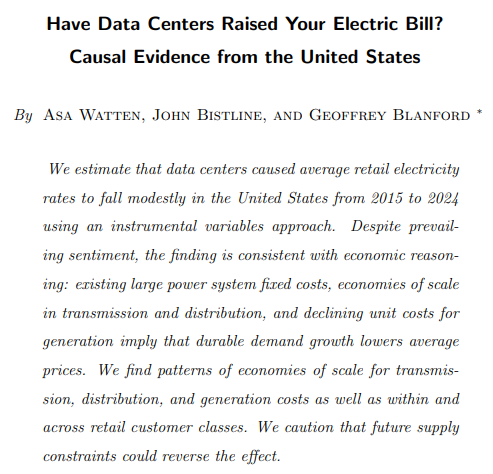
Data centers didn’t raise electric bills nationally from 2015–24. Surprise! Actually, they modestly lowered them. That's because big fixed grid costs get spread over more kilowatt-hours, and new demand can unlock economies of scale.
@arxiv
New reporting on the Fable/Mythos story links last Friday’s export-control decision to the June 2 AI Cybersecurity EO. It also bears out one warning I raised about that EO.
Here’s a short “I regret to report I was right” thread. 1/
With KOSA and NO FAKES still seemingly alive as potential currency in a deal for a federal AI regulatory framework, a reminder that both bills compromise free speech online and should be non-starters. https://t.co/u6BnFRZyG7
this sort of headline -- "The Job That AI Was Supposed to Kill Needs More Humans Than Ever" -- is becoming more common as pundits and papers realize the AI job apocalypse narrative is exactly backwards.
This new op-ed from economists like Piketty, Stiglitz, and Hickel call for essentially de-growth. A few notable incorrect statements here 🧵
https://t.co/95kgzVhzo4
I really loved this article. A one-time increase in per capita growth from 2% to 2.1% for a single year, then dropping back to 2%, would permanently raises the level of GDP per capita - and because that small gain recurs and compounds every year afterward across the population, it would add up to roughly a trillion dollars in cumulative value. https://t.co/aaUHcLslRd
When people talk about pausing AI development, I can't help but think about the enormous cumulative value that would get lost over time, the higher rates of absolute poverty that would persist across the world, and the needless deaths from delayed medical advances. There may be worlds where some version of this is something to consider, but the evidentiary bar for delaying technological development should obviously be pretty high.