✨ Exciting news! I've accepted an offer from @Meta as a Research Scientist Intern in May 2025 in NYC! I am looking forward to contributing to groundbreaking neuroscience and tech research, enhancing human-computer interaction through wearable EMG interfaces.
#HCI#Neuroscience
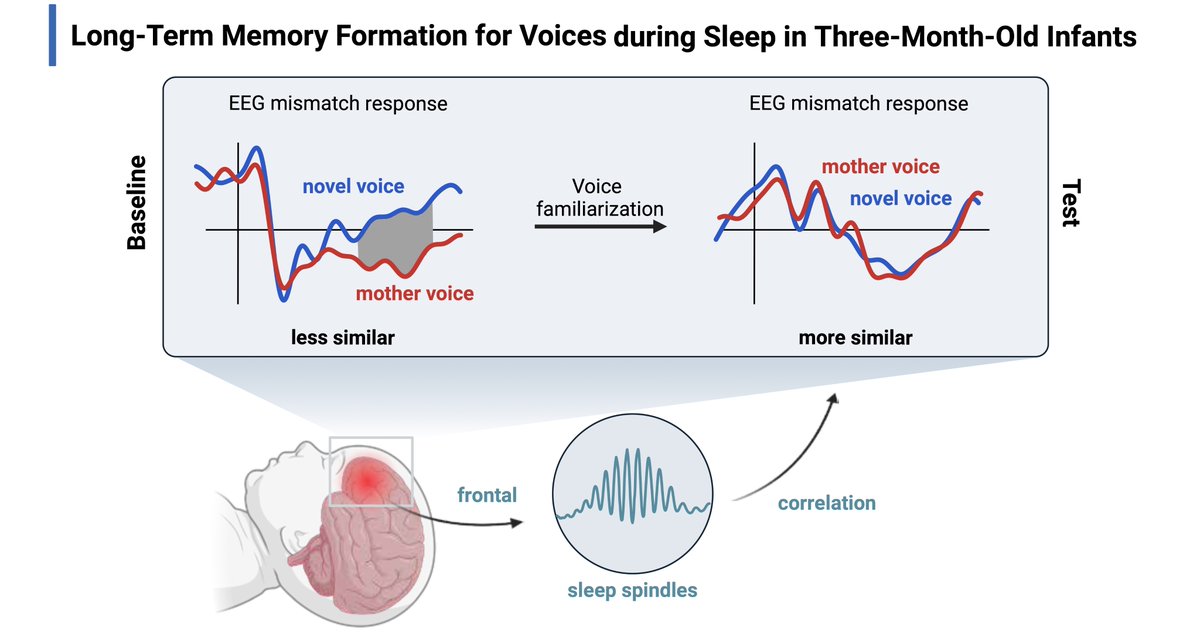
🧠👶 Excited to share our latest work: 3-month-old infants can form long-term memories of new voices after familiarisation and a nap! Using EEG, we discovered that sleep spindles are associated with the emerging memory representation of the new voice.
These findings highlight that fNIRS, with its portability and non-invasive nature, can be a powerful alternative to other neuroimaging techniques when paired with data analysis methods specifically tailored for it.
🚀 Excited to share our latest preprint on using Riemannian Geometry to classify brain states with functional near-infrared spectroscopy (fNIRS)!
https://t.co/qmm6rSQDgn
After that, we combine the kernel matrices into a block diagonal matrix. Our method achieves 96% accuracy in binary classification and 65% in 8-class classification of mental imagery tasks.
🎯 We introduce a classification framework that leverages the dual nature of the fNIRS signal. This approach significantly outperforms traditional classification methods by applying separate kernel functions and regularizations to each chromophore.
Now out at Comms Psych! https://t.co/zfcG6xr93r
Many thanks to our co-authors, and employees and visitors of the NEMO museum 💚
Almost 1,000 museum visitors donate their data per month, so I’m looking forward to adding more to OSF soon! #openscience
New paper led by @IsabelRaposo16 on altered rhythmic attentional sampling in frontoparietal lesion patients is now published in @CurrentBiology and available here https://t.co/bhfQVIhZvB Tweetprint below.
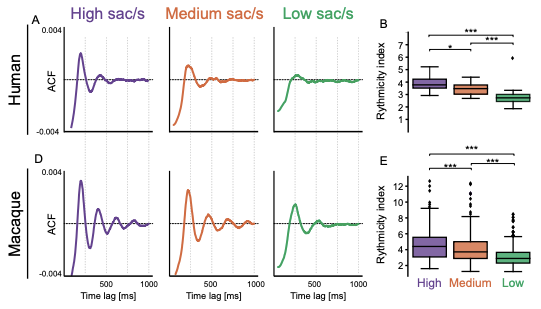
Excited to share our new #preprint on primate saccade rhythmicity! We investigated temporal saccade dynamics in humans & macaques, revealing theta rhythmicity, however only under specific conditions. 🐒👀 https://t.co/Cg2F15ZEWS
4/ 🧠 Our insights indicate that while primate saccades aren’t perfectly regular, they can exhibit strong rhythmicity under certain conditions, suggesting a balance between predictability and visual system flexibility across tasks. 🔄👁️
Attention and microsaccades: do attention shifts trigger new microsaccades or only bias ongoing microsaccades? https://t.co/OZfdWos1jf #biorxiv_neursci
Great work by @NaherTim and his colleagues at the @FriesLab! They explore saccade rhythmicity under different free-viewing conditions, in both, humans and macaques 👀
Do you like them neural manifolds?
Then check our latest preprint "Neural manifolds in V1 change with top-down signals from V4 targeting the foveal region" 👀🧠💫
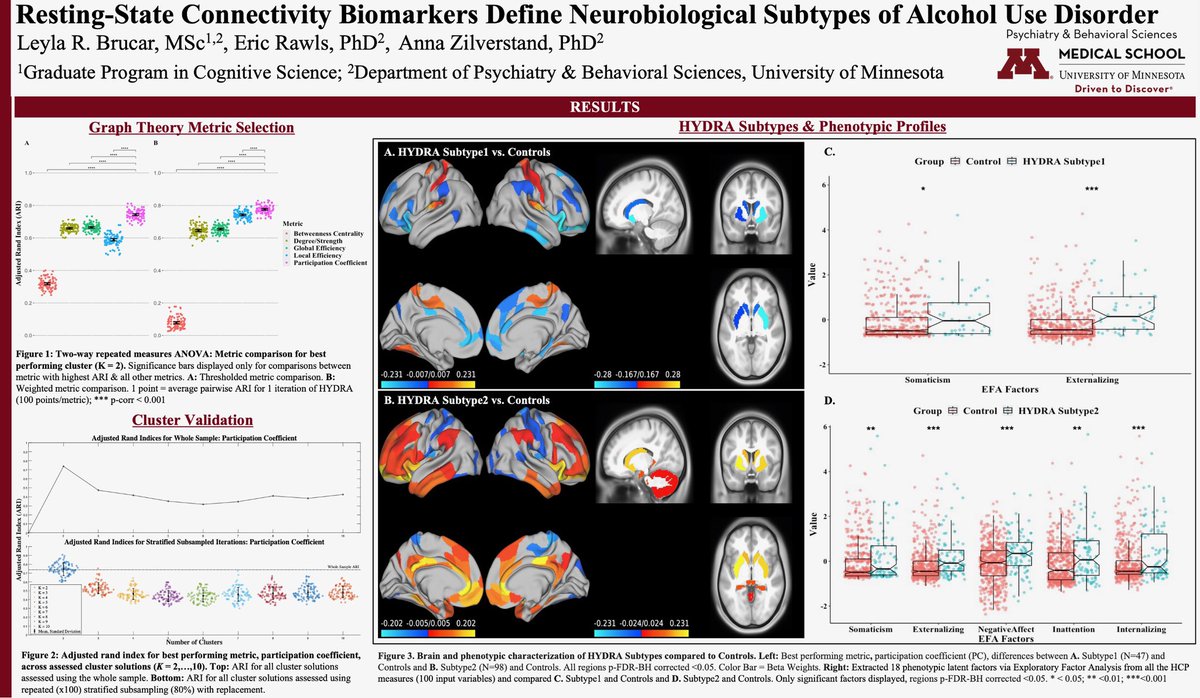
Going to #OHBM ? Here’s a sneak peak of my results for my poster on rsfMRI-based subtyping in Alcohol Use Disorder! Come chat with me Tues & Weds at poster number 1757 to hear all the details 🧠 @AZilverstand@OHBM @UMN_Psychiatry @UMN_MDTA#OHBM2023
My 1st first-author paper of my PhD is out in @BiologicalPsyc1! We wrote a systematic review of psychiatric brain-based subtyping, providing an overview of methodological practice, progress&limitations in this field
@EricFeczko@DrDamienFair@AZilverstand
https://t.co/cWMfsB9Oue