Cerebras contributes its specialized hardware optimized for rapid token generation in reasoning and multi-step agent tasks, while Oracle provides enterprise-scale infrastructure trusted for mission-critical data and applications.
The fastest inference in the world is coming to @OracleCloud.
@cerebras and @Oracle partner to enable blisteringly fast inference on OCI.
Cerebras brings fast AI.
Oracle brings deep expertise building and running AI infrastructure at scale.
Enterprises have trusted Oracle with their most important data and applications for decades.
Partnering with Cerebras gives Oracle customers more choice to match each AI workload to the compute that suits it best.
Coming soon, they’ll be able to build agents with true super fast AI in the cloud they already use.
Thank you to @MThiagarajan_ and the @Oracle team.
Excited to build this with you.
Full announcement here: https://t.co/wACT9YiG7F
an open-source project turning Meta Ray-Ban 3 smart glasses into real-time AI chess cheat glasses reaching 3000+ Elo, using Opus 5.5 for board vision, Jev for efficient frame filtering, and Stockfish for move analysis.
this is crazy...
the guy reverse-engineered his Meta Ray-Bans 3 with Opus 5.5 into a 3,000+ Elo chess engine
he built AI chess cheat glasses on Opus 5.5 + Jev and open-sourced the whole workflow
here's how it works step by step:
step 1 → install it on your Mac with one command: npx chesshacker setup.
It downloads Stockfish from GitHub and verifies the checksum
step 2 → put on Meta Ray-Bans and video-call your own Mac on WhatsApp.
The glasses see the board, the Mac sees what the glasses see
step 3 → the Mac grabs frames straight from the call window.
About 1 per second while it waits for the opponent, 1 every 3 seconds on your turn
step 4 → Jev runs a cheap pre-check on every frame:
is the board readable, is a hand over it, did a piece move? No change means no expensive AI call
step 5 → only then Opus 5.5 reads the board.
The app compares it with the position it already knows and accepts a move only if it's legal
step 6 → Stockfish thinks for half a second and picks the best reply, with an eval like +1.5 or "mate in 3"
step 7 → macOS speaks it through a virtual mic into the WhatsApp call: "Rook a to d1". You hear it in your ear
step 8 → on the Mac a command center shows everything live: whose turn it is, the suggested move with a confidence bar, the move list and a log
under the hood:
→ if Opus loses track of the board, the glasses say "Lost track of the board" and you fix it with undo or by typing the move
→ if Stockfish crashes, it restarts once and says "Something went wrong. Still trying"
→ every game is saved as a PGN file, API keys live in the macOS Keychain
→ an overlay draws the suggested move as an arrow on the live video, ready for OBS
Clone his workflow below
Then read the guide on how to reverse-engineer anything with Opus 5.5.
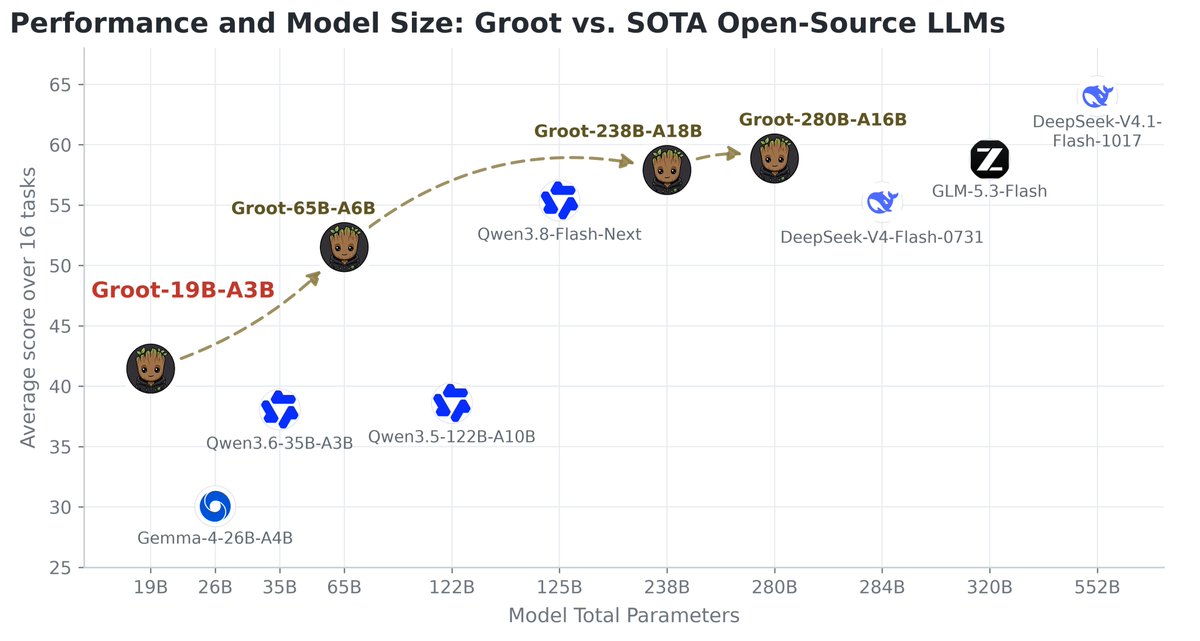
efficiency gains like 128K context on 16GB GPU, 28% fewer output tokens than Qwen3.8 Flash Next, 1M context support, and strong results on agentic tasks plus SWE-bench Pro (63.47 score).
Interesting models from a community member 👀
Groot Series 4 MoE models ranging from 19B to 280B
✨ 19B/A3B
128K context on a 16GB GPU, outperforming larger models on reported benchmarks
✨ 65B/A6B
28% fewer output tokens vs Qwen3.8 Flash Next
✨ 238B/A18B
Beats larger models on 6 agentic benchmarks, with 1M context
✨ 280B/A16B
- 63.47 on SWE bench Pro
- $0.13/task on DeepSWE 1.1
- Adjustable reasoning effort
an open-source, self-hostable proactive AI agent template that works with any agent via AG-UI, offering features like morning briefs, background task handling, generative UI, computer use, and human-in-the-loop approvals.
🎉 Introducing OpenDuet
Self-hostable, proactive AI agents that you own and works with ANY agent harness.
Includes:
- Build, generate, and edit live assets
- Human-in-the-loop approvals
- Computer use
- Mobile, Web, and Channels
Repo → https://t.co/DbzVdwLIkf
Powered by @CopilotKit and AG-UI.
Clone this template and customize it however you want. Enterprise-ready.
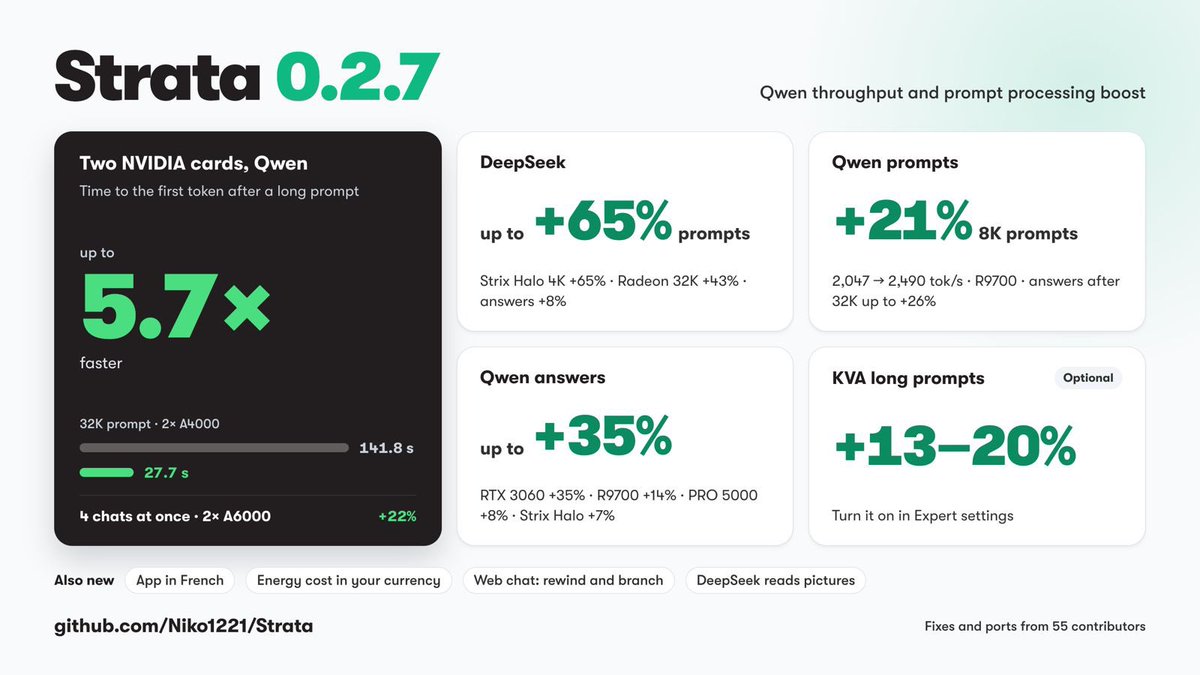
tool runs Qwen3.8-Flash-Next and similar models locally on consumer hardware (NVIDIA, AMD, Intel, Apple Silicon) with OpenAI/Anthropic API compatibility and one-click Windows/Linux install.
The approach leverages persona-grounded synthetic datasets that reflect local demographics, culture, and official procedures, as detailed in their same-day technical blog with examples from French and Belgian public services.
Build AI agents that speak the language and understand the local context.
Here's 5 steps to learn how to post-train NVIDIA Nemotron with synthetic data and LoRA to adapt its responses for regional terminology, policies and tone.
Follow the step-by-step tech blog: https://t.co/5TddqdSxib
a transformer architecture with nested sparsity that extends Mixture-of-Experts by allowing tokens to dynamically route to both FFN experts and attention modules via column and expert routers.
Introducing Nestor!
In standard MoEs, tokens choose their FFN experts. What if they could choose their attention modules, too? 🤔
We introduce a transformer with nested sparsity for scalable pretraining and continual learning.
Amodei specifically forecasts that within 12 months, AI will routinely accomplish feats considered impossible today, underscoring rapid progress driven by scaling laws observed in early models.
Dario Amodei, CEO of Anthropic, says scaling AI could make it better than humans at everything.
He sees this as the defining scientific and economic moment of our age.
The future of nations, economies, and humanity itself could depend on it.
"In 12 months, AI will routinely do things that seem impossible today."
Quantized versions are highly efficient at 2.71GB (Q4_K_M) and 4.48GB (Q8_0), runnable locally on CPU via llama.cpp, Ollama, or LM Studio, producing complex examples like dragonrider aeries, voxel rocket sites, Japanese gardens, and CPU sockets.
I'm excited about this. Local AI and small models are the future.
A 2.71GB local model is generating complete interactive 3D scenes from a prompt.
Qwen3.5-4B-3D-Coder is a new 4B community fine-tune focused on coding + Three.js scene generation.
And the local quants are sooo small
💾 Q4_K_M → 2.71GB
💾 Q8_0 → 4.48GB
🧠 4B parameters
🔓 Apache 2.0
It already runs locally with these
🦙 llama.cpp
🟢 Ollama
🖥️ LM Studio
And these aren't just cubes and spheres.
The examples include
🐉 Dragonrider aerie on a sea stack
🚀 voxel rocket-launch site
🌸 Japanese gardens
🪑 furniture
🛠️ workshop interiors
🧠 even an LGA 3647 CPU socket
The model generates the scenes as self-contained HTML + JavaScript using Three.js.
And here's the weird part:
Get this, training isn't even finished yet.
The developer expects training to finish Oct. 28, then plans to release the full weights, more quants and the training dataset.
⚠️This is an early community preview, not an official Qwen release, and the author says it can still hit bugs like duplicate variable names.
Link in ALT
Key insights from the studies include progress redistributing task success across agents, unpredictable composition of improvements, varying parent selection for gains, stricter gates discarding candidates, domain-specific generalization, and the need for separate evidence in evolution decisions like selection, mutation, and admission.
Interested in building your own RSI agent?
Check out RSIHub: an open-source RSI infra for building, comparing, and extending RSI recipes.
We studied existing RSI algorithms across MiniSWE and Codex, with model weights frozen.
👇 Insights for RSI researchers:
- Progress can redistribute success. All 16 evolved agents gained some covered tasks and lost others across eight evaluation passes.
- Today’s best agent may not be tomorrow’s most improvable parent. In all controlled pools, the highest-scoring parent differed from the one yielding the largest average improvement.
- Useful changes do not compose predictably. Some components interfere; others become useful only in combination. Growing a skill library creates a compatibility problem: the value of a change depends on the agent that receives it.
- Stricter gates can discard better candidates. In frozen-pool replays, stricter admission retained the best candidate in 6/16 pools, versus 15/16 originally. Acceptance rules shape the alternatives available to search.
- “Generalizes” needs a destination and a metric. In our transfer tests, coverage fell in 7/8 general-task cases but rose in 7/8 coding cases. Reliability could move in the opposite direction. Every reusable improvement needs an applicability condition.
- Evolution has a deployment bill. Eight of eleven reliability-improving agents cost more per attempt. Yet some reached comparable coverage with fewer attempts and lower total cost. Compare coverage at matched budgets alongside the cost of individual runs.
- Self-modification needs a stable measuring stick. Prompts, tools and evolution policies can change while evaluation and certified records stay protected. RSIHub makes that separation explicit, so gains remain attributable to particular agents and evaluation conditions.
- Each evolution decision needs different evidence. Selection needs evidence about subsequent gains; diagnosis needs execution traces; mutation needs compatibility checks; admission needs evidence about preservation and cost. Reusing one aggregate score throughout the loop leaves these distinctions invisible.
It breaks down any effective memory system into three challenges—deciding what to write (via Claude's judgment of future utility), how to represent it (flat latest-state Markdown files lacking version history or graphs), and retrieval harness (profile via CLAUDE.md, on-demand tools, but limited proactive hooks)—based on docs, experiments, and file inspection.
functions as the simulation's brain by translating instructions, planning events, tracking scenes, and adapting dynamically, while introducing ambient sound and responsive human dialogue as shown in the demo's evolving scenarios. @GoogleAI
Introducing Genie 4 from @GoogleDeepMind, our most realistic and interactive world model yet 🌍
Now you can use natural language to dynamically steer the world and its soundscape in real-time, whether you're changing the weather, moving the camera, or introducing new elements to the environment.
So, how does the model do that?
Behind the scenes, Gemini acts as the "brain" of the simulation. It translates your requests into actions, plans out complex events, watches the scene unfold to keep track of what's happening, and adjusts as you change the story. Genie 4 also introduces ambient audio and real-time interactive human dialogue that adapts on the fly.
Claude Code Projects is Duet except you get to pick the model and you can specify if you want to run a Claude code session on your computer.
It’s coordinator that can do ANYTHING. And it’s easy to do things in parallel.
Claude Code projects is the best feature in the Claude App. Very underrated.
Claude Duet is clearly not using Opus 5.5 for all requests. And once you go Opus 5.5 anything worse is intolerable.
Distillation as a Service" as an emerging startup sector, enabling companies to commission specialized, on-premise models for specific tasks instead of relying on expensive frontier API subscriptions from big labs.
The quietest gold rush in AI right now isn't building models.
It's shrinking them.
It's called distillation:
you take a giant model, have it teach a tiny one and end up with something close to frontier quality that runs at a fraction of the cost.
Why everyone wants it:
• Frontier APIs get expensive fast at scale
• Small models are faster and can run on your own servers
• Your data never leaves your company
• You own the model instead of renting it
So a new business is forming around it:
"Send us your use case. We'll hand you a small model that does that one job really well."
Call it Distillation as a Service.
The big labs build the giant brains.
The next wave of startups will sell the cheap, fast, specialized ones.
Every company paying a big AI bill is a potential customer.
@GoogleDeepMind it enables prompt-based scene changes, multi-step event planning for coherence, and realistic interactions like aerodynamics and collisions, shown in demo clips ranging from snowy landscapes to labs and urban scenes.
This is Genie 4, our most realistic and interactive world model yet. 🌐
Explore dynamic environments in real time to see how the scene responds, sounds, and how the people in it move, react, and speak.
a benchmark with 120 closed-loop multi-turn tasks across six categories including Guidance, Planning, and Prevention, scored via state-based rewards for objective evaluation of MLLM reliability.
model improves on predecessor MAI-Image-2.6 across all seven editing actions and ten use cases, ranking #1 in scene & style, text/symbol edits, reasoning-based edits, enhancement/restoration, live-action film, consumer, frontier, and UI/UX design.
MAI-Image is now the #2 image edit model in the world!
... once again beating Google, Meta, xAI, and GPT-Image-2.5-Flare.
Try it today on MAI Playground. Links below 👇
The model demonstrates strong long-context capabilities, maintaining improving next-token prediction loss to 10.2M tokens and achieving high scores on RULER tests like 100% single needle and variable tracking.
A new US 🇺🇸 AI lab just unveiled its own 100B–500B model with a 10-million-token context window.
And they're already training models as large as 10T parameters. 👀
This isn't another Qwen/Llama/DeepSeek post-train.
@mirendil says it pretrained Mirendil-Base from scratch on public data, without distillation or synthetic training data.
Fern 0.1 is the first short post-train of that base.
Stats we know right now
🧠 Fern → 0.1–0.5T params
🌳 Base-Large → 0.5–2T, 80%+ pretrained
🌲 Base-XL → 2–10T, 20%+ pretrained
📚 Fern context → up to 10M tokens
What 10M context means to us
💻 ~500,000 lines of code
🤖 days of an agent's work
📜 complete agent traces
📊 huge training logs
🧠 all in context at once
Mirendil actually tested Fern out to ~10.2M tokens.
At 10M on its RULER tests:
🎯 single needle → 100%
🔑 multi-key retrieval → 90%
🪡 all needles → 100%
🔀 variable tracking → 100%
🧩 multi-hop QA → 45%
Its next-token prediction loss also kept improving as more context was added all the way out to ~10M.
... but Fern 0.1 isn't beating the strongest coding models today.
⚠️ No downloadable weights yet | No GGUF | No quants | No llama.cpp | No announced weight license
Access is still coming soon.
So this isn't a local model right now.
Link in ALT
SLQ targets high Expected Acceptance Rate (EAR) to closely match the original BF16 next-token probability distributions; Unsloth's UD Q8_K_XL reaches 99.5% fidelity, exceeding the official FP8 checkpoint while enabling smaller file sizes.
Coming later today: statistically lossless quantization for Qwen3.8 27B, GGUF versions!
> Better than the GPTQ versions published last week
https://t.co/UYBd96XK7h
> Made from Unsloth's best UD GGUFs
btw, when running this process, I found that Unsloth's UD Q8 K XL matches the original BF16 next-token full vocab probability distribution at 99.5%. That's insanely high and significantly better than the official FP8. Unbeatable.