8 free ML courses -- our favorites:
1. Deep Learning @nyuniversity
2. NLP with Deep Learning @Stanford
3. Learning From Data @Caltech
4. Full-stack production deep learning (DL) @UCBerkeley
5. Linear Algebra Review @CarnegieMellon
Check the rest here: https://t.co/l32JABPH13
quantum double slit experiment. A gaussian wavepacket hits a double slit, which lets some of the probability density through, reflecting the rest. A familiar diffraction pattern appears before the wave function descends into chaos
This 3D structure of a polio vaccine was enabled by a #NobelPrize-awarded discovery. Cryo-electron microscopy allows us to see intricate details in biological structures. Jacques Dubochet, Joachim Frank and Richard Henderson were awarded the 2017 Chemistry Prize for their work.
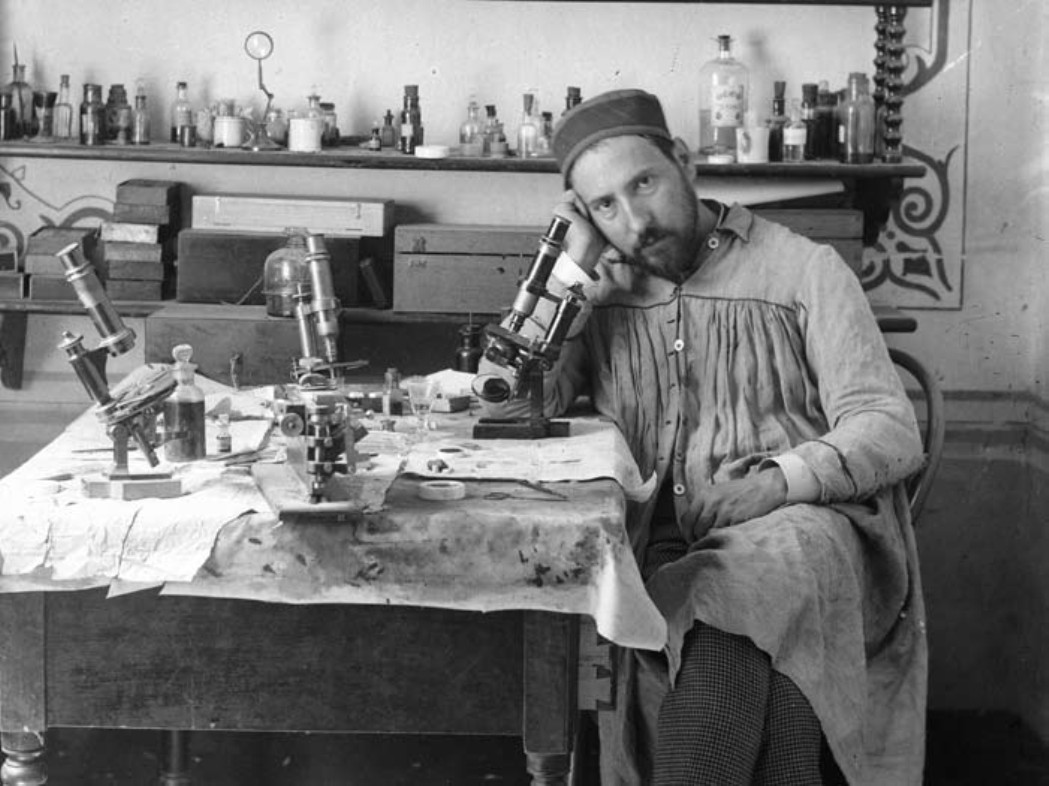
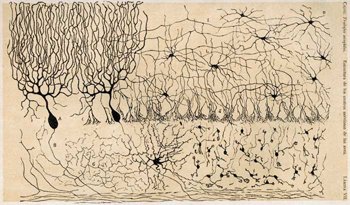
Santiago Ramón y Cajal proved that each nerve cell is an independent entity and nerve synapses transfer nerve impulses from one cell to another. He was awarded the 1906 #NobelPrize.
Photos: Cajal and his drawing of cells of the chick cerebellum, 1905.
Thanks CSAIL!
In the video:
- Larry Jackel, Adaptive Systems Research department head (my boss), behind the camera.
- Donnie Henderson, research engineer who put together the demo system.
- Rich Howard, lab director (Larry's boss)
The ConvNet runs on a 20MFLOPS DSP board.
Oldies but goldies: C. Shannon, 1949, Communication in the presence of noise.
States the Nyquist–Shannon sampling theorem. Explains the aliasing of signals. https://t.co/Dtguyw4bDm
Principal component analysis and non-negative matrix factorization are two particular of non-convex matrix factorization problem. They differ by the constraints on the atoms D and coefficients X. https://t.co/TAWN78orhy https://t.co/knuRHQvKp6
New blogpost! A friendly introduction to PCA. https://t.co/XLq9O0fq64
I wanted to get to the bottom of how principal component analysis actually works. As I dug deeper, the post turned into a four-parter, which was not the original plan, but PCA's roots run deep.