A new beginning arises in the quantum realm. Today, a new chapter begins.
Naoris Protocol is now NaoX.
$NAORIS remains unchanged, our post-quantum Layer 1 infrastructure continues exactly as before, and the work we have been building toward moves forward with the same fierce resilience as we prepare for the post-quantum future.
We will share more about the story behind NaoX soon. For now, thank you for being part of this journey with us.
The Year of NaoX begins now. Welcome to Fort NaoX.
Composability is the missing frame. Store of value without privacy creates a transparent ledger of who holds power. Privacy without monetary stability means your private transactions still lose purchasing power. These aren't competing use cases, they're load, bearing layers that only work when stacked together.
What if Q-Day already happened? 🕵️
There may be three or four Q-Days, and the first could belong to an adversary who never tells anyone.
We might only read about it in the history books. One of the more sobering predictions to come out of @IBM.
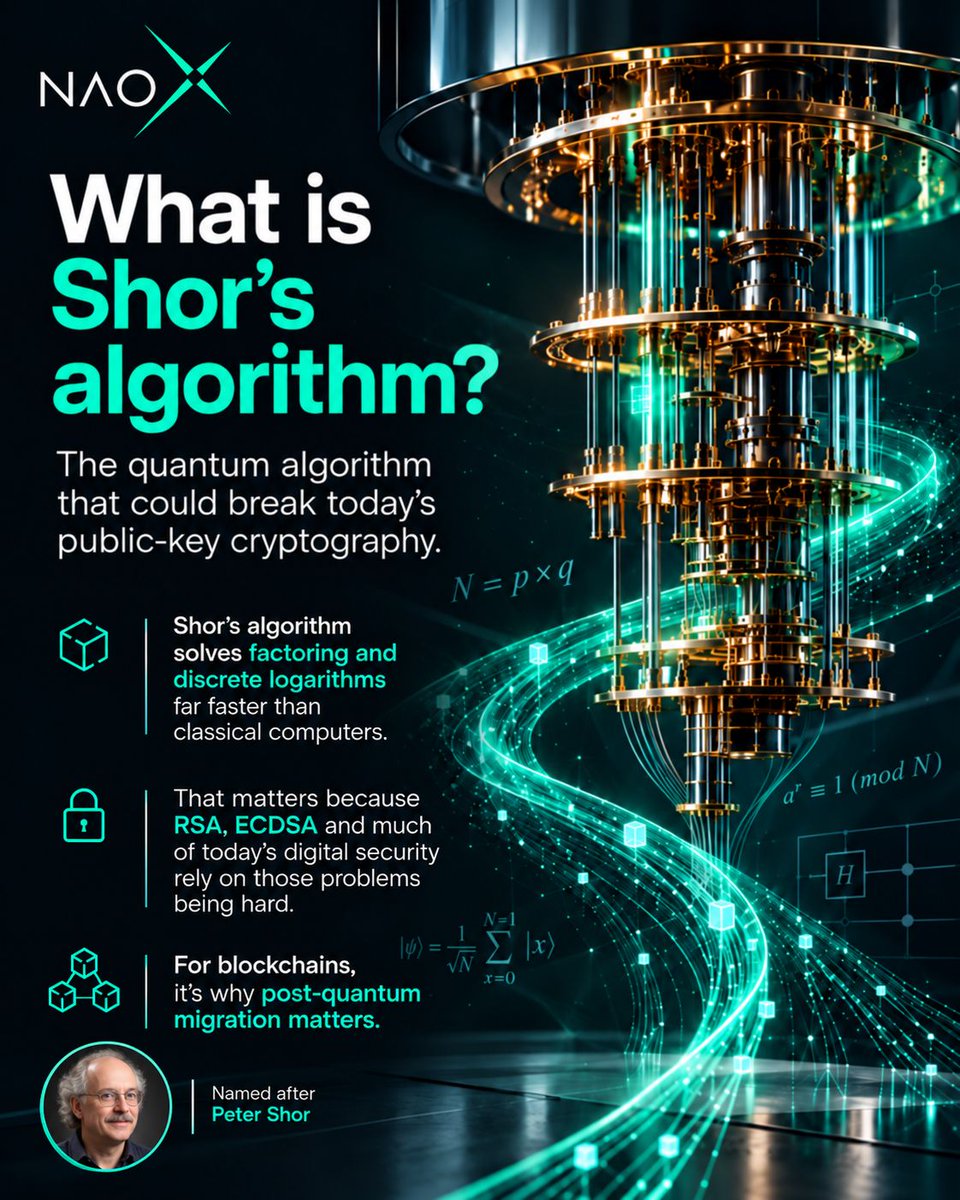
🧮 Shor's algorithm is one of the biggest reasons blockchain security needs to change
Peter Shor wrote it in 1994. It's a quantum algorithm that solves the exact mathematical problems holding up most of today's public-key cryptography.
Here's what that means for a blockchain.
Bitcoin, Ethereum and most others run on elliptic-curve cryptography. On a classical computer, working backwards from a public key to the private key is computationally infeasible. That one-way street is the entire security model.
Shor's algorithm turns it into a two-way street.
→ Attacker sees an exposed public key
→ Recovers the private key
→ Produces a valid signature
→ Authorises a transaction the owner never approved
And here's the part people miss.
The network wouldn't reject it.
There is no invalid signature to catch. The forged signature is mathematically correct. To every node on the chain it looks exactly like the owner signing.
No quantum computer can do this to real keys at scale today. Not close. But the vulnerability isn't hypothetical, it's understood, documented, and permanent for every public key already sitting exposed on-chain.
It's why NaoX signs transactions with ML-DSA-87 and verifies them natively in the protocol, from the genesis block.
The question was never whether Shor's algorithm exists.
It's whether the infrastructure is ready by the time the machines are ⏳
@BullMeechum3 Fair that lattice problems can be expressed as QUBO, and fair that annealing hardware is further along than gate machines. Two things worth taking seriously, and you've argued them consistently all thread 🤝
@BullMeechum3 Annealing is an optimisation machine, and nobody has shown it pulling a 256-bit key out of anything yet. ML-DSA-87 rests on lattices, which annealing doesn't reach either. Happy to read the paper if there's one
Unpopular opinion: crypto agility is a bit of a fantasy 🦄
It's becoming a real buzzword across the industry right now. But is it actually a smart move?
People don't build cryptography. They build applications, and the crypto has to fit whatever limits the app sets.
The cryptography team at @HorizenLabs explain👇
@CryptoHayes@flop_labs Worth noting this pattern repeats before every testnet launch. Scammers front, run the announcement window because search interest and new followers spike precisely then. The absence of a token is the easiest claim to fake, since there is nothing yet to verify against.
@blknoiz06 Viral trends resurface through nostalgia or remix cycles. Memecoins don't get that second wind. Once liquidity exits, the chart becomes the only narrative, and charts don't generate new attention, they just confirm what already happened.
Preparing systems for post, AGI assumes we know which systems matter before the transition. The harder problem: AGI will redefine what counts as critical infrastructure entirely, so the target keeps shifting. Open source adapts faster than closed stacks precisely because of that uncertainty.
Worth noting that "one time" wealth taxes rarely stay one time. Europe's wealth taxes in the 1990s were sold identically before becoming annual fixtures once revenue was baked into budget projections. California's legislature will need that 5% again the moment spending commitments outpace it.