@NaoXprotocol@IBM Great point on signatures being the hardest part of quantum migration. Most L1s still run on ECDSA. NaoX is already post-quantum with Dilithium at the consensus layer. This is exactly what IBM Quantum Safe needs.👽🛡️
@NaoXprotocol Exacto. Crypto-agility is like trying to fit Dilithium signatures into a secp256k1-sized box. Apps built for 64-byte sigs break at 2-3KB. You don't patch it, you rebuild it natively. That's why NaoX matters. Shor joining Zapata today just proves the clock is ticking.
Unpopular opinion: crypto agility is a bit of a fantasy 🦄
It's becoming a real buzzword across the industry right now. But is it actually a smart move?
People don't build cryptography. They build applications, and the crypto has to fit whatever limits the app sets.
The cryptography team at @HorizenLabs explain👇
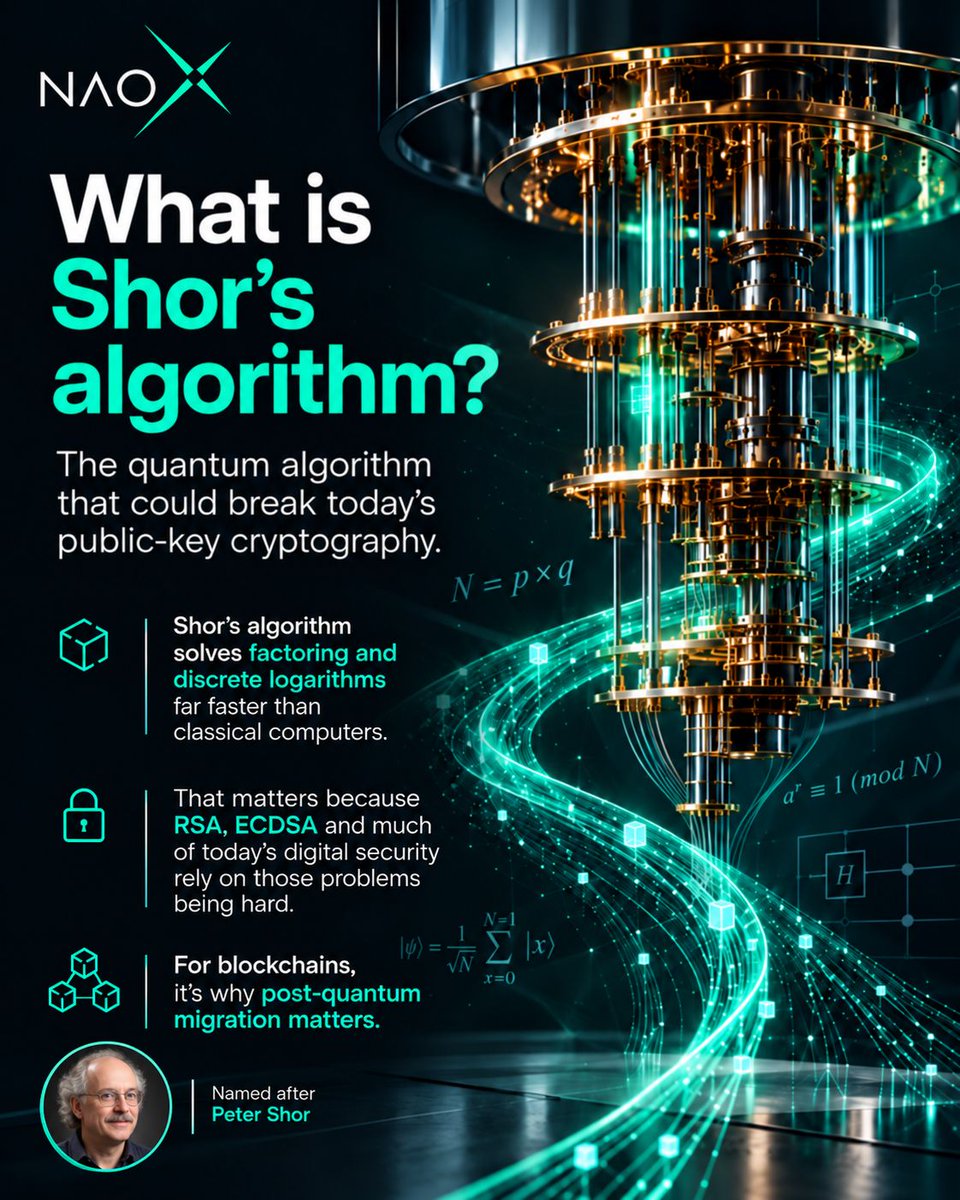
🧮 Shor's algorithm is one of the biggest reasons blockchain security needs to change
Peter Shor wrote it in 1994. It's a quantum algorithm that solves the exact mathematical problems holding up most of today's public-key cryptography.
Here's what that means for a blockchain.
Bitcoin, Ethereum and most others run on elliptic-curve cryptography. On a classical computer, working backwards from a public key to the private key is computationally infeasible. That one-way street is the entire security model.
Shor's algorithm turns it into a two-way street.
→ Attacker sees an exposed public key
→ Recovers the private key
→ Produces a valid signature
→ Authorises a transaction the owner never approved
And here's the part people miss.
The network wouldn't reject it.
There is no invalid signature to catch. The forged signature is mathematically correct. To every node on the chain it looks exactly like the owner signing.
No quantum computer can do this to real keys at scale today. Not close. But the vulnerability isn't hypothetical, it's understood, documented, and permanent for every public key already sitting exposed on-chain.
It's why NaoX signs transactions with ML-DSA-87 and verifies them natively in the protocol, from the genesis block.
The question was never whether Shor's algorithm exists.
It's whether the infrastructure is ready by the time the machines are ⏳
@NaoXprotocol@IBM Exactly. The retrospective risk is the real issue - every legacy tx that ever exposed a pubkey is already compromised. Looking forward to Antti's breakdown on sig schemes. Will NaoX enforce PQ signatures from genesis to avoid this?
@NaoXprotocol@IBM Great point on signatures being the hardest part of quantum migration. Most L1s still run on ECDSA. NaoX is already post-quantum with Dilithium at the consensus layer. This is exactly what IBM Quantum Safe needs.👽🛡️
WLFI x MOVA x NAORIS = Financial Sovereignty in Post-Quantum Era 🛡️
Eric Trump at Token2049 Singapore talking USD1 & OCC license while Naoris secures the stack. 32 zero-days hacked at Pwn2Own yesterday proves current security is broken.
Evolution of Digital World is clear:
1990s = Connectivity
2000s = Ownership (Web2)
2010s = Ownership (Web3)
2020s = Intelligence (AI)
2026+ = Security.
Each layer leaves the previous one exposed until it's secured.
This is why PQC is inevitable.
AI × QUANTUM. The convergence is accelerating, and the implications for cryptography are becoming impossible to ignore.
There's been a lot of discussion lately about the extraordinary potential of AI and quantum computing. But beyond the scientific breakthroughs, something equally important is happening:
⚡ AI is beginning to accelerate both the development of quantum computers and the discovery of weaknesses in the cryptography designed to protect us.
The evidence is already emerging:
• @GoogleDeepMind has helped advance quantum error correction through reinforcement learning, while @IBMResearch used AI to discover 465 candidate quantum error-correction codes.
• @AnthropicAI demonstrated AI-assisted cryptanalysis against HAWK, a lattice-based post-quantum signature candidate. The findings were significant enough that HAWK was withdrawn from @NIST's standardisation process.
An important distinction: HAWK was not a deployed standard. NIST's finalised ML-DSA and ML-KEM algorithms were not broken.
But consider the wider implications.
AI is helping researchers overcome engineering barriers to more powerful quantum computers, while also accelerating the mathematical research that tests our cryptographic assumptions.
The security implications extend far beyond classical RSA and elliptic curve cryptography. Even post-quantum algorithms must withstand continuous scrutiny as AI-driven cryptanalysis advances.
This is precisely why we built @NaoXprotocol with NIST-standardised, lattice-based post-quantum signatures (ML-DSA-87) from inception, rather than waiting for quantum computing to reach the point of breaking existing systems.
The next generation of computing promises extraordinary scientific progress. I'm incredibly optimistic about what it will unlock.
But advances in computational power must be matched by advances in the infrastructure protecting our digital world.
The quantum era won't wait for the security industry to catch up.
In July, HAWK, one of the algorithms competing to become a post-quantum standard at NIST, was pulled from the race.
Experts had been testing it since 2022. With the help of AI, researchers found a serious weakness in just a few days. Its designers withdrew it shortly after.
This isn’t new. In 2022, another candidate, SIKE, was cracked in roughly an hour using an ordinary laptop.
Some will read this as “the standards aren’t settled, let’s wait.” I read it the opposite way.
The process worked. The finalized standards weren’t affected, and candidates are published precisely so the world can attack them before deployment. Meanwhile, the threat hasn’t moved: data harvested today can still be decrypted tomorrow.
The real lesson is about how we migrate.
Most organizations plan post-quantum as a one-time switch: replace today’s cryptography, then move on. But with AI accelerating cryptanalysis, more algorithms are likely to fall, and faster.
So the question isn’t only “which algorithm should we choose?”
It’s “how quickly could we replace it?”
If the answer is years of re-architecture, you’re exposed every time the field moves.
Choosing the right algorithm matters. Being able to change it matters more.
Everyone's racing to make encryption quantum-safe.
Signatures are getting left behind ✍️
The view from @IBM: a key exchange links two points, while a signature is trusted by libraries, middleware, certificates, HSMs and network devices all at once.
On a blockchain, the signature is the asset. NaoX transactions can be signed with @NIST's ML-DSA-87 at Security Level 5.
One step ahead.
What a Post-Quantum Signature Actually Is ✍️
Every wallet in crypto rests on one piece of maths.
You hold a private key. It produces a public key. You sign with the one you hold, and anyone can check it against the one you publish, without ever seeing your secret.
The whole thing works because nobody can run it backwards.
Shor’s algorithm runs it backwards.
A quantum computer takes a public key, derives the private key, and signs as you. Nothing gets hacked. The signature is still valid. It just isn’t yours any more.
A post-quantum signature does the same job on different maths.
ML-DSA, NIST’s standard, hides the key inside a lattice: a grid of more than a thousand dimensions where finding the one point that matters is hard for classical and quantum machines alike.
It costs size. Around 4,600 bytes against 65.
That cost is the reason most of the industry is still planning its migration.
→ Transactions on @NaoXprotocol can be signed with ML-DSA-87, FIPS 204 at Security Level 5, the strongest parameter set the standard defines
→ Verified natively by the chain in around 38.5 microseconds, roughly 26,000 per second on a single core
→ Same seed phrase, same tools, not a line of contract code changed
The old maths could be run backwards. Nobody has found a way to run a lattice backwards.
@StockSavvyShay Quantinuum just hit 99.9995% logical fidelity on Helios.
5 errors per 1M operations.
10x better than its own record last month.
100x better than Google Quantum AI.
Fault-tolerant quantum by 2029 is no longer theory. It's the roadmap.
Naoris pqc 👽🛡️
🎙️ The next episode of The Post-Quantum Experience takes us inside the world of enterprise post-quantum security
On Episode 8, we’re joined by Rahmadi Trimananda, Senior Research Engineer at @Comcast
From cryptographic discovery to migration at scale, Rahmadi breaks down what’s really driving post-quantum adoption, the challenges facing major enterprises, and what it actually takes to prepare for the quantum era
Must watch 👇
Something structural is happening in cybersecurity right now, and the data is making it impossible to ignore.
94% of leaders now say AI is the single biggest driver of change in cybersecurity. 87% say AI vulnerabilities are the fastest-growing risk they are facing. And 92% expect a catastrophic cyber event within two years. (World Economic Forum, 2026)
@CrowdStrike put a number on the speed problem. AI-enabled attacks surged 89% year-over-year. The average breakout time, from initial access to lateral movement, is now 29 minutes. The fastest observed, 27 seconds.
Here is what this really means.
For most of the last decade, defence was built on the assumption that defenders had time.
Time to detect. Time to patch. Time to respond. AI has deleted that assumption.
The attacker now moves at machine speed. The defender still largely moves at human speed. That gap is where every single breach of 2026 is being born.
At @NaorisQuantum, this is exactly the problem we are built to close. Continuous, decentralised, machine-speed validation. The defence model has to catch up to the attacker. Fast.
To read more on the matter:
https://t.co/xUaYEcYBky