Flying buses make for great headlines.
But today, no country has flying buses in regular public transport. Even the world’s leading aerospace companies are still testing small eVTOL air taxis.
@nitin_gadkari What’s the technology, timeline, certification plan and cost?
Public deserves facts, not futuristic headlines.
@umashankarsingh The easiest way to win a debate is to answer a question that wasn’t asked.
E10 compatibility? Talk about flex-fuel.
Mileage? Talk about consumer courts.
Petrol prices? Talk about something else.
The questions remained.
What do you mean by “Narendra Modi ka Naya Bharat”?
Bharat kisi ke baap ki jagir nahi hai.
Aur haan, sprinkler system ka kaam hi emergency mein activate hona hai. Calling a standard fire safety system a miracle is like calling a seat belt an innovation every time it saves a life.
🚨 Two Fuel Stations. Two Very Different Approaches to Consumer Rights. 🚨
Dear @nitin_gadkari Ji & @HardeepSPuri Ji,
In the video I’m sharing from a fuel station abroad, the customer is treated as an informed decision-maker.
⛽ Super E10 (95 RON) – €1.909/L
⛽ Super E5 (95 RON) – €1.969/L
⛽ Super Tech+ E5 (98 RON) – €2.169/L
The ethanol blend is clearly displayed on every nozzle, the price of each fuel is transparent, and the customer decides what best suits their vehicle and budget.
Now look at India’s rollout.
Millions of consumers were never clearly told:
❌ What ethanol blend they were buying.
❌ Whether their vehicle was designed for it.
❌ What alternatives existed.
❌ Why there was no regular, affordable E0/E10 option at the pump.
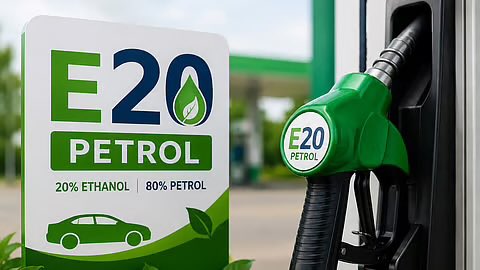
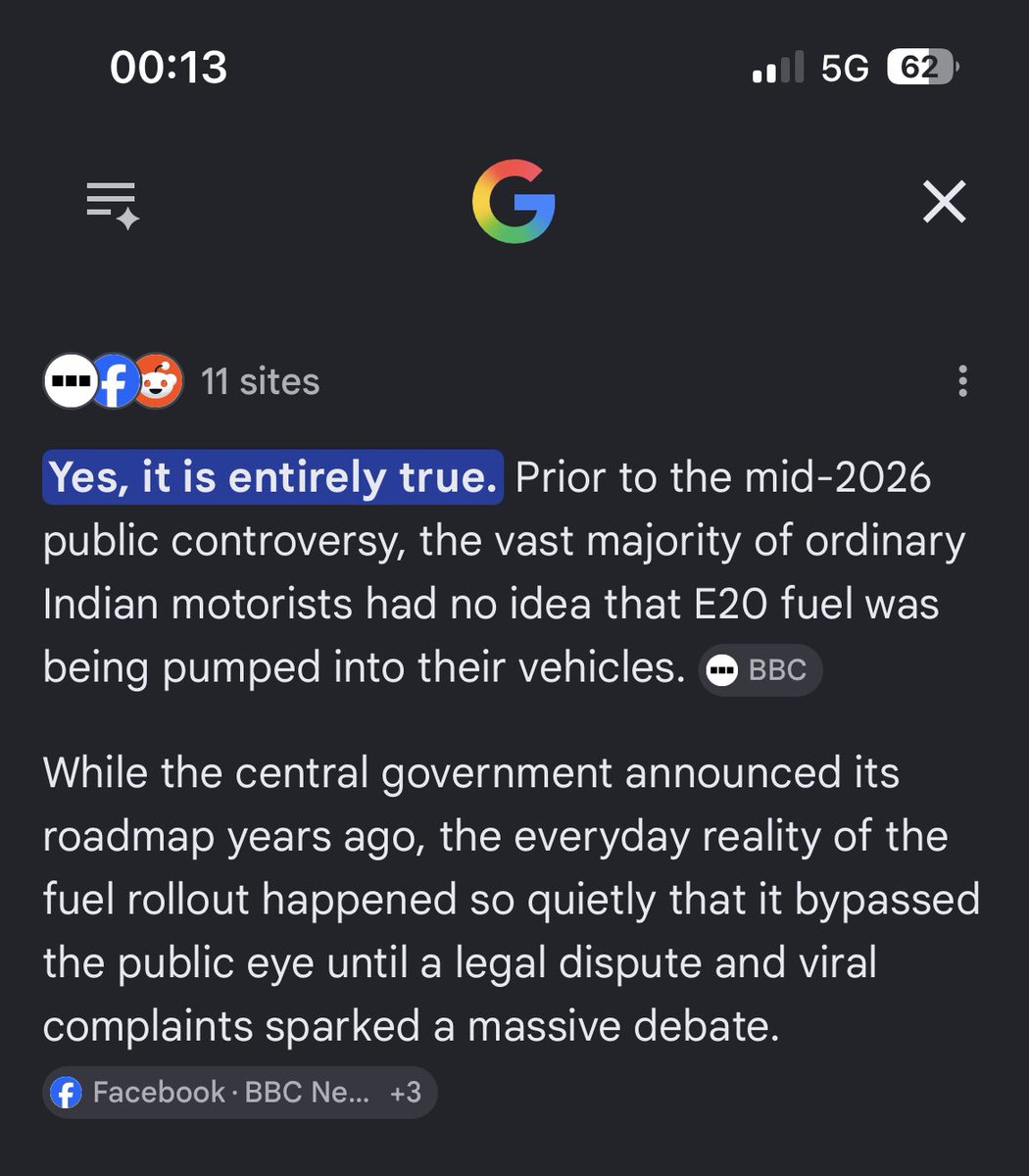
Instead, E20 quietly became the default fuel in many places, and the real awareness campaign only began after YouTubers, journalists and ordinary vehicle owners started asking questions.
Premium options like XP95 and XP100 are not substitutes for regular consumer choice. XP100 is also significantly more expensive and not widely available, making it impractical for most Indians.
This isn’t an anti-ethanol argument. It’s a pro-consumer argument.
If E20 is genuinely the future, then trust consumers with the truth:
✔ Clearly label every nozzle.
✔ Explain the ethanol percentage.
✔ Publish compatibility information.
✔ Offer meaningful, affordable fuel choices wherever feasible.
An informed consumer strengthens a policy. An uninformed consumer only fuels controversy.
#ethanol #e20
#fuelpolicy
🚨 Two Fuel Stations. Two Very Different Approaches to Consumer Rights. 🚨
Dear @nitin_gadkari Ji & @HardeepSPuri Ji,
In the video I’m sharing from a fuel station abroad, the customer is treated as an informed decision-maker.
⛽ Super E10 (95 RON) – €1.909/L
⛽ Super E5 (95 RON) – €1.969/L
⛽ Super Tech+ E5 (98 RON) – €2.169/L
The ethanol blend is clearly displayed on every nozzle, the price of each fuel is transparent, and the customer decides what best suits their vehicle and budget.
Now look at India’s rollout.
Millions of consumers were never clearly told:
❌ What ethanol blend they were buying.
❌ Whether their vehicle was designed for it.
❌ What alternatives existed.
❌ Why there was no regular, affordable E0/E10 option at the pump.
Instead, E20 quietly became the default fuel in many places, and the real awareness campaign only began after YouTubers, journalists and ordinary vehicle owners started asking questions.
Premium options like XP95 and XP100 are not substitutes for regular consumer choice. XP100 is also significantly more expensive and not widely available, making it impractical for most Indians.
This isn’t an anti-ethanol argument. It’s a pro-consumer argument.
If E20 is genuinely the future, then trust consumers with the truth:
✔ Clearly label every nozzle.
✔ Explain the ethanol percentage.
✔ Publish compatibility information.
✔ Offer meaningful, affordable fuel choices wherever feasible.
An informed consumer strengthens a policy. An uninformed consumer only fuels controversy.
#ethanol #e20
#fuelpolicy
@epanchjanya@amitmalviya So the success of a public policy will now be measured by counting the number of vehicles stranded on the roadside?
Do data, long-term durability studies, independent technical evaluations, warranty claim analysis, and engineering evidence no longer matter?
@epanchjanya यह वैसा ही तर्क है जैसे कहना—
“अगर प्रदूषण इतना खतरनाक होता, तो लोग सड़क पर चलते-चलते गिर जाते।”
हर प्रभाव धीरे-धीरे सामने आता है, तुरंत नहीं।
@mohitlaws Supporting the government makes you a patriot.
Questioning one policy makes you anti-national.
That’s a very fragile definition of nationalism.
A ₹160/litre premium performance fuel is not the equivalent of regular ethanol-free petrol.
High-octane fuel and ethanol-free fuel are two different things. Presenting XP100 as a regular consumer alternative is misleading.
Labeling every concern as a “toolkit,” every criticism as a “paid campaign,” or every question as misinformation doesn’t answer the real issue.
@pulkitnpc New certificate:
❌ E0 माँगो = Chinese Agent
❌ E10 माँगो = Deshdrohi
❌ E20 पर सवाल पूछो = Environment Enemy
Next: अब हवा लेने से पहले भी NOC लेनी पड़ेगी. 😄
@MercedesBenzInd Funny how the advisories start flowing only after the debate & vlog goes viral.
If manufacturers already had all this information, why weren’t customers informed when E20 was introduced?
Transparency shouldn’t be a damage-control exercise.
This video exposes the biggest flaw in the E20 rollout—not the fuel, but the complete lack of awareness & Choice
A car owner with an E10-compatible vehicle asked a few basic questions at an Indian Oil fuel station:
• Is this E10 or E20 petrol?
• Which nozzle dispenses which fuel?
• What is XP95?
Even the fuel station staff and manager couldn’t answer confidently. Their response was essentially: “Company se jo aata hai, wahi bhar dete hain.”
If the people dispensing fuel every day aren’t properly informed, how can crores of ordinary consumers be expected to know what they’re putting into their vehicles?
No fuel policy should be implemented like this. E20 should not be sold as the default fuel without proper nationwide awareness, clear labelling, trained fuel station staff, and a genuine consumer choice to buy E0/E10 or E20 based on their vehicle’s compatibility.
Consumers deserve informed choice not forced choice. Awareness should come before implementation, not after a national controversy.
The biggest problem with E20 isn’t just the fuel—it’s that millions of consumers were never properly informed.
Over the past few days, many YouTubers, journalists and independent content creators have been speaking to people at fuel stations, local garages, authorised service centres and automobile workshops. One thing stands out—many two-wheeler and four-wheeler owners didn’t even know they had been using E20 petrol. Most don’t regularly track mileage or subtle changes in vehicle performance, so if an issue develops months later, they rarely connect it to a change in fuel.
What’s equally concerning is that many local mechanics—and even some service advisors—don’t proactively explain E20 compatibility or what vehicle owners should watch out for. As a result, any vehicle problem is often attributed to normal wear and tear, poor maintenance, or fuel adulteration, without even considering whether fuel compatibility could be a contributing factor.
Whether you’re for or against ethanol blending isn’t the point. Consumers deserve transparency, proper awareness and the freedom to make an informed choice. A policy that affects millions of vehicles should be introduced with clear public education—not discovered only after it becomes a national debate.
#ethanol
If all Bajaj motorcycles manufactured over the last 10+ years were truly “fully compatible and safe” with E20, a few questions naturally arise:
• In 2015–16, the Government of India’s roadmap was still focused on E10, not nationwide E20. The E20 target came years later and was initially aimed for 2030 before being advanced.
• If Bajaj had already engineered its motorcycles for E20 a decade ago, where are the long-term validation reports, durability tests, material compatibility studies and field data supporting that claim?
• If the compatibility was always there, why wasn’t this communicated to customers all these years? Why are millions of owners hearing this only after the E20 debate became national news?
Consumers aren’t asking for slogans—they’re asking for evidence. If the claim is true, Bajaj should publish the technical test reports, independent validation, and warranty data. That would settle the debate far better than a television sound bite.
@Equateall@divya_gandotra Absolutely. But legal institutions carry immense constitutional weight. If judicial vacancies, pendency and outdated procedures are crippling justice, they should be pursuing reforms with the same persistence with which they defend constitutional values.