Nature Machine Intelligence has turned 5! Many thanks to all colleagues, authors and referees for helping us shape the journal. Read our anniversary edition of AI Reflections - interviews with recent Comment and Perspective authors https://t.co/bkU8tsibQF https://t.co/bkU8tsibQF
Focus: Artificial intelligence in geoscience - collating recent @NatureGeosci research articles that use AI methods and opinion pieces on issues relating to the application of AI to geoscience
https://t.co/ZU8SuIhjCJ
So pleased to have been able to write a little commentary piece with my advisor @weixx2 for @NatMachIntell! It's about this great work by @JamesGornet and Matt Thomson taking a look at how cognitive maps can arise just from predicting visual observations: https://t.co/Owc6BKH9UN
I'm thrilled to announce that our paper has been published in Nature Machine Intelligence @NatMachIntell today! To encourage research on the natural and agile movement of quadrupedal robots, we've open-sourced our code and data. Check out our project page: https://t.co/XxZo9Q5ki9
This year may see big advances in solving longstanding robotics challenges with generative AI - or are expectations too high? We discuss various viewpoints in our June editorial. https://t.co/JYlB0FiLbB
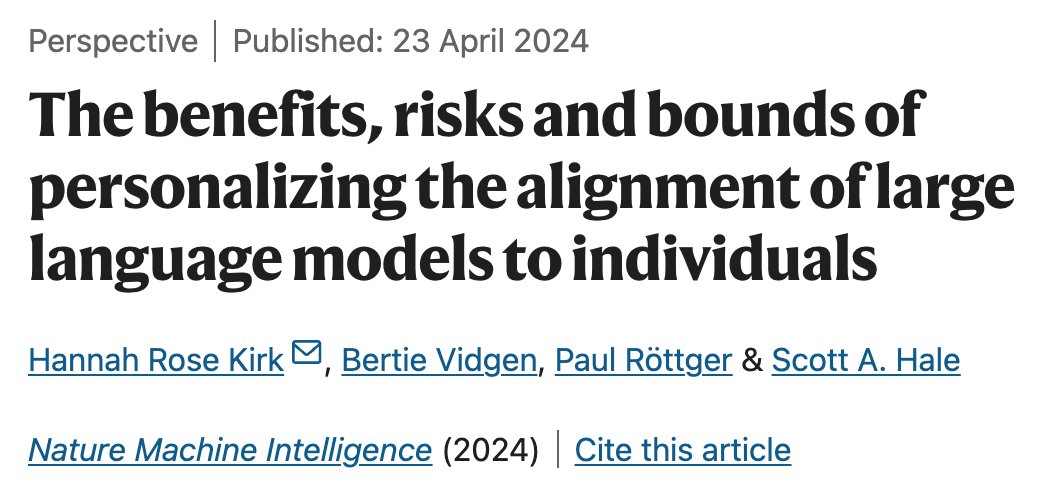
Great to see our personalised LLMs article in this @NatMachIntell editorial.
Increased empathy exemplifies 2nd-order effects of personalised alignment...may seem preferable in the short-term but has long-term consequences for healthy human-AI interaction
https://t.co/KxYKszxfLJ
📢Our May issue is now live, and it includes a Perspective on computational frameworks for semiconductor discovery, a database for structure-based drug discovery, an algorithm to uncover laws of skill acquisition -- and much more! Check it out! https://t.co/6b4fOPezDc
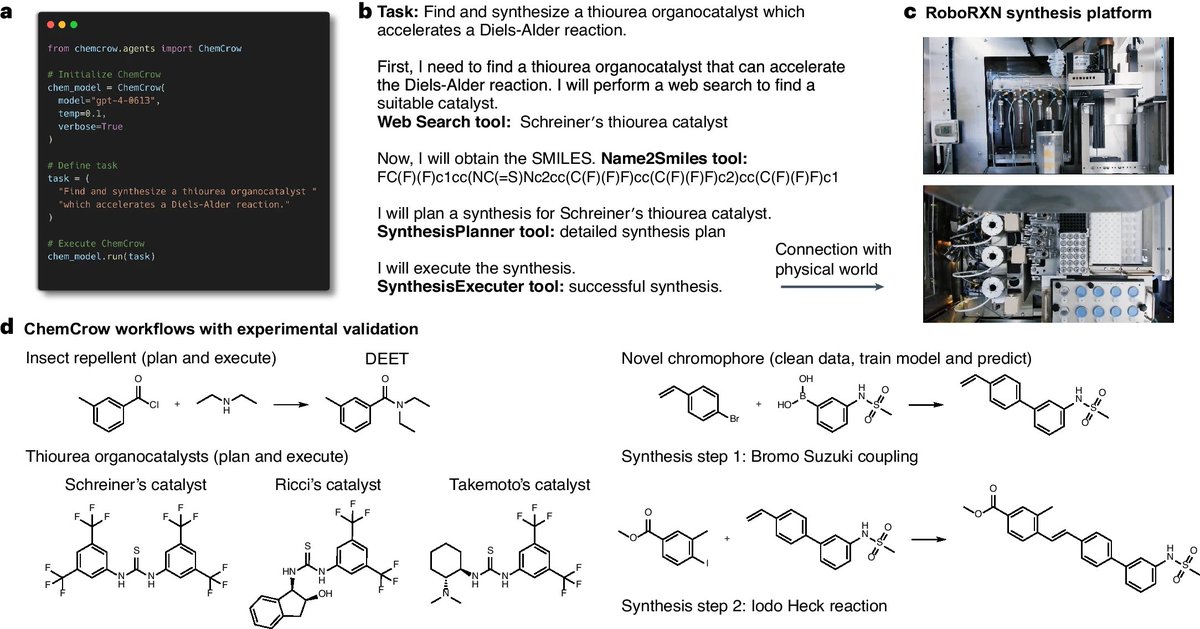
More than a year after the preprint, I’m excited to have the first @SchwallerGroup study featured on the @EPFL landing page - out in @NatMachIntell!
We present how LLM agents can be augmented with chemistry tools and demonstrate some of the few first successful syntheses — from user prompt to robotic platform execution.
Thanks to the whole team! Let me highlight the two co-first authors, Andrés (@drecmb) and Sam (@SamCox822), and Andrew (@andrewwhite01), who were instrumental in this collaboration.
Paper: https://t.co/6AEKFAImyI
Andrés’ thread: https://t.co/JBtPlPq2cO
Andrew’s backstory (with pictures): https://t.co/EY7UpKHNIL
@NCCR_Catalysis@EPFL_CHEM_Tweet@EPFL_AI_Center
Great questions about AI and empathy in this short piece: People cannot experience love from an LLM unless they act on the supposition that LLMs can love. Because LLMs cannot love, the experience of their love is premised on self-deception.
https://t.co/O7PSEwOLMV
This is the end of the world as we know it, if this is reproducible! The new era of functional modeling has begun. I took a transcription factor with an unknown structure and folded it with its recognition sequence embedded in longer DNA. AlphaFold3 accurately positioned the transcription factor.
ChemCrow is out today in @NatMachIntell! ChemCrow is an agent that uses chem tools and a cloud-based robotic lab for open-ended chem tasks. It’s been a journey to get to publication and I’d like to share some history about it. It started back in 2022. 1/8
⚡️New paper in @NatMachIntell⚡️
Embodied AI is the future, but are our algorithms ready for it? With MaxDiff RL, we reveal how continuity of experience breaks the performance of RL algorithms.
Continuity is a fact of embodied experience, introducing correlations between data samples. MaxDiff RL was designed to account for this, leading to robust policies that work regardless of initial conditions or model variations---just look at the variance in our reward curves!
MaxDiff RL also attains SOTA across embodied navigation benchmarks. In addition to our empirical results, we present a formal theory that we hope inspires future work examining the role of embodiment in AI.
👉Article: https://t.co/9ssrn4ivcE
👉Website: https://t.co/dbrHg9OSHJ
Published in Nature Machine Intelligence today, our new article explores the trade-offs of personalised alignment in large language models ⚖️ Personalisation has potential to democratise decisions over how LLMs behave, but brings its own set of risks...
https://t.co/fROWsE64nI
Very happy to share this work testing a widespread assumption in chemical AI and showing that invalid SMILES are a feature, not a bug: https://t.co/cLcYjE1uoX
📢Our March issue is now live, and it’s a special one, including a Focus that highlights the state of the art, challenges, and opportunities in the development and use of digital twins across different domains.
👉https://t.co/KvsNtDvQb8
🧵1/11
We made it to the cover of Nature Machine Intelligence @NatMachIntell !
Congrats @rodbonazzola@affrangi and team!
If you are interested in imaging genetics and how to discover new phenotype-genotype associations for anatomy, check it out: https://t.co/nqksOurSj6
👇
We’re pretty excited about this work from @KyleWSwanson, @james_y_zou, @ItsJonStokes and team, out now in @NatMachIntell.
Kyle kindly shared the SyntheMol preprint and code with us a few months ago, and we’ve been able extend his work in some interesting new directions. 👀 1/2