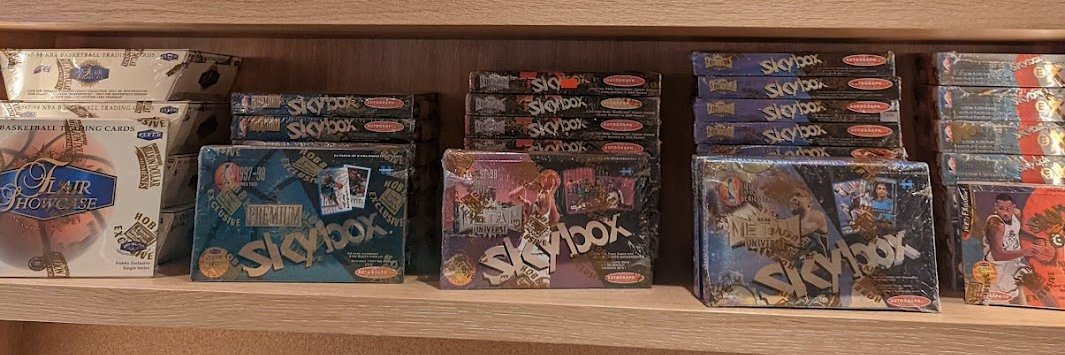
hobby twitter - does anyone have or know someone who has a sealed/unopened box of any of the following sets? hobby only
1995 SP Top Prospects Baseball
1997 Upper Deck S2
1997 UD3
1998 MJX
1998 Ovation
1998 SP Top Prospects
1998 SP Authentic
1999 Athlete of the Century
1999 HoloGrfx
1999 MVP
1999 UD Authenticated Last Shot
working on a fun project and need to find one of each of these
@WGSCARDS@PSAcard@CardPurchaser it's not stupid at all actually. these in particular (97 Autographics) were backdoored at one point with unsigned out there, and then bad actors fake signed them... must go through auto authentication too to be 100% sure it's the pack-pulled copy with a real auto...
Today @inductive_bio is launching Beacon-2, which can predict human dose directly from chemical structure.
A dirty secret of AI for drug discovery is that most systems optimize the wrong reward, making them near useless in practice. Human dose is the right reward – it’s what every drug program is already optimizing. Making it computable will unlock the real-world impact of agentic drug discovery.
Beacon-2 builds on our Beacon-1 models that beat 750+ competitors to win all three OpenADMET blind challenges. Whereas Beacon-1 provided a suite of models for individual molecular properties, Beacon-2 is a single system that predicts human dose end-to-end.
It has three configurable modules: an ADMET-PK foundation model, a potency module that can use our fine-tunable co-folding affinity model or physics-based methods like FEP, and a PK/PD model with physiologically-informed mechanistic models of pharmacokinetics.
We share validation results from Beacon-2 in a blog we are releasing today. We show that across 20 real-world drug programs running through Inductive, dose predictions from Beacon-2 agree with those from experimental data with a Spearman’s ρ of 0.61. And in a similar study on 325 publicly available compounds from the ExpansionRx OpenADMET competition, we show a Spearman ρ of 0.79.
As a proof-of-concept, we gave Beacon-2 to Indy, our medicinal chemistry agent, which used it over 5 autonomous design cycles on a recently disclosed SARS-CoV-2 program to cut predicted human dose 17x, which can be the difference between a drug program that gets killed and that makes it to clinical trials.
We compared the compounds that Indy designed using Beacon-2 against compounds from an optimization loop that used a potency-only reward function. The Beacon-2 compounds were favorable across three independent measures: they were preferred by chemists in blinded comparisons 87% of the time; were more druglike according to QED; and had a lower projected dose when computed by alternate methods relying on in vivo rat models and allometric scaling. Based on these encouraging results, we are now running prospective studies where compounds optimized by Beacon-2 will be validated in the lab.
Read the full post here: https://t.co/nVgAinJ9nu
At Inductive, our long-term goal is to build superhuman chemical intelligence, and by completing the reward function for autonomous drug discovery, Beacon-2 is an exciting step toward that goal.
Reach out if you’d like to get involved.
Today @inductive_bio is launching Beacon-2, which can predict human dose directly from chemical structure.
A dirty secret of AI for drug discovery is that most systems optimize the wrong reward, making them near useless in practice. Human dose is the right reward – it’s what every drug program is already optimizing. Making it computable will unlock the real-world impact of agentic drug discovery.
Beacon-2 builds on our Beacon-1 models that beat 750+ competitors to win all three OpenADMET blind challenges. Whereas Beacon-1 provided a suite of models for individual molecular properties, Beacon-2 is a single system that predicts human dose end-to-end.
It has three configurable modules: an ADMET-PK foundation model, a potency module that can use our fine-tunable co-folding affinity model or physics-based methods like FEP, and a PK/PD model with physiologically-informed mechanistic models of pharmacokinetics.
We share validation results from Beacon-2 in a blog we are releasing today. We show that across 20 real-world drug programs running through Inductive, dose predictions from Beacon-2 agree with those from experimental data with a Spearman’s ρ of 0.61. And in a similar study on 325 publicly available compounds from the ExpansionRx OpenADMET competition, we show a Spearman ρ of 0.79.
As a proof-of-concept, we gave Beacon-2 to Indy, our medicinal chemistry agent, which used it over 5 autonomous design cycles on a recently disclosed SARS-CoV-2 program to cut predicted human dose 17x, which can be the difference between a drug program that gets killed and that makes it to clinical trials.
We compared the compounds that Indy designed using Beacon-2 against compounds from an optimization loop that used a potency-only reward function. The Beacon-2 compounds were favorable across three independent measures: they were preferred by chemists in blinded comparisons 87% of the time; were more druglike according to QED; and had a lower projected dose when computed by alternate methods relying on in vivo rat models and allometric scaling. Based on these encouraging results, we are now running prospective studies where compounds optimized by Beacon-2 will be validated in the lab.
Read the full post here: https://t.co/nVgAinJ9nu
At Inductive, our long-term goal is to build superhuman chemical intelligence, and by completing the reward function for autonomous drug discovery, Beacon-2 is an exciting step toward that goal.
Reach out if you’d like to get involved.