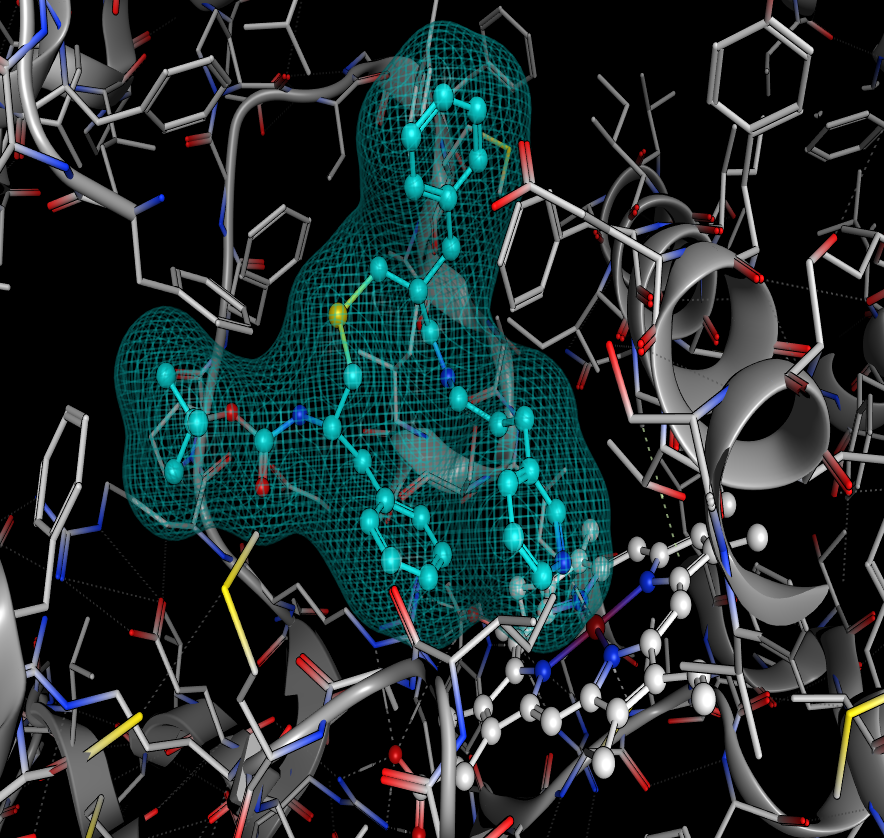
Today we’re sharing work we’ve been collaborating on with the @nvidia BioNeMo team.
One of the central challenges of advancing AI for medicinal chemistry is the lack of high quality evaluation sets. Even the best benchmarks suffer from the problem that once they become public, it’s difficult to guarantee that knowledge of the benchmark did not find its way into model development. This can make it hard to know which models are performing best and slow down progress in AI.
The dataset we’ve assembled through our pre-competitive ADMET consortium at @inductive_bio, which enabled our four consecutive OpenADMET wins, is not only a great training set – it’s also an unusually good evaluation set. It’s a large, diverse, sample of data from modern drug discovery campaigns spanning multiple therapeutic areas and small molecule modalities, making it a perfect testing ground for new models.
We use this dataset internally all the time to test new ideas, but given our customers’ need to keep their data confidential, it can never be made publicly available. While this limits access to the dataset, it also gives it an important advantage over public benchmarks: models can be evaluated on data their developers have never seen.
For the first time, we’ve collaborated with an outside group to evaluate a model using this dataset in a secure, privacy-preserving way. Working with the NVIDIA BioNeMo team, we evaluated KERMT, a chemical foundation model developed by Merck and enabled by BioNeMo, against Chemprop on a curated subset of consortium data.
All model evaluations were performed by Inductive scientists in our secure environment, with only anonymized, aggregate results shared with NVIDIA.
KERMT outperformed the baseline on all 29 endpoints, improving mean Spearman's R from 0.64 to 0.69 and cutting MAE 10%. Given the size of our dataset, we could perform meaningful deep dives on where KERMT performed best. Permeability saw the largest gain (+15% Spearman's R), and KERMT's advantage grew for compounds close to the training set.
Given the quality of this evaluation set and the fact that the model developers had no direct access to it, these results provide strong independent evidence of KERMT’s performance, building on the evidence that already exists. It’s also a proof of concept for future collaborations with researchers who want to evaluate their models in a similarly rigorous way.
Great to collaborate with Drew McNutt and @alex_s_rich from Inductive and Srimukh Prasad @sgpaliwal from @NVIDIAHealth.
Link to blog: https://t.co/PFe2kcn297
4 for 4! Incredible work from the @inductive_bio team to continue to top the ADMET blind challenge benchmarks for AI in drug discovery, ahead of leading AI and bio companies like @nvidia and @RecursionPharma
We’ve won our 4th consecutive OpenADMET Blind Challenge, coming ahead of 270 entrants, this time for predicting CYP direct inhibition.
Why do we keep winning? The short answer is our data, but it goes deeper than that.
Our goal at Inductive is to build superhuman chemical intelligence. In chemistry, the most valuable data remains orders of magnitude slower and more expensive to generate than in domains like coding and math, which have benefited from the near-infinite scalability of compute and reliable verification.
Because of this cost, any strategy for building chemical intelligence that relies on brute force data generation alone – even if you have billions of dollars to spend – will lose to a strategy that also aggregates data already being generated as part of economically valuable work.
That’s why, from the start, we’ve built products and services that generate immense value to drug discovery scientists while building a consortium to access large amounts of diverse, experimentally relevant chemistry data as a byproduct. That data enables us to build better models for the drug hunters we work with.
Doing this effectively requires trust from scientists who have decades of scar tissue dealing with the unending complexities of biology while being told again and again by Silicon Valley that technology is about to change everything. Earning that trust has taken years, and we take it seriously.
It’s also in the DNA of our team, where the best ML scientists and software engineers I know work with veteran drug discovery scientists. Together, we dream big while simultaneously thinking pragmatically about how to improve drug discovery today.
Thank you to OpenADMET for organizing yet another well-run competition and thank you to our customers for continuing to trust us to support their drug programs.
Big week at @inductive_bio with the launch of our agent Indy on Monday and our new model Beacon-2 today. These launches are important milestones on our journey to building superhuman chemical intelligence.
Today @inductive_bio is launching Beacon-2, which can predict human dose directly from chemical structure.
A dirty secret of AI for drug discovery is that most systems optimize the wrong reward, making them near useless in practice. Human dose is the right reward – it’s what every drug program is already optimizing. Making it computable will unlock the real-world impact of agentic drug discovery.
Beacon-2 builds on our Beacon-1 models that beat 750+ competitors to win all three OpenADMET blind challenges. Whereas Beacon-1 provided a suite of models for individual molecular properties, Beacon-2 is a single system that predicts human dose end-to-end.
It has three configurable modules: an ADMET-PK foundation model, a potency module that can use our fine-tunable co-folding affinity model or physics-based methods like FEP, and a PK/PD model with physiologically-informed mechanistic models of pharmacokinetics.
We share validation results from Beacon-2 in a blog we are releasing today. We show that across 20 real-world drug programs running through Inductive, dose predictions from Beacon-2 agree with those from experimental data with a Spearman’s ρ of 0.61. And in a similar study on 325 publicly available compounds from the ExpansionRx OpenADMET competition, we show a Spearman ρ of 0.79.
As a proof-of-concept, we gave Beacon-2 to Indy, our medicinal chemistry agent, which used it over 5 autonomous design cycles on a recently disclosed SARS-CoV-2 program to cut predicted human dose 17x, which can be the difference between a drug program that gets killed and that makes it to clinical trials.
We compared the compounds that Indy designed using Beacon-2 against compounds from an optimization loop that used a potency-only reward function. The Beacon-2 compounds were favorable across three independent measures: they were preferred by chemists in blinded comparisons 87% of the time; were more druglike according to QED; and had a lower projected dose when computed by alternate methods relying on in vivo rat models and allometric scaling. Based on these encouraging results, we are now running prospective studies where compounds optimized by Beacon-2 will be validated in the lab.
Read the full post here: https://t.co/nVgAinJ9nu
At Inductive, our long-term goal is to build superhuman chemical intelligence, and by completing the reward function for autonomous drug discovery, Beacon-2 is an exciting step toward that goal.
Reach out if you’d like to get involved.
In our benchmarks our chemistry agent consistently outperforms generalist agents. Today we’re sharing some of these metrics (twice as accurate as Opus 5/Sol at finding data QC issues and better precision/recall at compound enumeration) and making the agent available to customers!
We’re excited to share that Inductive Bio has joined the OASIS Consortium, a collaborative effort focused on predicting liver toxicity from advanced in vitro assays within the Health and Environmental Sciences Institute (HESI).
As part of OASIS, we’ll be helping assess how different pharmacokinetic (PK) approaches define drug exposure for DILI prediction, including exposure estimates powered by Inductive’s Beacon-1 ADME models. This work builds on the foundation of our ARPA-H CATALYST award, where we’re developing next-generation in vitro and AI methods for liver and cardiac safety prediction along with our collaborators Amgen Cincinnati Children's Baylor College of Medicine and Torch Bio.
A key challenge in toxicology modeling is that clinical risk depends on both mechanistic hazards and exposure. We believe exposure-aware toxicity models are essential for generating predictions that are both accurate and clinically meaningful, and we’re excited to contribute to the consortium’s efforts in this area.
Thrilled to launch our new ADME-One service at @Ginkgo with our partners @inductive_bio and Tangible Scientific!
Amazing price point at $199 -- this is what AI + autonomous labs will enable in biopharma CRO services.
ADME-One delivers a high-throughput Tier 1 ADME (absorption, distribution, metabolism, and excretion) panel paired with best-in-class AI-powered human pharmacokinetic (PK) projection and fully integrated compound management.
* Ginkgo Datapoints: Data Generation. All five Tier 1 assays (microsomal stability, cell permeability, kinetic solubility, CYP inhibition, and plasma protein binding) are executed end-to-end in Ginkgo's automated laboratory in Boston. Validated, standardized workflows produce AI-ready data without the variability of manual handling.
* Inductive Bio: AI-Driven Contextualization. Inductive Bio's Compass platform turns the experimental panel into actionable human PK projections, integrating disparate individual ADME datapoints into a single multiparameter optimization endpoint that guides compound prioritization. The company's ADMET models are independently validated as best-in-class, having recently won both the 2025 ASAP and 2026 ExpansionRx OpenADMET blind prediction challenges, two of the most rigorous public benchmarks in the field.
* Tangible Scientific: Compound Management. Customers submit compounds and receive results. Tangible handles compound intake, plating, real-time tracking, and management for every ADME-One order, eliminating the logistics overhead that typically accompanies outsourced ADME work.
Read more here and try it out!
https://t.co/kEifpADyng
We are excited to announce we have won first place in the OpenADMET-ExpansionRx blind challenge - our second consecutive first-place finish in a major ADMET benchmark.
This challenge had 370+ teams competing to predict 9 ADMET properties on over 2,250 unseen compounds from a real drug discovery campaign, rather than retrospective datasets. Beacon’s performance reflects how our virtual chemistry labs are used in practice: helping teams make earlier, higher-confidence decisions around safety, dose, and developability.
Thanks to OpenADMET and Expansion Therapeutics for running a rigorous community benchmark, the Inductive team for all the work behind the results, and all our pre-competitive ADMET consortium members who made this possible.
We’re excited to lead a $21M ARPA-H initiative with @Amgen and leading academics to build AI models for drug toxicity - improving drug safety and reducing reliance on animal testing. We’re generating human organoid, microphysiological system (MPS), and ex vivo tissue data to build digital liver & heart models to better predict DILI and cardiotoxicity.
https://t.co/1kMVDPfodQ
Can AI fix one of drug discovery’s biggest bottlenecks? At Inductive Bio, we think so, by making ADMET optimization faster and smarter.
In this new @DrugTargetRev feature, our CEO Josh Haimson shares how: https://t.co/s6BFuNauyF
We’re thrilled to announce that our latest generation of Beacon-1 ADMET models secured first place in the recent @Polaris_HQ blinded prediction challenge focused on ADMET properties in a real ASAP discovery antiviral program. Read about our lessons learned: https://t.co/CiqYuhUEX2
Big news: Inductive has raised a $25M Series A to democratize AI that transforms small molecule drug discovery.
Our Compass platform, powered by our pre-competitive data consortium, predicts ADMET properties before synthesis - helping find higher quality drugs for patients, faster.
• Backed by @obviousvc, @a16zBioHealth, @Lux_Capital, @S32_VC & more
• 1st place in Polaris ADMET challenge
• Supporting dozens of active drug programs already
We’re just getting started.
👉 https://t.co/2wlMumNHGR
#DrugDiscovery #AI #Biotech #Pharma #InductiveBio
The rapid rise of AI in drug discovery brings both new opportunities and new challenges to navigate. We’ll be exploring these topics at two sessions at @ACS Spring 2025 this year. Looking to see a demo of Inductive Bio’s latest at #ACS? https://t.co/jjxOBFqdVx
Switching from SMILES to IUPAC reduces invalid molecules generated by LLMs by >90%.
Want to know why?
Catch up on our blog now: https://t.co/wLVx7rZOQw
#GenerativeChemistry#DrugDiscovery#AI#ML
LLMs’ impact in generative chemistry has been limited to date. We show that a slight change in how you ask the question, simply by switching the input from SMILES to IUPAC, can reduce invalid molecules by >90%.
Learn more: https://t.co/wLVx7rZh0Y
#GenerativeChemistry#AI#ML
Join us at #ACSFall 2024! Our own Josh Haimson will be host "Sifting Reality from Hype - AI & ML in Drug Discovery" on Aug 20 with experts from Eli Lilly, Atavistik Bio, & Sanofi.
Looking to meet with our team while at #ACS? https://t.co/md4Xo0A0Ez