@cyrildelattre Good comparison... Apart from the model and harness, there is a more critical variation that can dramatically alter accuracy, quality, reliability when it comes to conversational agents - curated knowledge.
Since enterprise knowledge comes in such diverse forms, curating them for AI Agents can dramatically improve quality of results.
Let's catch up to discuss more. At @rapidflarehq , we are excited to partner with you on this next evolution of Agent Evals.
@robotaxi Heard of License Plates? ;-)
Millions of Uber, Lyft customers today use License Plate to identify and confirm their ride in crowded areas.
The problem is the occasional Tesla without front license plates. :-)
Lyft already supported adjustable colored lights many years ago.
AI-powered art in real-time? Yes, please. ✨ The Rapidflare team stopped by the @amphenol booth at #AIInfraSummit to check out their SketchBot and get some portraits drawn up. Incredible to see industrial robotics and creative AI merge so seamlessly.
#DeepTech#GenAI#Hardware #TechCommunity #Rapidflare #Amphenol
Our CEO @NavaneeRF is live at #EmbeddedWorldNA!
His latest takeaway: AI coding has cut innovation costs 10-100x - not just software, but hardware design too. Seeing it firsthand with DEEPX and Critical Link.
I asked Opus 5.5 to explain camera focus by building an interactive lens lab
Here's what it came up with after 1 hour 26 minutes in one shot, $25.66 API cost
https://t.co/uqDgUs8H9h
Move the focus ring and you can see the glass elements shift the sharp plane through the scene
There is a lot of talk about AI killing all humanity...
Meanwhile Claude still makes silly mistakes in printing a simple answer in Incognito mode...
What is with all this Json and HTML mess? :-)
Let's pace the frontier by fixing bugs first. ;-)
The Part 1 of your Pacing plans focused on safety/alignment makes sense. Controllability should be part of that effort.
But during this "pacing phases", I'd also recommend focusing serious efforts on three additional things that'll build trust with users:
1. Reliability and explainability. Not just internal but being explicit to end users what exactly models are thinking, planning, and doing. While interpretability of models is happening, interpretability of Agents is likely more important. That'll enable external systems to monitor Agents better leading to better safety.
2. Efficiency. For example, trying to shove every possible fact ever written into models is a highly inefficient use of compute resources. They have to anyway verify the facts at inference time. Instead, if there were standardized ways for models to get updated facts will make them more efficient and reliable.
3. Standards. While MCP has caught on, it is still a very basic model-centric way of letting agents communicate with the environment. More standards and interpretability on how models are engaging with the external world are necessary.
Given the current capabilities of AI Agents, Self-improvement is just a natural next step.
Most AI native companies have some form of continual improvement of their AI Agents. In this case, model companies are focusing that on model improvements.
To clarify, it is not the Models improving themselves. It is Agents continuously monitoring and managing the Model training. And when a better model is better, the Agent uses the newer model to continue the next stage of the training process.
So, quite an obvious thing to do.
@ProfBuehlerMIT Fascinating!!
Research like this in many ways can help explain human (and animal) nature as well.
And it could also point to the future.
Our Rapidflare agent is live on https://t.co/poqeLByXqn. Every SDK doc, Github reference, and tutorial DEEPX has published, queryable in one place, with source backed answers. Excited for this one!
Check out DEEPX’s LinkedIn post 👇
https://t.co/GARBnFJA9F…
I'm officially done reading AI-generated code.
It's been two weeks since I looked at any of it.
I think the IDE is officially on its way to the graveyard. The job is no longer about "writing code," so we need new tools that better reflect this new reality.
While reviewing the code, I realized my only complaints were stylistic, and I wasn't finding any obvious bugs anymore.
The more code I generated, the harder it became to keep track of every line. I found that my time is better spent designing ways to verify that the overall system works than looking at the code.
State-of-the-art coding agents are better at writing code than I'd ever be, and I'm going to stop pretending otherwise.
I still think these coding agents can't go too far without an experienced human guiding them, but we're past the point where we need to check every line of code.
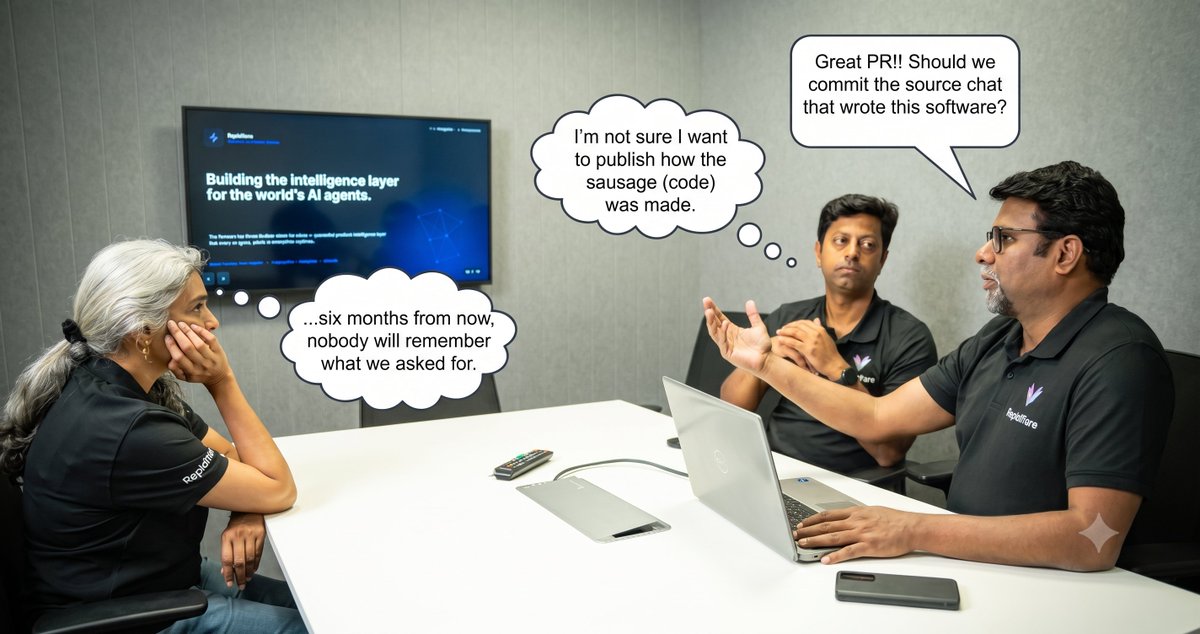
"Source code is the collection of human-readable instructions written by a programmer. It acts as a blueprint for software, telling a computer or website how to function. Computers/processors cannot read it directly, so it must be translated into machine code by a compiler or interpreter" - Google AI Overview
If all the programmer did is chat with a coding agent and instruct it, what is the "source code"?
Shouldn't the chat instructions/transcript be "source" that is checked into a Git repository?
The generated PR/code just happen to be intermediate representations to get the machine to understand it.
This came up at an interesting campfire discussion at @rapidflare_ai.
Sparsity is another way Neural Network Models function somewhat like human brains...
Our hardware is obviously very different and our model architectures. We also have different training flows. But pre(birth)-training and post-training (Reasoning/RL) concepts might apply to humans too...
Fascinating times to be in Neuroscience I'd bet.
A lot of young researchers will look at this and feel lost and hopeless.
Some might be thinking: “If AI can do this, what’s the point of what I am doing?”
I assure you that the reality is the exact opposite.
The opportunities AI unlocks are endless. Don’t let anyone or any company convince you otherwise.
AI is a brilliant tool. Use it to explore more and go deeper. Explore ideas in parallel. Use it to explore ideas that extend to multiple fields; these are extremely hard to do and extremely time consuming.
Spend time brainstorming with AI. Use it to pose interesting and unique research questions. Brilliant research is highly dependent on the quality of research questions. Use it to find better ways to communicate the science and discoveries.
If I was starting my PhD all over again, I would certainly be doing that.
It’s important to take the time to assess how you can leverage such tools. Now is a good time to do so. It’s inevitable that AI will lead to more of these findings but your intuition and research pedigree can accelerate what’s possible with it.
“Agentic kernel optimization is the future of on-device inference”
@xenovacom used Fable 5 to write kernels that pushed Gemma 4 to a massive 255 tok/s on WebGPU with M4. He shared the demo, so you can try in your browser!!
This is a fascinating example of the kind of 2nd order innovation triggered by AI Agents. This is suddenly an extremely useful little device when paired with AI Agents.
Now you could have a powerful computer sitting in a corner connected to this NanoKVM device with an MCP interface open. From your phone or laptop, you could just interact with simple voice commands and have the powerful computer/server perform complex software work behind the scenes.
In theory, this could even be the powerful brain powering mobile robots in your home!
In a way, kudos to USB-C for enabling such devices. 10years back, my friend Rajaram and I wrote a book about USB Type C envisioning such new innovative devices. Adoption has taken a lot longer but pleased to see that it is now happening.
https://t.co/0sEeMS2Of8
4K USB-C KVM with AI integration, support for Microsoft Recall-like feature.
https://t.co/dcJZ2JmUIp
@SipeedIO NanoKVM-Go/Go+ works with any device featuring a USB-C port with DisplayPort Alt mode, including several Android smartphones, iPhone 15+, mini PCs, laptops, and so on. Only one cable is required to easily enable hardware-level remote access.
Both variants are AI-Native KVM with all KVM functions exposed as an MCP server, and the Go+ model, featuring more memory and storage, enables "Ambient Screen Intelligence" to allow people to search for screenshot history.