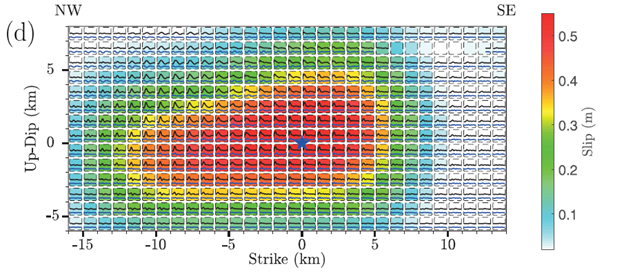
The neuro-fuzzy method kinematic finite-fault inversion method https://t.co/xMaZ7zdBUa is recently applied to image the rupture kinematics of 2019 M7.1 Ridgecrest event, a very preliminary result is the below gif:
I am glad that my first (& second), first-author article that is derived my PhD thesis is now accepted to publish in JGR: solid-earth https://t.co/VRUIt8KduV. I am grateful of my wonderful colleagues @AnsAnoosh (IIEES) and Susana Custódio @IdlLuiz
Update: started my new role as Editor-in-Chief for Bull. Seis. Soc. Am. formally 2 days ago, taking over from Tom Pratt who did an amazing job leading the journal the past 5 yrs. Humbled to be selected for this post, some big shoes to fill, still learning.
@AnsAnoosh دانشجوی شما بودن و آموختن مبانی تئوری حل معکوس، تئوری آمار و احتمالات و منطق فازی و پیشنهاد ایده ای فوق العاده زیبا برای تز، افتخار و از بخت خوب من است
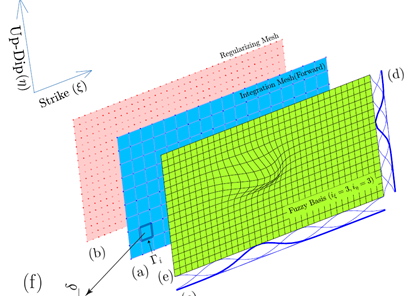
The spectral source time function is transferred to the time domain simply by IFFT/ A maximum likelihood approach is proposed to select the number of basis functions.
In a companion to https://t.co/xMaZ7zdBUa we applied the method to the data recorded within the 2016 Mw 6.2 Amatrice earthquake: https://t.co/6nRn4B0r75 , thread
I am glad that my first (& second), first-author article that is derived my PhD thesis is now accepted to publish in JGR: solid-earth https://t.co/VRUIt8KduV. I am grateful of my wonderful colleagues @AnsAnoosh (IIEES) and Susana Custódio @IdlLuiz
The source function is inferred from three data sets, the static and HR-GNSS and strong motion, each one is used to constrain a specific frequency band. A train/test split applied to check the ability of the method to predict observations not included in the inversion (training)
The method is synthetically tested using SIV-inv1 benchmark data. Check out https://t.co/Xepgjb2Cia for comparing the solution with available online tools.
I am glad that my first (& second), first-author article that is derived my PhD thesis is now accepted to publish in JGR: solid-earth https://t.co/VRUIt8KduV. I am grateful of my wonderful colleagues @AnsAnoosh (IIEES) and Susana Custódio @IdlLuiz
The fuzzy basis functions (shown in green below) could be used to approximate a function of 2 variables, e.g. slip at a given frequency on the fault plane. The coarse discretization results in an inversion with only large singular values.