Navier AI is building the first Agent-Driven Engineering platform.
We believe engineers should focus on designing great products, not wrestling with software.
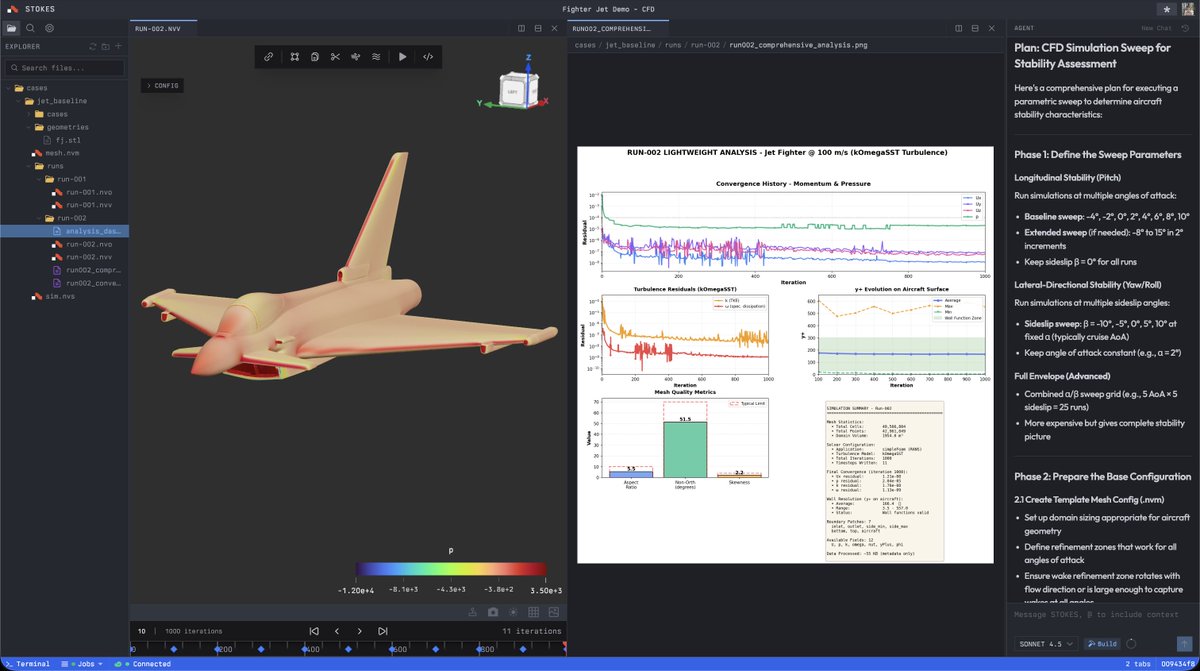
The Navier Agent turns one prompt into an end-to-end aero simulation workflow:
• Dynamic compute, up to 192 cores
• Run management
• Automated issue triage
• Report generation
Engineering is deeply coupled. Our tools aren’t.
CFD, FEA, and GNC all live in silos. Every handoff = lost context.
Prism brings them into one workspace, one source of truth.
Multidisciplinary design, natively.
Learn more about Prism at https://t.co/mtUgyMkD06
This GTO mission was built end-to-end by Stella in <30 minutes.
From trajectory design → production-grade Rust flight software → fully simulation-verified GNC.
When iteration takes minutes, you don’t run one sim, you explore hundreds.
Learn more at https://t.co/mtUgyMkD06
Most mission concepts die before they are simulated.
Stella changes that. We spun up an 8-sat SDA tracking constellation (design, orbits, sensors, tracking logic) in under 10 minutes from a single prompt.
Explore 25 concepts in the time it used to take to stand up one.
At Navier AI, we're building the simulation layer autonomy depends on. Agent-driven GNC, CFD, and FEA. All built for the pace this budget implies.
Building the systems DAWG is about to fund? Let's make sure your simulation stack can keep up. Book a demo today:https://t.co/F7BmyjN6mH
The Pentagon's Defense Autonomous Warfare Group (DAWG) budget is reportedly jumping from $225M to $54.6B in one year.
That's a 24,166% increase.
Autonomy just became a pillar of US defense spending. The question is whether the simulation stack underneath it can keep up.
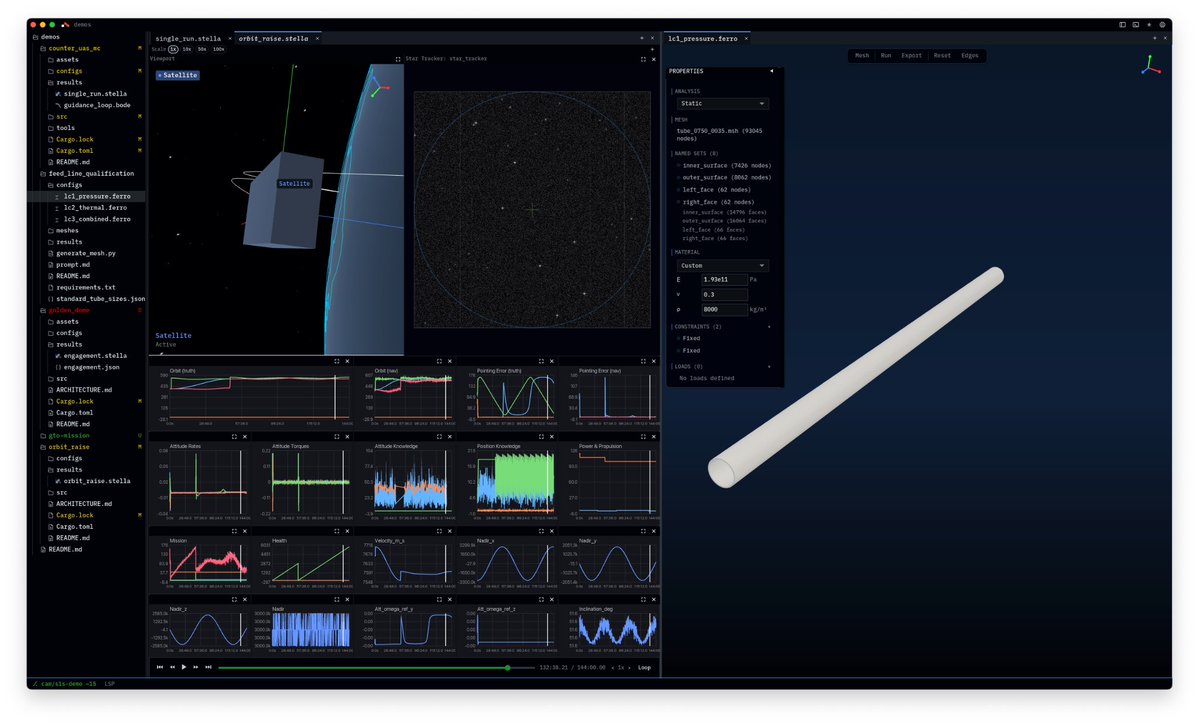
What if FEA ran itself?
Ferro, our agentic FEA platform, autonomously handles meshing, boundary conditions, solving, and design iteration. No manual intervention required.
This is Agent-Driven Engineering.
Engineers decide what matters. Agents handle the rest.
In the example above, the agent analyzed a full NACA 2412 AoA sweep, correlated results with experimental data, and generated a comprehensive report in under 10 minutes.
Days → minutes. Your senior engineers get their time back.
Read more here: https://t.co/9R9JnPX3lU
Your best engineers shouldn't be living in PowerPoint.
Post-processing a multi-case CFD or FEA sweep means hours clicking through ParaView, debugging plot scripts, and assembling slide decks.
Navier's Post-Processing Agent closes that gap. 🧵
It reads outputs from your existing solver stack, interprets the physics, and generates customizable stakeholder-ready reports autonomously.
And it goes beyond plots. The agent automatically identifies separation zones, detects anomalies across cases, evaluates convergence, and recommends next steps. Scripting alone cannot replicate this.
Monte Carlo analysis is how GNC engineers build confidence a vehicle will fly - or survive. Setting one up has always been a chore.
Stella collapses it into a single prompt. Histograms, scatter plots, sweeps back in minutes.
More campaigns. More confidence per engineering hour.
1/ Navier AI v0.3.0 is live! 🚀
This release is a major step forward in the usability of agent-driven engineering workflows across the platform. Here’s what’s new 👇
3/ 🤖 Improved Agentic Workflows
Our agents are now more context-aware — able to:
• Work across cases
• Synthesize complex engineering data
• Build detailed post-processing pipelines automatically
From raw outputs → decision-ready analysis, faster than ever.
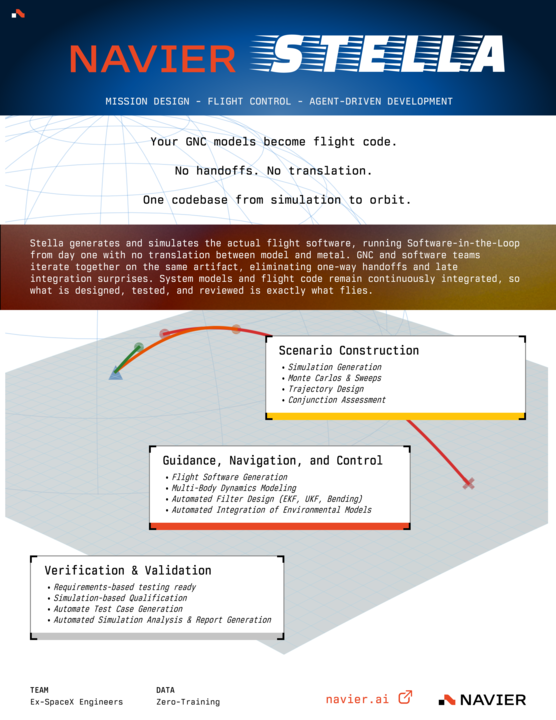
2/ Run software-in-the-loop from day one. GNC and software teams work on the same artifact — no late-stage integration surprises, no one-way workflows, no blackbox code gen.