My latest essay: Kaleidoscopes.
In which I look at the mechanics of how the Irish state defends the country from ever having to change, through language.
"A kaleidoscope is a most wondrous thing to look into, but it is a terrible thing to mistake for reality. And we have allowed ourselves to be dazzled by this one for too long."
It always astonishes me how there is virtually ZERO public debate - or even public awareness - in Europe about the decisions that will most shape ordinary people's lives.
These days, the EU is drafting a new anti-China legal framework where - quite literally - the more affordable and competitive Chinese products are, the more illegal they'd become.
You'd think EU citizens would want to be informed about such things - as it couldn't be more consequential for their prosperity.
Yet I bet virtually no EU citizen is even aware of it, beyond a vague sense that there is some sort of trade dispute going on.
So what's going on exactly? It all centers around a new legal instrument the EU is drafting called the "overcapacity instrument" (https://t.co/mNpCMudYyS).
First of all, the very notion of "overcapacity" is pretty ridiculous to begin with, especially the way it's being defined by the EU, as it basically means being competitive enough to export.
By this definition of "overcapacity," pretty much every European industry that's ever run a trade surplus - German cars, French wine, Italian fashion - has been guilty of "overcapacity."
I'm not even exaggerating: if you read this study by the EU Parliament on "Industrial overcapacities, with a focus on China" (https://t.co/TcwEBoL8mD), they define "overcapacity" as building more capacity than your domestic market can absorb. So the moment you build capacity to export abroad, you're in "overcapacity."
Utterly ridiculous.
And what this "overcapacity instrument" is about is creating a permanent legal mechanism for the EU to block Chinese competition across whole sectors of the economy, if they happen to be in "overcapacity."
In effect, this means that if China is competitive globally in a given sector in such a way that it exports a lot, that's proof of overcapacity, and legally it'd mean that the entire sector can be restricted from the EU market.
Which means it really, factually, is a legal framework where the more affordable and competitive your products are, the more illegal they become.
Which is a CRAZY economic concept! 🤦♂️
Please note that it's different from the anti-subsidy legal instrument, which the EU has already put in place in 2023 (the "Foreign Subsidies Regulation": https://t.co/SvPKFyN0zo).
This "overcapacity instrument" would be above and beyond this: it wouldn't even matter if a particular sector was subsidized by the Chinese government or not, the mere fact of its competitiveness in exports would be grounds for restrictions in the EU.
It doesn't take a genius to understand how badly this could impact everyday people: this is European consumers being forced to pay more for worse products by law, so that uncompetitive European firms don't have to improve.
Politicians frame it as avoiding a "China shock 2.0" but really this is choosing an even steeper self-inflicted decline than is already the case, where EU citizens would subsidize mediocre EU companies that would have even less pressure to catch up. It's a hidden tax: subsidies for uncompetitive firms paid by consumers instead of governments, which in turn makes them less incentivized to become competitive.
The first "China shock" did de-industrialize Europe somewhat, but at least it made things cheaper for European consumers. If this becomes Europe's response to a second "China shock" not only it'd make everything more expensive but it'd do nothing for EU industry: you don't become competitive by banning the competition...
Look at China itself: the way it industrialized was NOT by banning Western firms but on the contrary by welcoming them strategically and learning from them. You learn to compete by... competing, duh!
What I find most shocking in all of this isn't even the policy itself - you can make arguments for and against protectionism, and reasonable people can disagree.
What's shocking is that virtually no European media outlet is explaining any of this to the public. This is unarguably one of the single most consequential economic decisions the EU will make this decade, affecting the price of everything, and it's being drafted in near-total silence.
No newspaper is running the headline "EU plans to make Chinese goods illegal if they're too affordable" - even though that's essentially what's happening.
But that's what you call a "democracy" with "freedom of expression" these days apparently...
I’ve just read this article. When does this become a criminal matter?
Accepting customer payments (deposits, prepayments, or orders) while knowing (or where it is clear) the insolvent/insolvent business cannot deliver the goods can constitute evidence of intent to defraud creditors. This is because it involves incurring new liabilities (or taking funds) without a reasonable prospect of fulfilling obligations, effectively prejudicing customers as creditors. https://t.co/G7xQSBkr8C
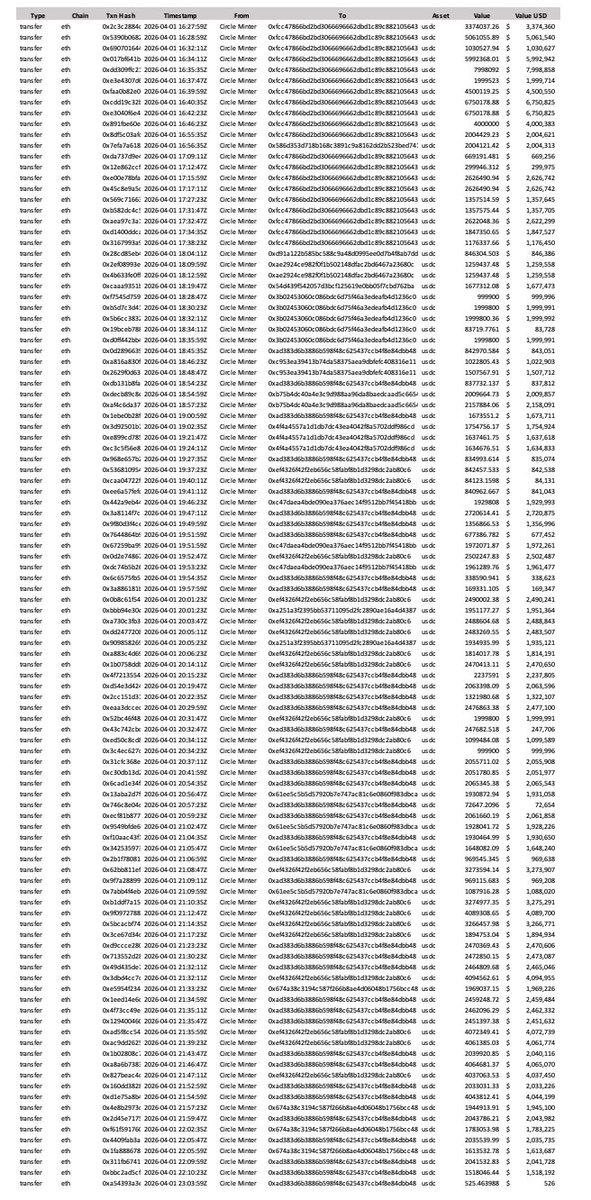
Update: $230M+ USDC bridged via CCTP from Solana to Ethereum across 100+ txns.
6 hours is how long Circle had to freeze stolen funds from the $280M+ Drift hack.
Circle is a centralized stablecoin issuer headquartered in New York and the attack began around 12 pm ET.
Why does our industry allow them to stay silent?
@jerallaire@circle@usdc
This is madness, The wholesale electricity rate in Ireland in 2019 (via the Single Electricity Market (SEM) covering the island of Ireland) averaged around €50 per MWh. This equates to about 5.0 cents per kWh (or €0.05/kWh)
The average wholesale price for January 2026 was approximately €126.96 per MWh, equivalent to 12.70 cents per kWh (c/kWh).
Electric Ireland unit rate is 34.75 cents per kWh which is effectively 173.62% mark up. Remember Electric Ireland is a billing platform they do not maintain the network.
The annual standing charge for a typical urban 24-hour tariff is approximately €251 including VAT this goes towards the network ESB.
Even at that price increases are blamed on Increased demand (e.g., from data centers, and economic growth).
The CRU has approved higher revenues for ESB Networks and EirGrid to cover grid maintenance, resilience (e.g., winter preparedness), renewable integration (including offshore wind), and rising demand from data centres, EVs, heat pumps, and new housing.
This led to an average increase of about €29 per year (€2.41 per month) on typical domestic bills from October 1, 2025.
Baseline: €13.8 billion over five years to upgrade the grid for 300,000 new homes, public transport electrification, offshore wind connections, and overall resilience.
Potential maximum: Up to €18.9 billion if targets are met. This adds about €1 per month (pre-VAT) initially for the baseline (most already applied via the October 2025 network review).
This Could rise to €1.75 per month (or up to €21 per year) if full spending occurs.
Yield farming sounds fancy but it's just crypto savings accounts with better rates. A teacher I know earns 8% on stablecoins while her bank pays 0.1%. DeFi (decentralized finance) removes the middleman markup. Math doesn't need marble lobbies 💡
@omooretweets@a16z +1 Driving repeat transactions. Merchants can move clients off marketplace platforms that take revenue share and engage directly with agents on social channels. @chatpaydotone
IRELAND HAS A WINNER OF @colosseum! 🏆
@AutonomRWA - 1st Place (RWA Track)
RWAs and equities struggle on onchain perps due to weak oracle confidence.
Traditional oracles miss corporate actions like dividends, splits, and M&A, creating pricing risk and limiting leverage.
@AutonomRWA is a specialised RWA oracle that accounts for these events, enabling reliable onchain pricing, funding, and risk management for perp DEXs.
This is the infrastructure that will unlock the next phase of RWAs on @solana!
@SuperteamIE is incredibly proud of Autonom and all the teams that shipped for Cypherpunk!
Follow the journey 👉 @AutonomRWA
Follow the founder 👉 @mcgirrh
Was at Solana Breakpoint this week with folks from @superteamIE . It was great talking consumer Apps and Stablecoin payments with other teams. @chatpaydotone