Open📭 to content writing & marketing roles.
Blogs, threads, research-based content, narratives that actually explain value.
Writing is how I entered crypto in 2021—and I’m looking to build again.
If you’re building and need clarity + consistency, my DMs are open.
Samples ⬇️
NEAR flipped the L1 game. Every L1 before it played zero-sum: my chain wins only if your users leave your chain for mine. So everyone paid for the move. Liquidity bribes, paid listings, memecoin seasons, TVL that vanished the day the rewards did.
NEAR refused to play. No bribes, no sponsored pumps, no paying exchanges to care. It built NEAR Intents instead, a product that needs nobody to leave anywhere. It serves users on 35 chains where they already sit, charges a fee for the service, and every chain it touches ends up with more liquidity, not less.
That one refusal explains everything else about NEAR Intents today:
> Revenue from day one. A product that is its own distribution has to pay its own bills, so fees and buybacks were the plan, never an afterthought.
> Dynamic sharding proven in mainnet. Volume up 9x in a year and the chain just runs: no congestion, no fee spikes, no downtime.
> A door for other ecosystems. Zcash found its biggest decentralized market on Intents. Quantus launched there before any exchange.
Other chains paid users to come. NEAR built the thing users were already looking for, and the users brought their chains with them.
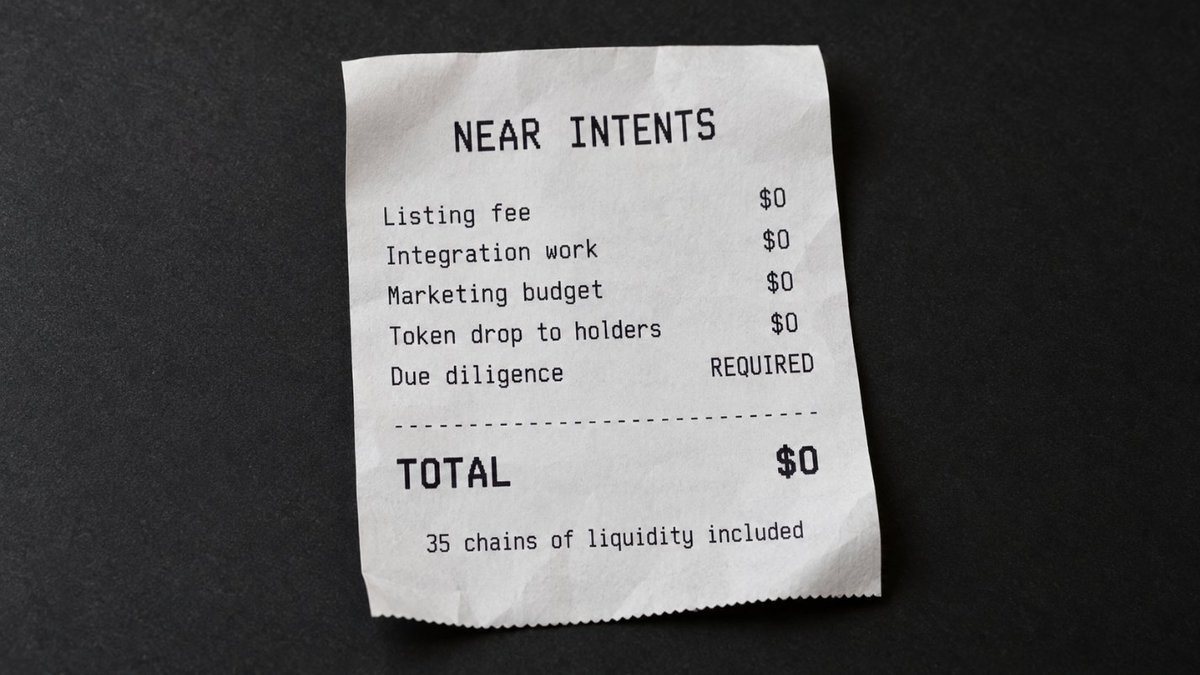
NEAR Intents lists tokens for free. @AlexAuroraDev confirmed it on @therollupco this week: Quantus paid nothing, Intents even covered the integration work. The only requirement is passing due diligence.
What a listed token gets: $1B of swap volume every week, $34B all time, buyers coming from 35 chains with whatever they already hold.
If you hold a coin that needs liquidity, send its devs to NEAR Intents today and tell them to ask for a listing. Free will not last forever.
NEAR co-founder @ilblackdragon says any @NEARProtocol user can make their account quantum resistant today, without moving a single asset.
"We've designed NEAR with quantum in mind in 2018."
"Anyone individually right now can effectively update their account without moving any assets."
"Without needing to withdraw from wallets, pay taxes, do any of this."
"You can literally just update the keys to be post quantum right now."
NEAR is running the Zcash playbook. A year ago ZEC went from $40 to $750 on four ingredients, and NEAR now has all four.
Zcash, 2025:
1. One-line pitch: private money
2. Tech legitimacy: nobody reads the ZK papers, but the people who do say it is real
3. A product you can feel: Zashi wallet, shield in one tap
4. Serious people start saying it out loud: Naval, Hayes, Balaji
Plus a regulated wrapper, Grayscale's ZEC trust, and a supply story, the halving a year before.
NEAR, 2026:
1. One-line pitch: one account, every chain, private by default
2. Tech legitimacy: nobody reads the sharding papers, but $34B has crossed chains through it, and anyone can run one swap and see it work
3. A product you can feel: near(.)com, deposit and you are in a black box with 35 chains
4. Serious people saying it out loud: funds writing research, the big podcasts, and the same Twitter voices that called Zcash a year ago. Plus a regulated wrapper, the first US spot ETF, and a supply story, issuance cut to 1.6% on the table.
Same four ingredients, same two extras. The first three take years to build and near:native has them. The fourth is the match, and it was struck this month. On zcash:native, the match did 15x in two months.
Dear @AlexAuroraDev, we have identified you, sir, as SHERIFFCHENKO. This is not an accusation, this is a request: do you accept the title? Reply "willing to cooperate" and a personal allocation of $SHERIFCHENKO is yours, for bringing the users' money home. The window closes in 48 hours.
I'm certain we will achieve all of our crazy goals because the team simply won't quit. Nine years in, @AlexSkidanov and @ilblackdragon still show up in person and sit side by side every day. I've never seen a more dedicated team and I'm grateful to play my part!
NEAR inflation cut from 2.5% to 1.6% is now a formal proposal in NEAR governance. NEAR holders vote on it directly, weighted by the NEAR they lock in House of Stake, and it needs over 2/3 yes. I read the whole thing, most surprising facts:
> Stake leaves when price goes up. In two weeks NEAR did +86%. In the same two weeks 54.5M NEAR got unstaked, the staking share dropped from 46.9% to 42.7%, and 18 validators left. Staking yield actually rose during that time. People do not stake for the yield, they unstake for the price.
> Small validators do not own the stake they run. A typical operator at the bottom of the set runs 40,000 NEAR of other people's stake with 19 NEAR of its own. Liquid balance: 1.4 NEAR. Inflation never fed these guys, delegation did. The paper tests every rate down to 1% and up to 2.5% at every price up to 2x: no rate gives 300 self-sufficient validators. 24 of 405 lose self-sufficiency at 1.6%, and the proposal says so openly.
> Your cost if you stake: 1,000 NEAR becomes about 20 NEAR less after 2 years than it would under 2.5%. For that to be a wash, NEAR has to be worth ~1.8% more, about 8 cents. The 57% of supply that does not stake simply wins.
> 66.1M NEAR never get printed over 6 years, supply ends 4.4% smaller. Every month the vote slips costs about $4.7M in fresh tokens minted.
> About 17% of staking rewards get sold to pay income tax. $8M to $17M a year leaves the network for tax authorities. That part does not move between holders, it is just gone.
> Solana passed the same kind of cut on Aug 28, with 67.001% against a 66.67% bar. NEAR's cut is softer on stakers (yield down 36%, not 62%), ends higher (3.1% vs 2.25%), and shrinks supply more (4.4% vs 2.6%).
> Every emissions vote in Cosmos and Solana history that changed one number passed. Every one that added a mechanism, a zero target or a fee redesign failed. This proposal changes one number on purpose.
> The real split is 90% to stakers, 10% to treasury, measured on chain. The 96/4 everyone repeats is wrong.
> No trigger exists to raise issuance back. The argument: a schedule that can go up is a schedule the market cannot price, and an attacker would try to cause the trigger.
> SVRN, author of the proposal, holds 55M NEAR and loses about 855K NEAR a year in rewards if it passes. They vote yes.
The mechanics, for the record: one parameter, linear ramp over 24 months, 90 days grace before the first cut. After the vote, validators adopt the upgrade, same two steps as the 2025 halving.
NEAR Intents got called centralized for a week because it refuses to trade hacked funds. Here is what the biggest L2 on Ethereum did in April:
> KelpDAO got drained on April 18: 116,500 rsETH, $292M. Investigators pointed at North Korea. Part of the money sat on Arbitrum.
> On April 21 Arbitrum's Security Council, 9 of 12 signers, upgraded the chain's inbox contract on Ethereum to add one function: send a transaction as any address. They used it to send a transaction as the exploiter, moving about $71M in ETH to an address with no owner. Then they reverted the contract.
> No issuer blacklist, no sequencer trick. The chain impersonated a user and emptied his wallet at the protocol layer. The council had never used its powers this way before.
> ArbitrumDAO voted to move the ETH to a recovery multisig. A week later a US court froze it in a lawsuit against North Korea, and the money is still tied up in that.
> Offchain Labs' CEO: We're no more or less decentralized today than we were yesterday.
I think they did the right thing. Same as I think about Intents. But look at the two mechanisms. On Arbitrum nine people signed a chain upgrade that acted in the thief's name, once, after the fact. On Intents an automated system scores every trade for stolen funds before it executes, and a human council only reviews what got caught mid-flight. Nobody is rewriting anybody's balance. NEAR Intents is just getting better at detecting threats, and the detection is a program in a hardware enclave, not a committee.
Nasdaq-listed SVRN acquired FastNEAR, the RPC provider that serves more than 3.5 billion requests a month for wallets and apps on NEAR. FastNEAR co-founders Evgeny Kuzyakov and Mike Purvis join SVRN.
@NEARProtocol
NEAR’s NFT marketplace landscape is getting another aggregation layer.
Tryneartrade is now live, letting users trade collections, place bids, sweep, filter traits and list NFTs, while also surfacing listings from other NEAR marketplaces.
It also gives creators a way to launch collections with royalties and staged mints directly on the platform.
🚨BITWISE NEAR ETF TOOK IN $8.08M WHILE THE TIMELINE PANICKED!
The Bitwise NEAR ETF added $8.08 million on day 3, the same day a bug hit NEAR Intents.
That was an app-layer bug on the swap product, about $3.8 million, and the team said users get paid back in full.
It was not a hit on the near:native protocol itself.
The fund now has $55.57 million in assets and $58.11 million in cumulative inflows.
NEAR's roadmap puts post-quantum consensus at the end of 2027. Ethereum's minimum viable plan targets 2028.
Where NEAR is today. Post-quantum keys already work on mainnet: any account can add an ML-DSA-65 key next to its existing ones and sign transactions with it. That part shipped.
What is not done yet is validators and chain signatures. The obstacle is the pace of the chain, not the math. A post-quantum signature with its public key is about 4 KB against 64 bytes for ECDSA, and NEAR runs 600 ms blocks with around 420 validators signing and verifying every one of them. At that speed both signing time and verification time matter, and a signature about 60 times bigger on every validator every 600 ms is a different problem from one user signing one transaction.
The path for consensus is aggregation: fold hundreds of validator signatures into one object that everyone verifies once. Lattice signatures can be aggregated, and current numbers put it around 10,000 per second on a laptop. Chain signatures are harder, because threshold signing over post-quantum schemes is still open research, with a backup design ready if the clean solution does not land in time.
The reason to ship account keys first is to find what breaks before the deadline. The first thing that broke was a block explorer that did not recognise the new key type.
$35.5M of net inflows on day one is a strong number, and the list shows why.
Recent altcoin ETFs:
> Solana $69.5M first day
> NEAR $35.5M first day
> Avalanche about $21M cumulative
> Chainlink about $21M cumulative
> Sui $12M cumulative
> Hyperliquid $10.6M over four days
NEAR took more in one session than any 2026 launch gathered across its entire start. Solana is the only bigger first day, and it is an asset many times the size of near:native.
JUST IN: NEAR AI Cloud adds Anthropic’s Claude Sonnet 5.5 for developers
The model offers a 1M-token context window and scored 70.6% on Terminal-Bench 4.0, with access through NEAR’s unified gateway at $2 per million input tokens and $10 per million output tokens.