Elite NATO commandos are training without high-tech gear to make sure they can survive modern battlefields like the one in Ukraine, where some advanced equipment can be easily tracked by enemy drones and other sensors.
https://t.co/gpJ7k0Ng3Q
The logical conclusion of Trump and Netanyahu getting what they want in Iran isn't "clean regime change" & a "prosperous democracy."
It's civil war, fragmentation, prolonged instability. This should be obvious to anyone who's given their policies a moment of critical thinking.
@shashj This maintains an ongoing relationship that began in the 1960s during another war in Yemen (when US forces were also busy elsewhere). Whether the military benefits for KSA have exceeded the economic benefits for the UK is debatable, but that may be part of the rationale.
Time for other American and European companies to accelerate their plans to compete with Starlink. @JeffBezos , I'm talking to you especially. Monopolies are always bad. Monopolies in critical technologies, where lives can be lost with the flip of a switch, are especially bad.
👇This remarkable Reuters investigation published today reveals the extraordinary damage inflicted by Iran's precision strikes on critical Persian Gulf infrastructure, how regional governments have concealed its true extent, and lends strong credence to longstanding reports that the UAE effectively paid Iran to ward off further attacks.
On the last point, Reuters reports that Abu Dhabi agreed to unlock at least $10 billion in frozen Iranian funds, with $3 billion reportedly released, in exchange for Tehran halting attacks on Emirati infrastructure.
The UAE denies any such deal, but notably, no further strikes on UAE infrastructure have been reported since May 17.
Other major findings:
• Scale and precision: Reuters documents at least 135 attacks on 84 infrastructure sites across seven Persian Gulf Arab countries, often striking indispensable components whose destruction crippled entire facilities for months or even years.
• Concealing the damage: Persian Gulf Arab governments repeatedly attributed damage to falling debris from intercepted Iranian missiles and drones.
Reuters identified at least 34 official statements making such claims. But 14 specialists who reviewed the evidence considered it “highly improbable” that debris accounted for the systematic destruction of critical equipment across so many facilities.
• Restrictions on reporting: The UAE, Saudi Arabia, Qatar, Kuwait, and Bahrain have restricted the photographing and sharing of images from attack sites, making independent assessments difficult and obscuring the true extent of the damage.
• Sophisticated Iranian targeting intelligence: Iran repeatedly struck critical equipment concealed inside buildings or otherwise difficult to identify from satellite imagery.
Three officials told Reuters that Tehran relies on networks of informants with access to sensitive facilities, helping explain the extraordinary precision of some attacks.
The broader strategic implications are enormous. Iran has demonstrated an ability to inflict substantial economic damage across the Persian Gulf despite overwhelming US conventional military superiority.
And this is precisely why renewed all-out fighting, particularly an escalation into more extensive infrastructure warfare, carries such enormous risks.
The destruction could trigger even greater economic shocks far beyond the Middle East.
https://t.co/hiWNsRldTl
Flydubai and Etihad are the only two airlines in the world that continued flying to Israel even during the most difficult times.
The UAE and the airline deserve for us to set aside speculation and allow them to thoroughly investigate what actually happened.
I trust them.
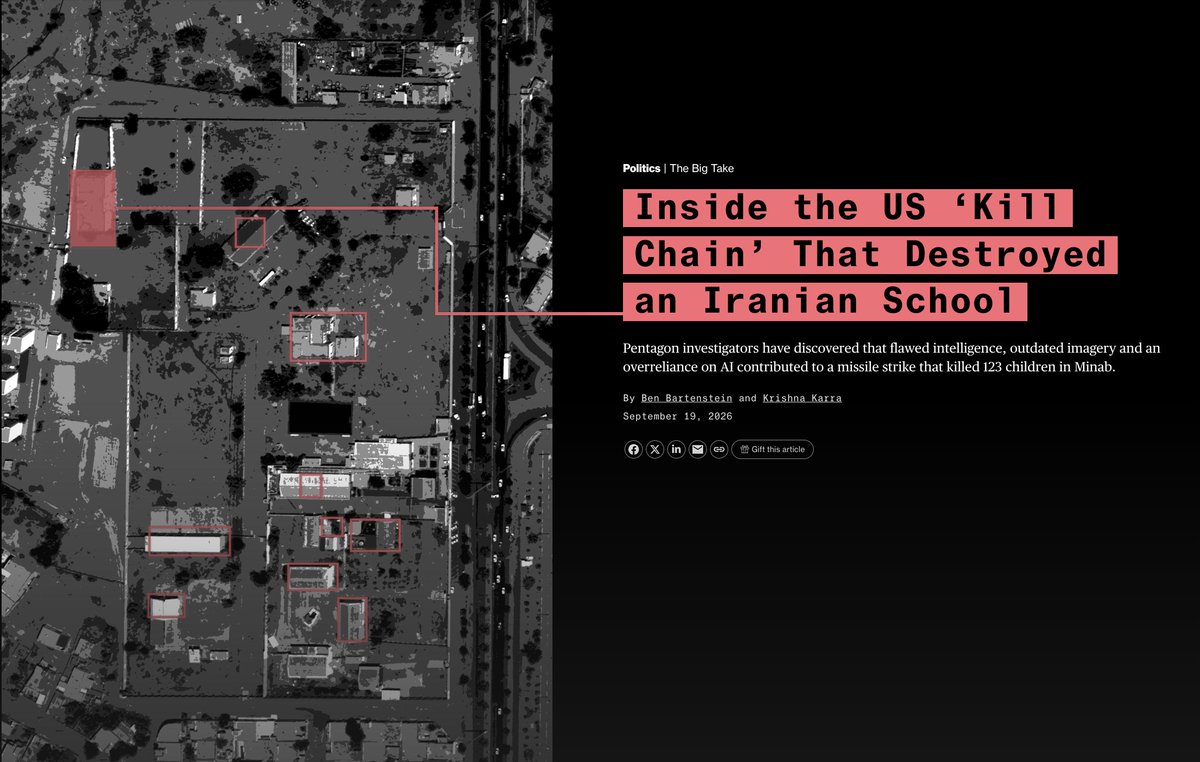
Bloomberg just dropped the most disturbing investigation I have read this year, and every AI builder should read it and take it seriously.
On February 28, two Tomahawk missiles hit an elementary school in Minab, a small town in southern Iran. 156 people died. At least 123 were children. The Pentagon knew within hours that it had bombed a school.
The school had its own website. It was labeled on Google Maps. You could see the soccer pitch from a satellite view. You could see the brightly painted walls. Any 12-year-old with a browser could tell what the building was.
The AI system could not.
Inside US Central Command, personnel were using Palantir's Maven Smart System. It is an AI targeting platform running on a $1.3 billion Pentagon contract, and embedded inside it is Anthropic's Claude.
On day one of the war, more than 1,000 targets went through it in 24 hours. Work that used to take a team hours per target got compressed into minutes.
The satellite imagery Maven was pulling from was seven years old. The site was still tagged in the database as an Islamic Revolutionary Guard facility.
The system spat it out as a recommended day-one target. Humans signed off. The first missile flew. Then a second one landed minutes later to hit the people who came to help.
Investigators later found that some Central Command staff had assumed Maven would flag stale intelligence for them. It did not. Nobody had told it to.
Palantir told Bloomberg the government is responsible for the underlying data. The Pentagon's civilian harm mitigation team, the people whose actual job is to catch a target like this, had been cut back before the war started.
This is not AI going rogue. This is the opposite.
This is AI doing exactly what it was built to do at exactly the speed it was built to do it. And a school full of little girls got vaporized because the humans in the loop trusted the machine more than they trusted their own eyes.
I keep thinking about the version of this story that comes next. What happens when the system is faster. When the target list is not 1,000 in a day but 10,000. When "review" becomes a button the operator has three seconds to hit before the next target loads. When there is no human left slow enough to notice that a soccer pitch is not a helipad.
We are not talking about a spam filter mislabeling an email. We are talking about a system that turned a seven-year-old database entry into two cruise missiles landing on children in the middle of a morning class.
A UN-backed panel has now called it a potential war crime.
In terms of children killed, it is the deadliest American targeting error of the entire 21st century. And according to Bloomberg, some of Defense Secretary Hegseth's own advisors are worried that too much public scrutiny of Maven might slow down its adoption inside the Pentagon.
Read that last line again.
If you build this stuff, you own what it does. You do not get to hide behind "the government owns the data." The whole pitch of your product is that speed and integration save lives. When it takes them instead, that is also on you.
I am not against AI in defense. I am against AI in a hurry. Speed is the entire mechanism that made Minab possible. Every guardrail we already know how to build takes time, and time is exactly what the system was designed to eliminate.
So here is the question I have not been able to stop asking, and I genuinely want to know what you think.
If a piece of software helped kill 123 children in a single morning while behaving exactly as designed, what does "responsible AI" even mean anymore?
Written by a colleague from our cyber defence team:
"cyber and social domains weaponize uncertainty itself. Yet this article demonstrates that friction’s intensification paradoxically validates Prussian solutions: decentralization, not technological omniscience, offers NATO’s path through hybrid fog"
https://t.co/ZZW3ifYiHE
⚡ Up to 25,000 North Koreans disguised under student visas are producing drones at facilities like Alabuga for Russia, an MSMT report revealed.
The DPRK regime seizes 80–90% of their $7,500 annual wages to fund nuclear programs.
The belief that rejecting decades of evidence makes you a critical thinker may be one of the strangest intellectual inversions of the social media age.
We have confused distrust with intelligence, contrarianism with skepticism, and confidence with expertise.
Scary stuff --> Iran used American-developed artificial-intelligence models to try to target U.S. Navy ships in the Middle East, according to an Anthropic report warning of emerging national-security dangers. From my @WSJ colleagues https://t.co/VPWTAcISLQ
I have always found the insistence on putting “Iran-backed” before “Houthis” to be too much of a simplification. It flattens a movement with its own history, ideology, grievances and ambitions, and too often implies a degree of Iranian control that does not capture how the relationship actually works.
But this may be one of those moments when the label is more apt than usual.
The Houthis’ advance toward the Bab al-Mandeb, their attacks on Saudi interests and the pressure they are putting on Red Sea shipping could hardly be more useful to Tehran.
At a moment when Iran is looking for ways to raise the costs of its confrontation with the United States and its Arab allies, developments in Yemen are surely music to the ears of IRGC commanders.
The Houthis are not simply an Iranian proxy. But right now, their own war and Iran’s regional strategy are aligning unusually closely.
For the first time in Highmark Stadium history, we will celebrate the American and Canadian anthems during pregame.
We can’t wait to have Bills fan Auliʻi Cravalho and @barenakedladies at our home opener!