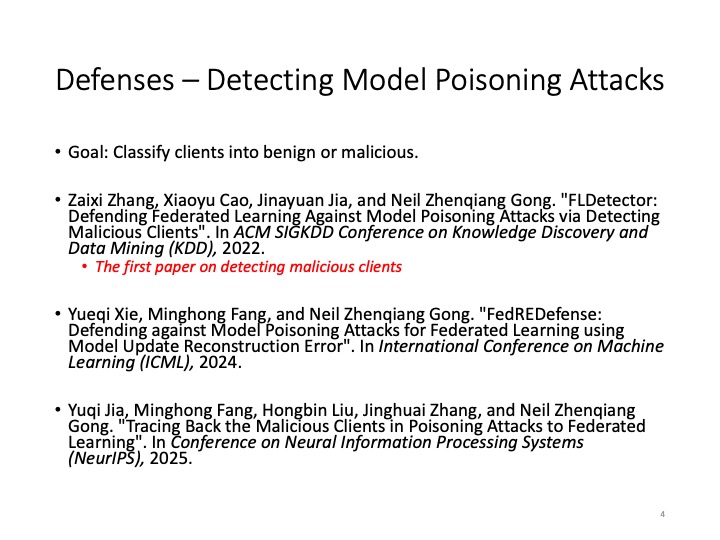
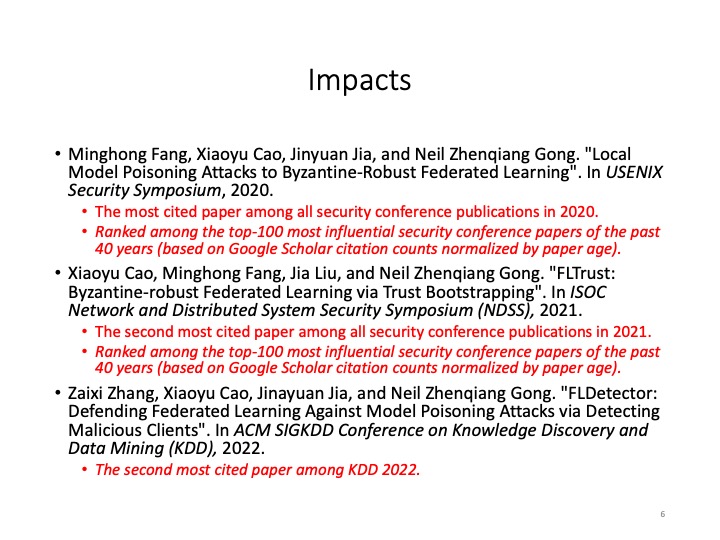
I’d like to take this opportunity to highlight their work and share a brief summary of our research on federated learning security over the past several years (2018–2025). Many thanks to my amazing former and current students and collaborators—all credit goes to them!
[Late Advertisement] My student Yuqi Jia presented two posters on federated learning security at NeurIPS last week (which is why I attended NeurIPS for the first time in over a decade!).
Our paper "DataSentinel: A Game-Theoretic Detection of Prompt Injection Attacks" (https://t.co/PXnfmGwibz) received a Distinguished Paper Award at @IEEESSP! Huge thanks and congratulations to my amazing co-authors Yupei Liu, Yuqi Jia, Jinyuan Jia, and @dawnsongtweets!
Our study (https://t.co/flUeUVcuxf) demonstrates that LLMs excel at such information extraction. This highlights the potential for LLMs to automate cyberattacks at scale, posing significant security challenges.
Still using symbol replacement, image conversion, and similar strategies (shown below) to protect your email addresses from automated scraping? Our research shows they offer limited effectiveness against LLM-based extraction while making it harder for regular users to email you.
The 8th Deep Learning Security and Privacy workshop co-located with IEEE S&P @IEEESSP May 15, 2025, San Francisco (https://t.co/SNuKq8jQuW) is calling for papers, posters and talks! The workshop seeks your awesome contributions on all aspects of deep learning and security, aiming to bring complementary views together by (a) investigating the security and privacy of deep learning, such as the recent generative models, and (b) exploring the application of deep learning for security and privacy.
We are calling for both proceeding papers (up to 6 pages) and non-archival extended abstracts (up to 3 pages). We will have one best paper award for the accepted papers and one best extended abstract for the accepted non-archival extended abstracts. For the first time, in addition to the talks, we will encourage the authors of the accepted papers to also present the posters for more in-depth discussions!
We @OSUbigdata and @osunlp are very excited to host Neil Gong @NeilGong tmr (10:30AM-11:30AM ET, Dec 6th) to give an invited talk on Safe and Robust Generative AI. He will cover several critical safety and robustness issues in generative AI, including preventing the generation of harmful content, detecting AI-generated content through watermarks, and addressing prompt injection in large language models. The talk is open to people outside OSU. DM me for a zoom link, if interested!
Was my data used to train an AI model? In our CCS'24 paper (with Zonghao Huang and Michael Reiter), we propose a framework to audit data use in model training, with a formal guarantee on false positive rate (probability of falsely detecting data use) https://t.co/KHFYYBekJJ
The key idea is to create two versions of each data sample and then publish one of them, selected uniformly at random. If a model was trained on the published version, it is more likely to be recognized as a member than the unpublished version.



![NeilGong's tweet photo. [Late Advertisement] My student Yuqi Jia presented two posters on federated learning security at NeurIPS last week (which is why I attended NeurIPS for the first time in over a decade!). https://t.co/v4GBc1tS32](https://pbs.twimg.com/media/G8FE9BbXQAA_dYP.jpg)
![NeilGong's tweet photo. [Late Advertisement] My student Yuqi Jia presented two posters on federated learning security at NeurIPS last week (which is why I attended NeurIPS for the first time in over a decade!). https://t.co/v4GBc1tS32](https://pbs.twimg.com/media/G8FE8C9WwAAgNqk.jpg)


![NeilGong's tweet photo. [Late Advertisement] My student Yuqi Jia presented two posters on federated learning security at NeurIPS last week (which is why I attended NeurIPS for the first time in over a decade!). https://t.co/v4GBc1tS32](https://pbs.twimg.com/media/G8FE900WQAAHn5J.jpg)






