Blow your mind stuff. Real time video model. The outputs look like video models from 18 months ago. But you can see where this is going.
Straight holodeck.
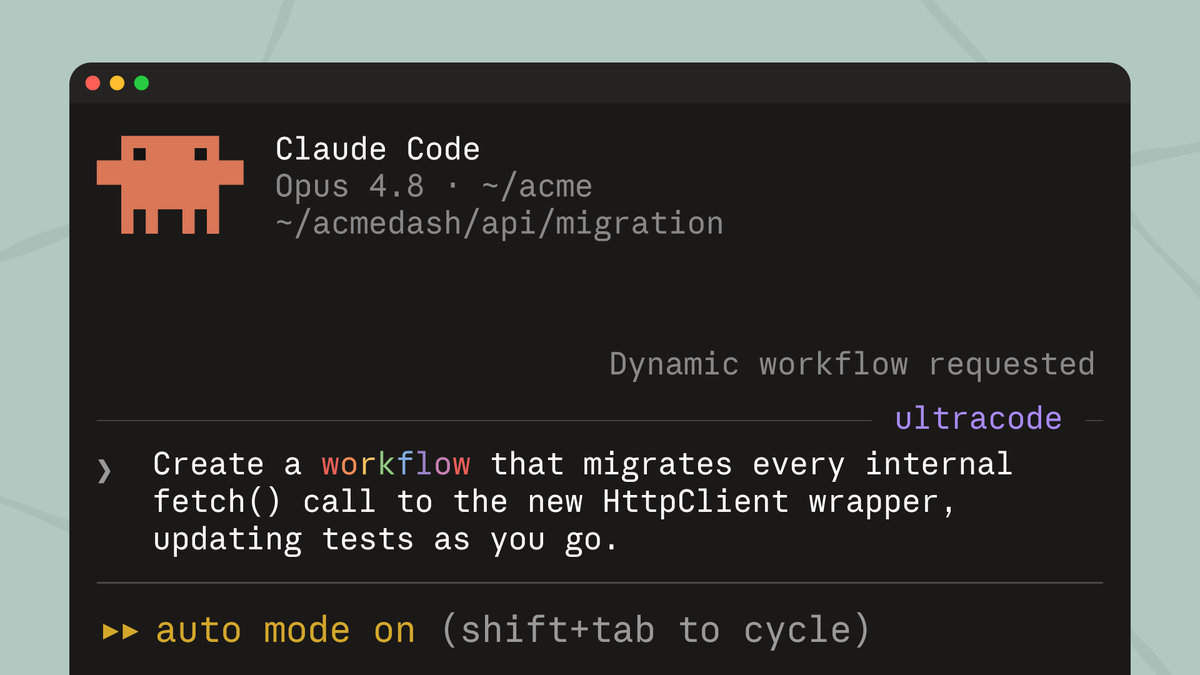
New in Claude Code (research preview): dynamic workflows.
Claude writes an orchestration script on the fly, then spins up a large fleet of coordinated subagents in parallel to take on your most complex tasks.
Use the word "workflow" in a prompt to get started.
Token management is going to be a growing field and big opportunity.
And it’s actually pretty complex. The simple version is you give departments token budgets and they allot them to projects.
But what you really want is something more dynamic. How do you judge the value of any particular token request in real time? Because most of those requests are being done by agents not people.
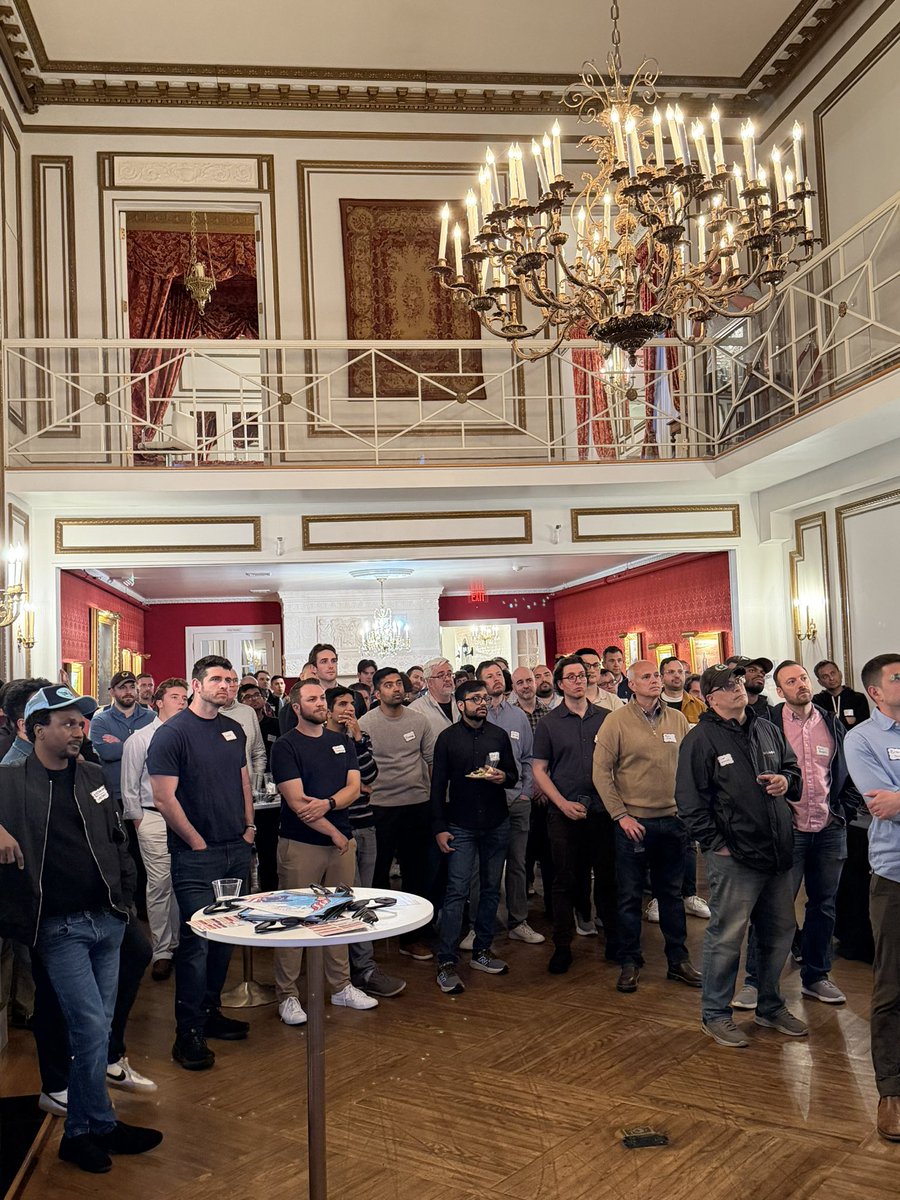
We organized a 125 person meetup in the suburbs of NJ.
What we didn’t tell the attendees was that 30% of the folks were in the trades.
What came of it was magic.
You had people from places like Figma, Google, Digital Ocean, Anthropic, OpenAI, Google and Meta mixed with owners of hvac, landscaping, poop scoop, plumbing and Christmas light companies.
By the end of the night the conversations all looked the same.
The AI builders wanted to know how real businesses actually run.
The operators wanted to know how AI actually works.
This is further proof that the future of vertical software isn’t getting built in San Francisco coffee shops.
It’s getting built in rooms like this one.
And hopefully in Westfield NJ.
I think this is more right than employment doomsday, especially for young people.
Who is more likely to be a vibe creating maniac… the guy who has been in the marketing dept for 20 years or the kid who hasn’t left his dorm room in the last 12 months and spends more on tokens than weed.
Same thing happened with web 1.0. This will be 100X.
I have changed my mind on how AI will impact jobs in America.
Previously, I believed AI would replace many entry level roles typically filled by young employees. The technology would then work its way up the organization and eventually reduce the total number of jobs in a company.
The data is saying something different, so when I get new information I am willing to change my mind.
The number of software engineers being hired has been increasing. The number of open software engineer roles is growing.
The number of new college grads who get hired has increased 5.6% over the last 12 months. The unemployment level for people aged 20-24 years old who have a college degree has fallen from nearly 9% to almost 5% as well.
The Wall Street Journal recently wrote “AI created 640,000 jobs between 2023 and 2025 in the U.S., according to an analysis by LinkedIn of job posting data, including new white-collar positions such as Head of AI and AI engineer.”
And I am starting to see companies throughout our portfolio aggressively hiring to keep up with the demand for their products and services.
If AI can make employees more productive, which is widely accepted as fact, then companies are going to want as many productive units of labor as possible. This is a key reason why I am changing my mind.
AI appears to be a magical technology that will make companies more productive and more profitable. The net result will be more corporations, more startups, and more jobs.
All three are big, positive wins for the American economy.
This is at least the 100th startup trying to make Linkedin more effective. Maybe it will work.
But every time I see one I think, why isn’t this coming from Linkedin?
There’s something different happening at Ramp. And I don’t mean how impressively they are using AI.
What’s interesting is they are broadcasting their techniques. Would Visa do that? Amex?
It’s brilliant marketing, both to get startups to join Ramp and to get 10X engineers excited to work there.
Anthropic made its first dollar three years ago. last month it crossed $30B in revenue. that money is coming from somewhere, and your CFO probably can't tell you where.
the problem isn't the spending. the companies on Ramp investing the most in AI have more than doubled their revenue since 2023. the problem is that no one can see where it's going: which team drove the spike, whether it's COGS, Opex or R&D, if commitments are actually being used.
your AI providers aren't going to help you spend less. they're not going to tell you a competitor's model does the same job for a fraction of the cost. or that an open-source alternative works just as well.
so we built something. Ramp pulls token-level usage data directly from Anthropic, OpenAI, and OpenRouter into the platform where you already manage cards, bill pay, and procurement. connect an API key — five minutes, no engineering — and finance can see every dollar by provider, model, team, and project. free for all Ramp customers. if you want it too, Veeral shows how to set it up in minutes.
the companies building financial discipline around AI now will know where to double down and where to cut. everyone else will be explaining to their board why their fastest-growing cost is also their least well understood.
@higgsfield The critics in this thread are nuts. No it’s not perfect but its better VFX than 90% of tv shows. Made for 1% of the cost.
And it will get better.
True disruption.
I dare you to watch this and say AI is slop.
The next George Lucas is chilling in his dorm room right now and all he needs is a stack of GPUs.
Hollywood isn’t ready for this.
AI agents will pay you to chat with them.
When AI agents hit a wall, Humwork's (@humworkai) MCP server connects them to a verified domain expert in 30 seconds. Their experts include senior engineers, marketers, designers, and more.
Congrats on the launch, @theyashgoenka and @OneRohanDatta!
https://t.co/HTb5KrjpAi
What happens when software is as easy to create as snapping a photo?
It gets shared like one. Apps as social objects is an interesting twist to the vibe coding revolution.
Today, we’re launching @autoaicam, a camera that builds personal apps for anything you point it at.
How does it work?
- Take a photo
- Auto picks a Frame, a mini-app built and designed by you or our community
- The Frame does something for you: track calories, virtually try on outfits, identify a plant, and much more
How many of you have a camera roll full of photos that are really actions or reminders? Auto turns these photos into something useful.
Our research 2 years ago showed exactly the same thing at exactly the same break point - around 10K pages.
The actual problem is similarity search, the primary method used in vectorized data.
Let’s imagine you are one in a million. In a planet of 8B people, there is actually quite a lot of you out there.
Similarity search has the same issue. A RAG with millions of chunks will struggle to find the right chunks you need.
We lay out a totally different approach to the problem going back to the roots of search and adding back ai layers on top.
No semantic collapse. Scale as big as you want.
https://t.co/GsFvF9SNRC
The more enterprises I talk to about AI agent transformation, the more it’s clear that there is going to be a new type of role in most enterprises going forward. The job is to be the agent deployer and manager in teams. Here’s the rough JD:
This person will need to figure out what are the highest leverage set of workflows on a team are (either existing or new ones) where agents can actually drive significantly more value for the team and company.
In general, it’s going to be in areas where if you threw compute (in the form of agents) at a task you could either execute it 100X faster or do it 100X more times than before. Examples would be processing orders of magnitude more leads to hand them off to reps with extra customer signal, automating a contracting review and intake process, streamlining a client onboarding process to reduce as many straps as possible, setting up knowledge bases than the whole company taps into, and so on.
This person’s job is to figure out what the future state workflow needs to look like to drive this new form of automation, and how to connect up the various existing or new systems in such a way that this can be fulfilled. The gnarly part of the work is mapping structured and unstructured data flows, figuring out the ideal workflow, getting the agent the context it needs to do the work properly, figuring out where the human interfaces with the agent and at what steps, manages evals and reviews after any major model or data change, and runs and manages the agents on an ongoing basis tracking KPIs, and so on.
The person must be good at mapping the process and understanding where the value could be unlocked and be relatively technical, and has full autonomy to connect up business systems and drive automation. This means they’re comfortable with skills, MCP, CLIs, and so on, and the company believes it’s safe for them to do so. But also great operationally and at business.
It may be an existing person repositioned, or a totally net new person in the company. There will likely need to be one or more of these people on every team, so it’s not a centralized role per se. It may rile up into IT or an AI team, or live in the function and just have checkpoints with a central function.
This would also be a fantastic job for next gen hires who are leaning into AI, and are technical, to be able to go into. And for anyone concerned about engineers in the future, this will be an obvious area for these skills as well.
Love this approach to ai adoption. We’ve heard so much of the opposite lately where tech companies do ai game of thrones.
Don’t become a power user overnight? It’s red wedding for you. Thats nuts.
You wind up with a lopsided org of AI early adopters as if there is no other skill set that matters.
Ramp is taking the other approach. Have the power users make it easier for other users to become powerful too.