Nataka nikukumbushe that Gratitude is a frequency that opens doors! Learn to be grateful! Appreciate even the smallest things! The ones that might look like they do not matter! Jifunze Gratitude nani!
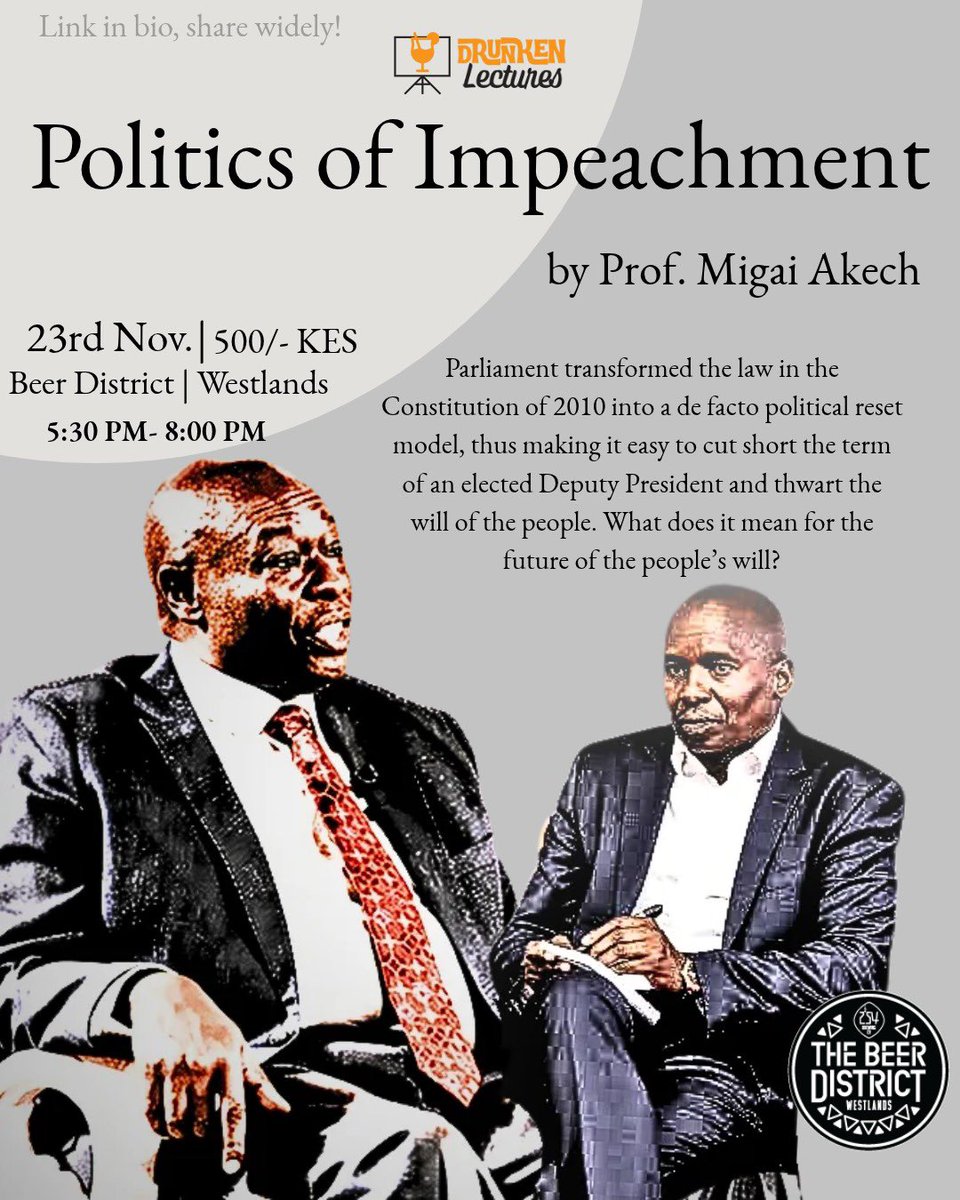
Impeaching The Deputy President, Parliament transformed the de jure bad actor model in the Constitution of 2010 into a de facto political reset model, thus making it easy to cut short the term of a democratically elected Deputy President and thwart the will of the people.
A Fresh Suit was filed in July 2026. The parties took directions for full hearing in July. We were given 16th September for argument. A judgment date of 23rd October was given. Lady Justice Patricia Nyaundi delivered a 45 page judgment on 23rd October. Case closed. If judges want to work, case backlog is easy to address. We have recruited hundreds of judges in the past few years and see no change. The problem in Kenya is that judges have turned rogue and don't want to work for their salaries(judges earn a monthly salary/allowance etc of 800k to 2.5 million and are the BEST paid GOK employees). And remember as i told Kenyans previously judges of the High Court and the Court of Appeal work only 56 days a year and Supreme Court judges work only 25 days a year. So @NelsonHavi had a very valid point when he protested a July 2027 date before Lady Justice Meoli. Such a date into the distant future has nothing to do with workload or the diary...Some judges give a distant date deliberately to scuttle the case...others do so for a number of reasons. Usually it is a combination of poor work ethics, frustration, spitefulness and even personal hatred/grudge...working for one of the parties in the processings etc..we know these manenos ya judges sana sana...please don't stir the pot..@Kenyajudiciary@jsckenya@LawSocietyofKe
Nachekanga tu nikiona such tweets.😂You will most likely take one shot in celebration and black out from exhaustion. People underestimate how much of a toll studying for the bar exams takes on you😂😂Hizi vitisho pia tulisema.💀
MICROPENIS:
It is becoming common for boys to have small dicks or disappearing dicks.
Small for expected age and maturity.
Eg a 20-year-old young man with a penis of a 5-year-old boy.
Reason:
Diapers, tight pants, bad foods eg wheat and soya, and lack of sunning.
#ManDay
Everyday, when I open this app I find @Mr_Guantai reminding @honkiborek that he is a pedophile who defiled a 16 year old girl and I honestly love to see it. I never understood why he was never convicted though.
I have practised law in the devolution space for more than sixteen years, and I cannot fail to notice this peculiar fecundity of the Court of Appeal for clawing back devolution in problematic decisions. My friend, the late Judge of the Court of Appeal Prof. Otieno Odek, termed this phenomenon "hourglass jurisprudence." It captures a striking institutional paradox. At the base, the High Court sits with a wide constitutional aperture, reading Article 259 as a living mandate to dismantle centralist inertia and breathe life into devolved governance. At the apex, the Supreme Court repeatedly restores that structural vision, affirming that the 2010 Constitution effected a radical redistribution of state power rather than a cosmetic administrative rearrangement. Sandwiched between them, however, the Court of Appeal routinely narrows the constitutional channel to a pinhole, constricting bold, purposive High Court declarations through rigid textualism, procedural formalism, and deference to legacy national statutes.
This appellate penchant for overturning progressive devolution rulings is not accidental; it stems from deep doctrinal and institutional habits. First is the triumph of common-law positivism over purposive constitutionalism. Where High Court benches treat the Fourth Schedule and Article 186 as self-executing commands that override conflicting statutory architectures, appellate benches frequently treat pre-existing or parallel Acts of Parliament as presumptively valid legislative choices. Unless a petitioner demonstrates a hyper-literal textual collision, the Court of Appeal tends to preserve national parastatals and statutory funds intact, effectively allowing ordinary legislation to claw back functions and revenues that the Constitution assigned to counties.
This textualism is reinforced by an instinct for administrative and fiscal preservation. Kenya’s state apparatus was forged over decades around centralized ministries, boards, and levies, and the Court of Appeal often privileges institutional continuity and National Treasury predictability over the disruptive restructuring that genuine devolution demands. Nowhere is this clearer than in fiscal federalism disputes under Articles 175(b), 187(2), and 202. While the High Court views the equitable share as a constitutional floor and insists that resources must follow devolved functions, appellate benches regularly construe Article 202 as an exhaustive ceiling, characterizing conditional grants, sector levies, and additional allocations as matters of executive and legislative grace rather than enforceable constitutional entitlements.
Compounding this doctrinal conservatism is institutional distance and judicial culture. Operating as an error-correcting forum confined to the cold record of appeal, the Court of Appeal is insulated from the immediate evidentiary realities of grassroots service delivery—the crumbling county roads, underfunded clinics, and stalled local infrastructure documented in High Court affidavits. Stripped of that lived context, urgent questions of constitutional survival are distilled into sterile debates over statutory vires and separation of powers. Shaped largely by a pre-2010 legal tradition rooted in commercial litigation and judicial restraint toward the executive, many appellate judges instinctively recoil from High Court orders that invalidate long-standing statutory frameworks or redirect billions of shillings in public revenue.
To be sure, the Court of Appeal defends this posture as constitutional discipline rather than hostility to devolution. From the appellate bench’s perspective, courts must neither rewrite national budgets nor usurp the legislative mandate of Parliament and the fiscal remit of the Commission on Revenue Allocation. Yet in practice, treating Article 259 with excessive timidity turns the appellate court into a bottleneck where constitutional transformation stalls.
Men,
Your friends know your password, your plans and your weaknesses.
Choose them like you choose a business partner.
The man who laughs at your sins today will sell your story tomorrow.
GUARD YOUR FRAME.
#MasculinitySaturday
When you "empower a woman", families collapse, fathers are robbed by divorce courts, children suffer, and society becomes miserable.
If you embolden men, the world prospers.
Amerix is a misogynist.
If a woman steals 10 million, she may be imprisoned for 1 month.
If a man steals 1 million, he shall be jailed for 10 years.
The bar for men is higher and crueller.