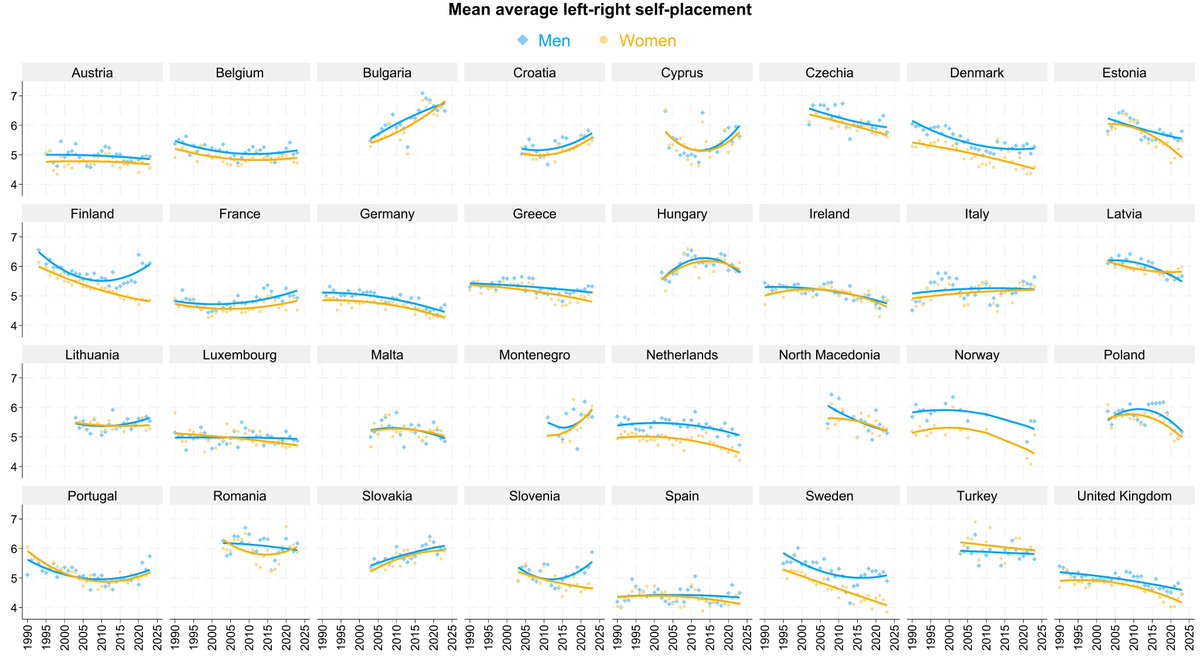
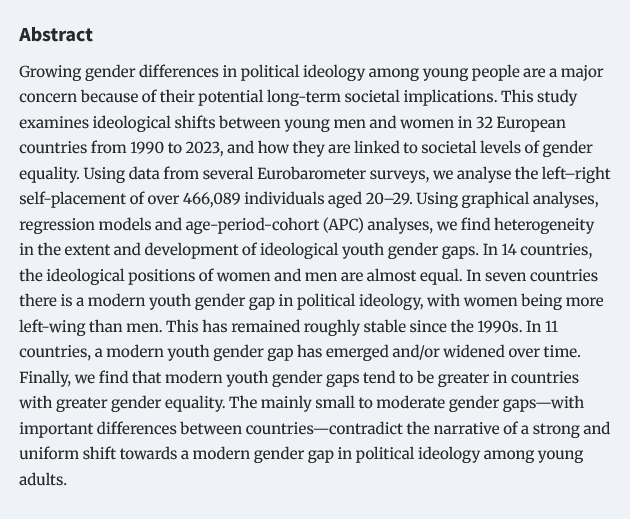
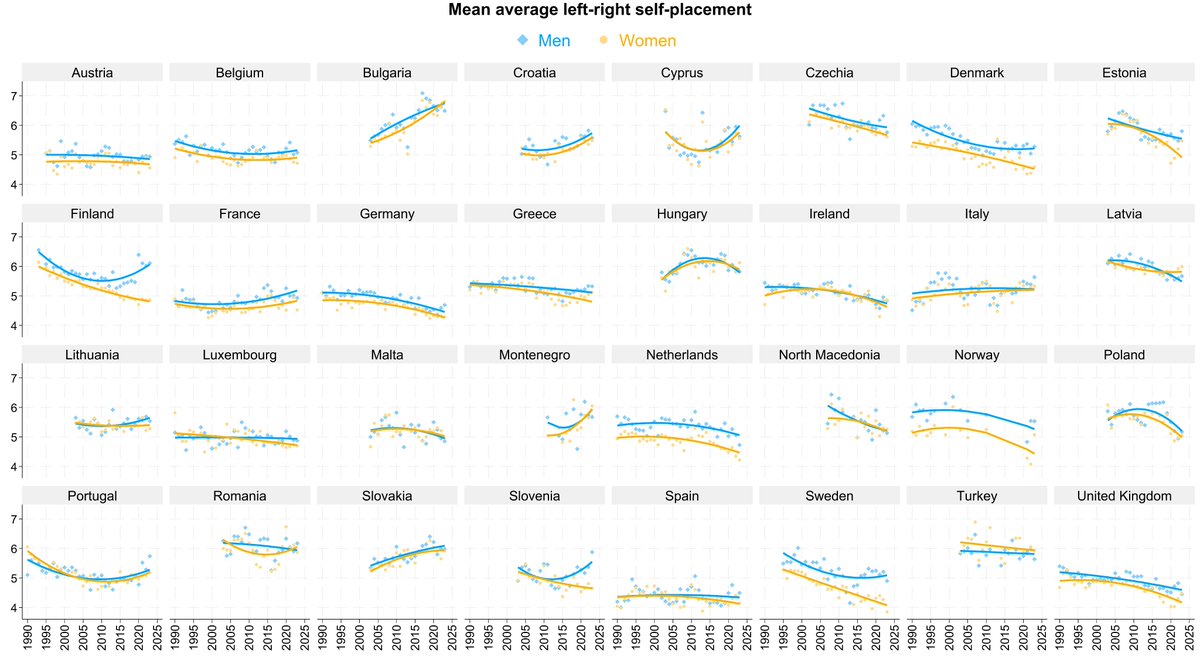
🚨 Are young women becoming more left-wing & young men more right-wing?
We analyzed 32 European countries (1990–2023).
📊Some show growing gaps—others don’t.
🇪🇺Gaps tend to be bigger where gender equality is higher.
w/ @A_Hudde
👉 https://t.co/9tdf2BUgGV
Last paper of my PhD thesis and first single-author publication out in SSM!
It shows a mechanism underlying health inequality: High-SES families buffer genetic propensity for obesity, while low-SES environments trigger it 🌍🧬⚖️
https://t.co/gjGOMuH5UA
📢 New in!
Is career class mobility becoming easier over time?
#M_Veljkovic says: Yes! But changes are not associated with any significant modification in mobility patterns, thus the social distance between social classes remains largely intact!
More at➡https://t.co/rwGSMJVAWd
Should socio-economic outcomes be associated with genetic variation? How much of an empirical difference does this make for our assessment of inequality?
Check-out the first article of my PhD! With @ Michael Grätz.
❌ “No” still isn’t heard equally.
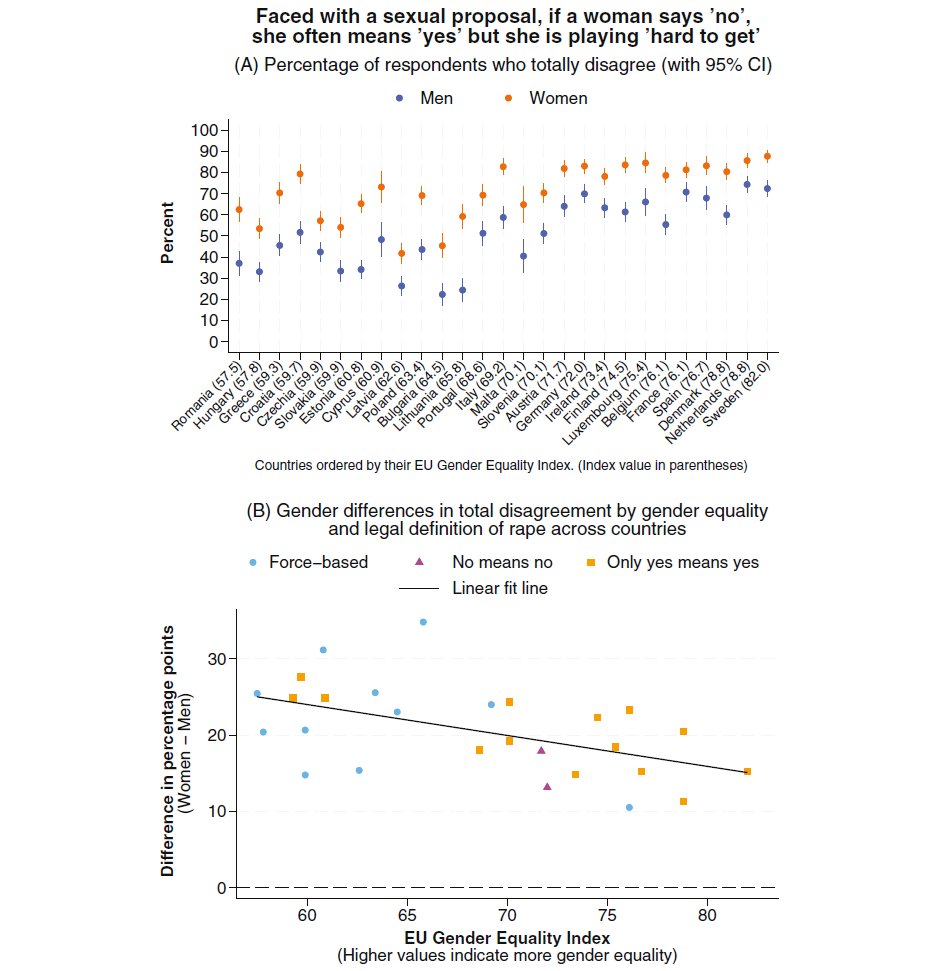
Drs @NennstielR & Möser’s #Socius study using @EurobarometerEU shows men across the EU are less likely to reject “no means yes.” Rejection rises with #GenderEquality and stronger #ConsentLaws.
Read: https://t.co/fm89pTjlV7
📊 We use @EurobarometerEU 544 data from @gesis_org and the EU Gender Equality Index data from @EURightsAgency / @eige_eu to dig into consent perceptions across 25,824 respondents in the EU 🇪🇺.
👉 https://t.co/G1LWpOCk4M
🚨 New paper out! 🚨
We use @EurobarometerEU data to explore how strongly people across the EU reject the “no means yes” rape myth.
Gender gaps persist, but shrink with higher gender equality and “only yes means yes” laws.
w/ Sara Möser (@unibern)
👉 https://t.co/G1LWpOCk4M
Women consistently reject this myth more than men — but in countries with higher gender equality and “only yes means yes”consent laws, these gender gaps are smaller.
Published in @SociusJournal@ASAnews
👉 https://t.co/G1LWpOCk4M
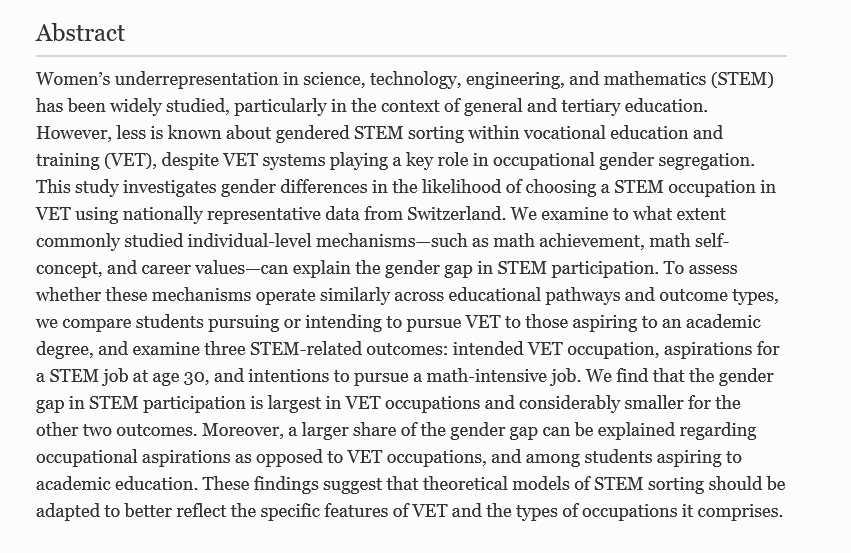
We analyze gender gaps in STEM aspirations across educational pathways in Switzerland.
Gender gaps are larger in vocational (VET) routes than in academic pathways — and existing theories explain less of these gaps among students aspiring VET.
👉https://t.co/aK1QpuiPYK
Women are less likely to pursue STEM in VET than men — with a gender gap of 48 percentage points (!) among those choosing VET occupations. Existing explanations (achievement, values, self-concept) help explain gender gaps better for academic routes than for VET.
Published in Research in Social Stratification and Mobility (RSSM), Special Issue “The Growing Gender Divide in Educational Credentials” edited by Claudia Buchmann.
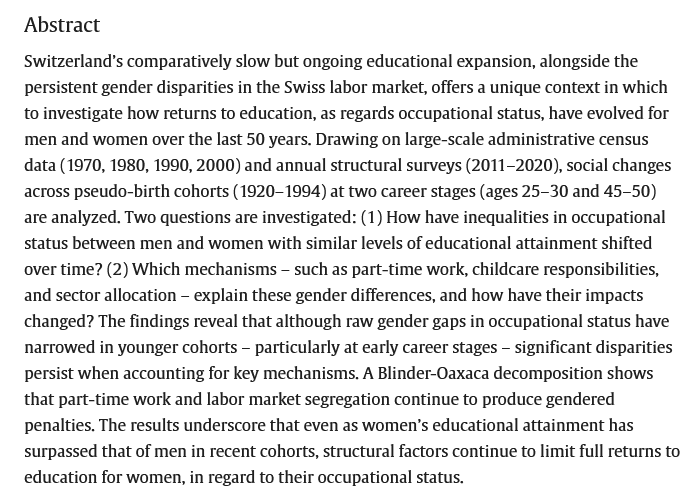
Findings show persistent gendered penalties despite women’s educational gains.
👉 https://t.co/3Irqqdb0Ci
🚨 New paper out in RSSM @OfficialRC28 ! 🚨
We explore how gender differences in occupational status evolved in Switzerland over 5 decades — as women have attained increasingly higher educational qualifications.
w/ Rolf Becker (@unibern)
👉 https://t.co/3Irqqdb0Ci
We use Swiss census data (1970–2000) + structural surveys (2011–2020) from @StatDataCH to study how equal educational credentials still translate into unequal labor market outcomes for women & men. 🇨🇭
👉 https://t.co/3Irqqdb0Ci
New Research: Longitudinal analysis of occupational prestige in Switzerland, 1946–2023: navigating economic modernization and changing labor market conditions https://t.co/tA75NFsuVQ #FrontiersIn#Sociology
📢Is the youth gender gap in political ideology increasing in Europe?
@NennstielR & @A_Hudde find mixed patterns across countries: no gaps, stable gaps & increasing gender gaps!
AND: countries' gender equality matters!
More equality ↗bigger gender gaps
https://t.co/rRFdZM3iXS
Based on over 466k respondents aged 20–29 from:
📊@EurobarometerEU surveys
📊@ESS_Survey (European Social Survey)
We used APC models + trend graphs to unpack youth gender gaps in political ideology across Europe.
@ESR_news
🚨 Are young women becoming more left-wing & young men more right-wing?
We analyzed 32 European countries (1990–2023).
📊Some show growing gaps—others don’t.
🇪🇺Gaps tend to be bigger where gender equality is higher.
w/ @A_Hudde
👉 https://t.co/9tdf2BUgGV
🚨 Open postdoctoral researcher position 🚨:
▪️ PhD in sociology, econ, organiz. psychology, etc.
▪️ 80%, 2-year position @unibern.
▪️ Main tasks: set up + manage Swiss employer-employee panel & doing research on careers in companies
▪️ More infos: https://t.co/ccGFQU9iq4
We (@A_Hudde) used @EurobarometerEU and @ESS_Survey data to explore political ideology shifts in young Europeans (1990-2023). Findings reveal diverse patterns of gender gaps across countries, from stability to polarization.
Are young men and women in Europe becoming more polarized in their political ideologies?
It depends. Across 32 countries:
14 show no meaningful gender gap
7 have a stable small to medium gap with women leaning more left
11 show widening modern gender gaps
https://t.co/LlyeYqIJkq