ADPKD—Kidney replacement therapy (Dialysis)
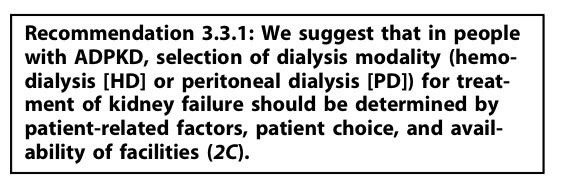
📍Dialysis modality choice = shared decision-making
📍Choose HD vs PD based on patient factors + patient choice + facility availability (2C)
📍No survival difference between PD & HD.
📍PD is a viable option in ADPKD kidney failure ✅
▪️Use caution only if massive kidney/liver enlargement or other standard PD contraindications
📍HD prescription + supportive care (e.g., anticoagulation) = same as non-ADPKD
📍Evidence summary (PD vs HD in ADPKD):
▪️Mortality: no significant difference (
▪️On PD (ADPKD vs non-ADPKD): no significant differences in Kt/V, peritoneal leaks, peritonitis, switch to HD, technique failure, exit-site infection, or mortality
▪️Hernias: more common in ADPKD on PD
▪️Median technique failure: 6.2 yrs (ADPKD) vs 6.5 yrs (non-ADPKD)
▪️Median time to death: 6.04 yrs (ADPKD) vs 5.57 yrs (non-ADPKD)
▪️More switching PD → HD
▪️One study: hospitalization for infection higher with PD vs HD (58% vs 44%); possible ↑ hernia surgery (7% vs 4%)
Cont. ADPKD—Kidney transplantation cont
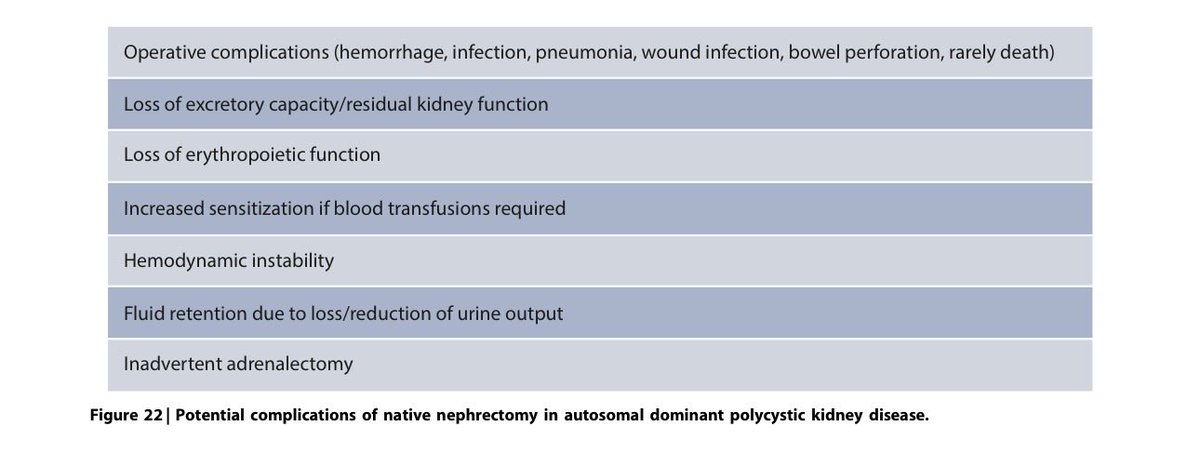
⚫️Nephrectomy
📍 Native nephrectomy NOT routine
▪️do only for specific indications when benefit > risk (2C)
▪️ 9 studies—no clear benefit for graft loss or all-cause mortality after Nephrectomy
▫️possible higher transfusion risk if nephrectomy done at time of transplan
▫️note kidneys often shrink up to ~30% in 1st year post-Tx (may improve symptoms)
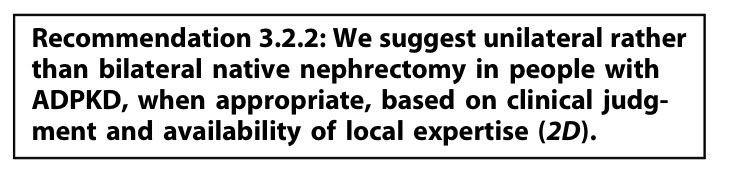
📍Prefer unilateral over bilateral nephrectomy when appropriate (2D) ✅ (lack of benefit for bilateral + concern for higher complications, e.g., refractory hypotension)
📍Pre-Tx nephrectomy: meta-analysis shows near-significant ↑ long-term mortality; large database suggests ↑ in-hospital post-Tx death
📍Consider longer operative time + transfusion risk → individualized planning
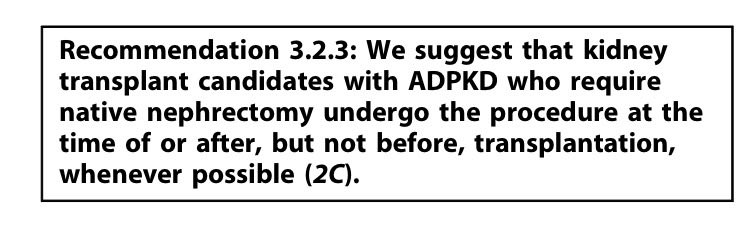
📍 Timing when nephrectomy needed 🕰️: suggested at time of or after transplant, not before, whenever possible (2C)
📍 Surgical approach 🔧:
▪️when feasible, hand-assisted laparoscopic over open nephrectomy (2D) ✅ (similar complications overall, less transfusion)
⚫️(RCC screening pre tx):
📍Individualize RCC evaluation; consider kidney imaging (e.g., abdominal MRI) within 1 year before anticipated transplant
📍Most studies: significant RCC risk not increased vs other etiologies
▪️some cohorts suggest increased RCC in ADPKD
📍Prefer noncontrast MRI in kidney failure/dialysis
▪️give gadolinium (group II) only if necessary
📍MRI advantages:
▪️better soft tissue
▪️can classify simple vs hemorrhagic/proteinaceous cysts
▪️solid lesions have intermediate signals + DWI helps
📍if solid lesion suspected (not AML), consider contrast for enhancement/staging; CEUS possible but often limited in ADPKD due to size/multiplicity