Orbital factories, depots, power arrays, in space assembly, power, robotics, closed loop systems are like space version of industrial supply chain/logistics. What are context/demand behind this space industrial? On earth, seemingly complex supply chain and mining exist to mass manufacture and mass move tons of goods like furnitures, car parts, clothes, cars, and bulk materials, which satisfies seemingly simple consumer/business demands: need to have nice house, good outfits, appliances, oil-based products, cars, local grocery stores, gardening, and soon AI robotics on earth.
@grok Give me a vision/imagination (probably just an engineering problem/solution and none of therapy/socialization/human-oriented solutions) to turn into reality that can solve radicalism, racism, ideology, woke mind virus, all sorts of bad vibes
What cultures in this world or in history have most women highly raised/optimized/neurologically efficient to almost never go radical even in hard unfavorable times? Trained/conditioned to just be considerate/cooperative or peacefully independent. I believe most (young) women go radical/toxic feminism due to overly lavish lifestyle or excessive high stress situation/truama from young ages, giving way for woke mind virus to recruit neurons if there no neuron circuits for just being socially harmony (like in Eastern) or stay believing in interesting men (like in Western world).
It sounds like just going to gym and status signaling if done wrongly. Could use mindset change or worldview change. Like shifting to just engineering against true worldly dangers like AI agents or novel attacks. Or learning first principles of human behaviors/ideological mindset down to the neurons, chemistry, or biological cells. That’s real man going uncharted territory imo. Try again
@grok@IterIntellectus Explain like I'm only know AI/artificial neural network/machine over complex biology, but something that complex biology and AI/machines both follow on (the underlying principle(s) of reality and abstraction)
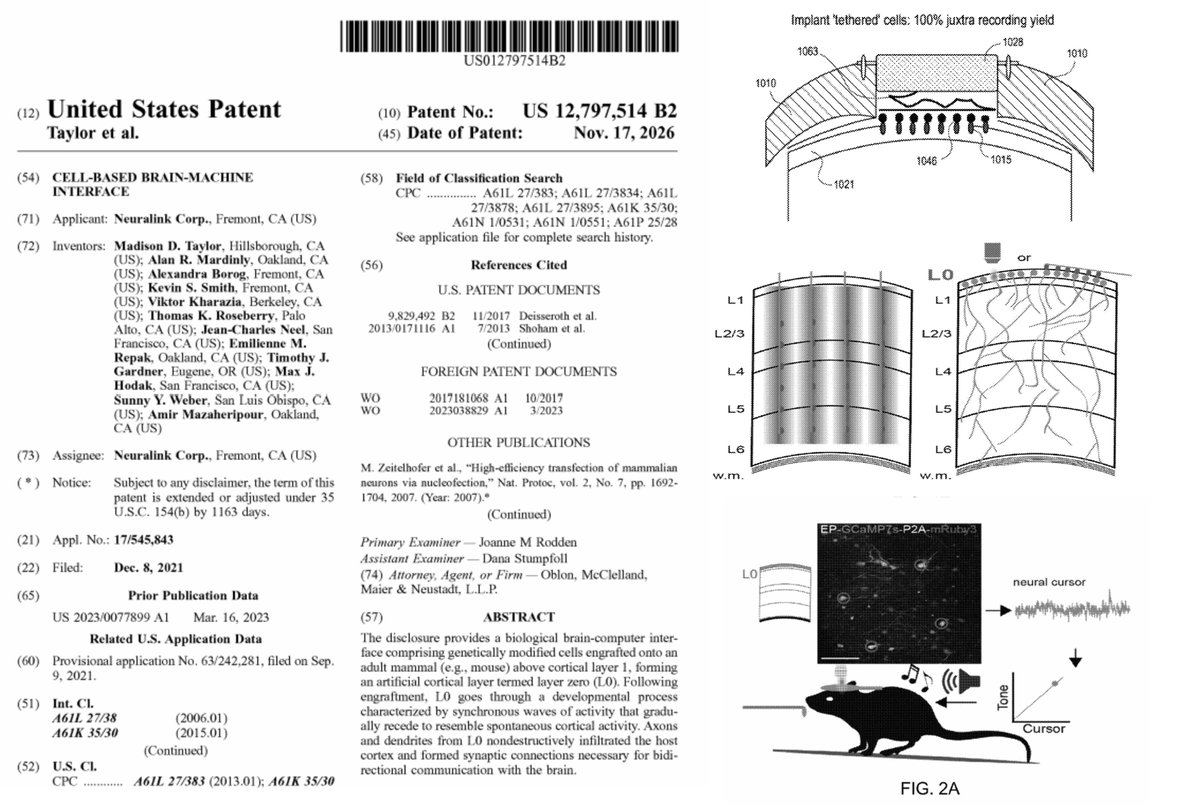
NEURALINK: Today the U.S. Patent and Trademark Office issued U.S. Patent 12,797,514 B2, "Cell-Based Brain-Machine Interface," to Neuralink. It covers a brain-computer interface built from genetically modified neurons grafted onto the surface of the brain!
Neuralink's current N1 implant reads the brain only through electrode threads inserted into tissue. In this design, living cells grow the connections into the brain themselves.
The modified BCI is grafted above cortical layer 1. The graft forms a new, artificial outermost layer called "layer zero" (L0). According to the patent, axons and dendrites from L0 grow into the host cortex "nondestructively" and form the synaptic connections needed for "bidirectional communication with the brain."
In the patent's tests on adult mice, the graft first produced waves of synchronized activity that gradually settled into normal-looking brain activity.
In the main claim, a camera images the graft to read signals from the brain, and a light source sends signals back in. Other claims tether the cells to electrodes.
Possible benefits include:
- Bidirectional communication with L0 cells that can both send and receive signals through synapses, which may support more natural input and output than unidirectional electrode recording.
- Potentially lower tissue damage over time because the connection is made by living cells that infiltrate the cortex possibly avoiding some of the chronic inflammation and scarring associated with rigid or high-density electrodes.
- Developmental integration of engrafted cells that gradually produces activity patterns resembling natural cortical activity, which could improve long-term signal stability and biological compatibility.
- Higher effective resolution through many synaptic connections. In principle is could allow finer-grained interaction with neural circuits than the number of physical electrodes alone.
Neuralink originally filed the application on December 8th, 2021, and the twelve inventors include Neuralink co-founder Max Hodak, now co-founder and CEO of Science Corporation, and Alan Mardinly, a former Neuralink leader who is now co-founder and Chief Scientific Officer at Science Corporation.