This article has received 11,000 views in the first 24hrs. The article is now also being referenced by Google 🎉🎉🎉
If you’re a network professional and you want to learn AI networking, please check it out!
https://t.co/I5KWzmm13S
https://t.co/I5KWzmm13S
I sometimes think of RoCEv2 as effectively band-aiding Ethernet for AI networking. There is nothing inherently wrong with Ethernet. It was simply not designed around AI networking model.
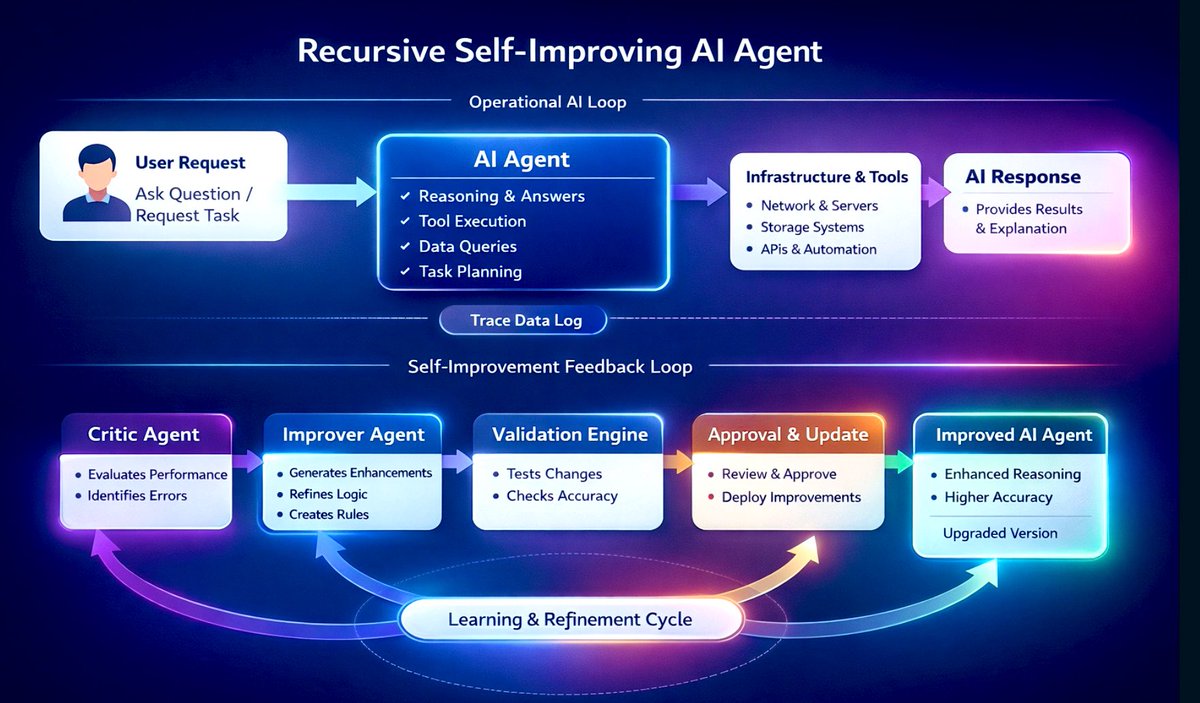
Together, these concepts transform a simple LLM interaction from prompt > response into an iterative reason > act > observe > reason workflow.
LangChain and LangGraph have become widely used frameworks for building agentic AI applications. LangChain provides the model, tool, and integration abstractions, while LangGraph provides the stateful orchestration layer that controls how an agent operates….
State tells the agent what it knows. Nodes define what work can happen. Edges connect that work. Routing determines which path is taken next. Loops allow the agent to act, observe the result, reason again, and continue working toward its goal.
I always deliberately build ver 0.1 of my AI agents without MCP tool first. Replacing the Python dummy functions with MCP tools becomes almost trivial.
That separation gives me easier unit testing with fake tools..
LangGraph > GPU Tool > Mock Provider
#langraph#AI#AgenticAi
I’ll like to remind everyone “inference” isn’t a single infrastructure profile, the traffic pattern and resource requirements can change significantly on the backend AI infrastructure depending on the serving backend parallelism architecture uses data, tensor, expert parallelism
66% of enterprises surveyed had shifted AI workloads from public cloud toward private or hybrid cloud, according to reporting on Cloudera’s 2026 Great AI Re-Architecture study of 1,500 enterprise architects and data leaders.
From an AI infrastructure perspective, an AI agent is fundamentally an inference workload, but with orchestration around it.
So an AI agent doesn’t introduce a completely new category of AI workload. It typically creates multiple inference calls, with tool/API/database.
#AI
I’m thinking of starting **FREE live sessions on AI Infrastructure & Networking** soon.
If you are interested, **LIKE this post** 👍 so I can see how many people would like to join.
If there is a topic you want me to cover, additionaly **write it in the comments**.
Some of the topics we can cover:
AI Infrastructure • AI Training • AI Inference • GPU Architecture • HBM • PCIe • DPUs • SmartNICs • Scale-Up vs. Scale-Out • Data Parallelism • Tensor Parallelism • Pipeline Parallelism • Expert Parallelism • Mixture of Experts (MoE) • Collective Communications • AllReduce • AllGather • ReduceScatter • NCCL • CUDA • RDMA • RoCEv2 • InfiniBand • Ethernet for AI • Lossless Ethernet • PFC • ECN • DCBX • ETS • DCQCN • Congestion Control • Clos/Fat-Tree • Rail-Optimized Design • Dragonfly • ECMP • Flowlet Switching • Adaptive Routing • Incast • Elephant Flows • Tail Latency • NVLink • NVSwitch • GPUDirect RDMA • NVMe-oF • AI Storage • AI Storage Networking • AI Cooling • AI Data Center Power • Ultra Ethernet (UEC) • UET • UALink • SUE-T • MTU • GPU Utilization • AI Fabric Telemetry • AI Cluster Design
And probably many more as we go.
#AI #AIInfrastructure #AINetworking #ArtificialIntelligence #Networking