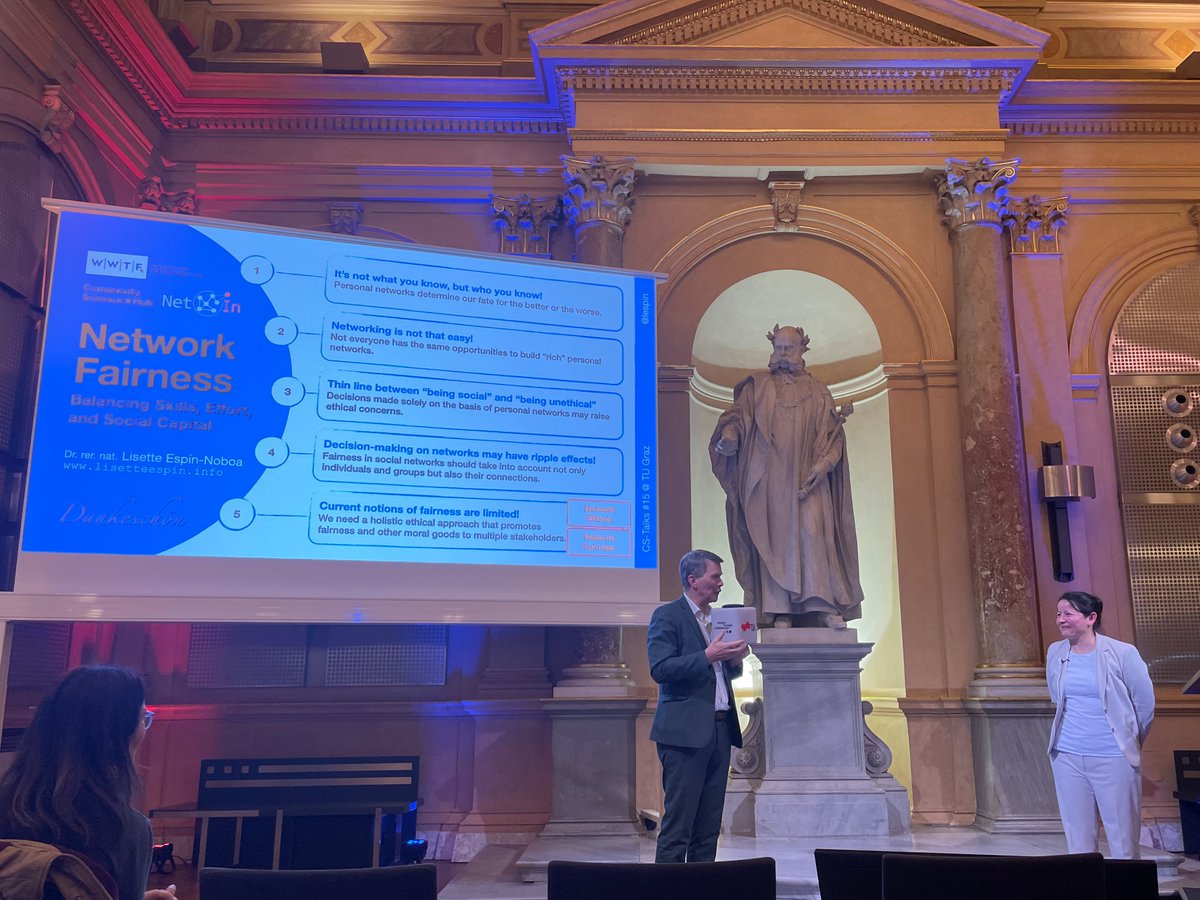
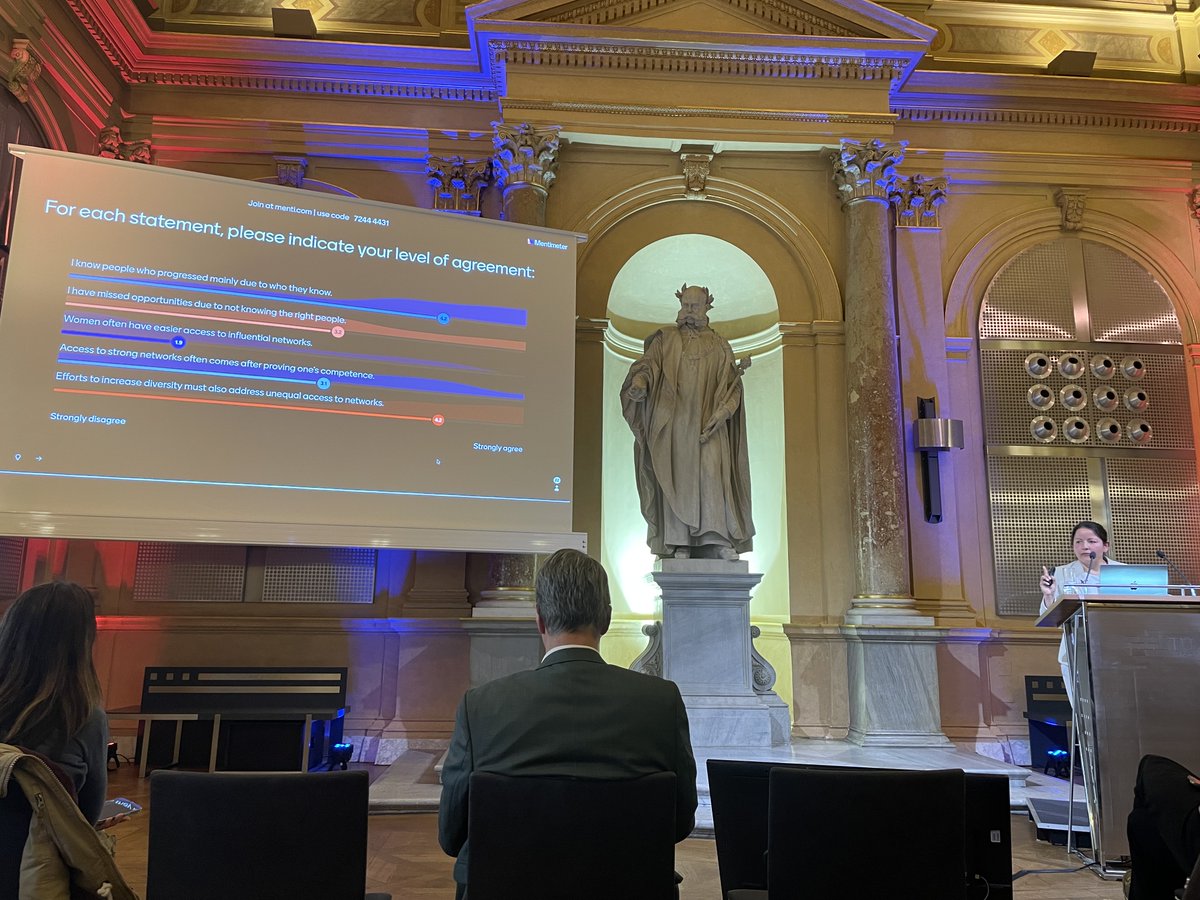
@lespin gave a captivating talk at the @tugraz about Network Fairness: Balancing Skills, Effort, and Social Capital, with definitions on the literature about these phenomena and engaging questions for the audience about their opinion on hiring in academia.
Reach out in Graz!
New paper allert!🚨🚨🚨
@fariba_k W/ Sina Sajjadi, Pourya Toranj Simin and others show how socio-economic inequalities exacerbate infection disparities using computational models and validated with empirical COVID data in the US.
https://t.co/FXNWOW7xa4
We are delighted to welcome Paula Nauta to our team as a #PhD! Paula will develop research on ***parenthood*** in Academia and the ethics and moral values behind ML papers. Stay tuned for the outcomes of her projects in the coming years!
These findings help address open questions in social psychology:
✅How do multidimensional identities drive connection preferences?
✅How do these preferences impact inequality?
✅What patterns emerge when identity attributes correlate (consolidation)?
In Paper 2, we show:
💡Attribute correlations (e.g., gender & race) create unexpected inequalities unobservable in one-dimensional systems.
💡 Minority overlap leads to severe disadvantages in some cases.
💡Our model accurately predicts inequalities in real-world networks.
I am pleased to share this research paper https://t.co/cj8Lmf1r9h, published in @epj_ds , a q1 journal in modeling. The research work is about the prediction of SES using GNN. This a joint work with: @carmenvruiz, @mvillavi1, @lespin, @nervoxavier. cc: @espol@DEC_INV_ESPOL
These findings address questions in social psychology:
📷 How multidimensional identities drive connection preferences?
📷 How these preferences impact inequality?
📷 What patterns emerge when identity attributes correlate?#SocialNetworks#Inequality#Intersectionality
In Paper 2, we show:
📷 Attribute correlations (e.g., gender & race) create unexpected inequalities unobservable in one-dimensional systems.
📷 Minority overlap leads to severe disadvantages in some cases.
📷 Our model accurately predicts inequalities in real-world networks.
Excited to share our colleague @LiuhuayingYang's sci-fi book inspired by our research on inequality in ranking systems! A creative take on how the rich-get-richer effect & homophily shape visibility. A must-read for all curious minds! Order on Amazon: https://t.co/wqyPoY1a73
Happy New Year from our lab! Grateful to our community—colleagues, partners, mentors, and followers. 2024 was a year of growth in exploring network inequalities, publishing research, and sharing knowledge. Thanks to our team, speakers, and @CSHVienna. Here's to an inspiring 2025!
Thank you to all speakers and attendees of the 2024 Lecture Series on Network Inequality! Special thanks to our #NetIn team for organizing 17 insightful talks. We hope these sessions inspire new ideas and collaborations for a more connected and equitable world. @CSHVienna
🚀 We’ve landed on @bluesky! Come vibe with us where the sky’s the limit. 🌌
We’re still hanging out here on X (for now) but the future’s looking pretty blue. 💙
Follow us there & stay ahead of the curve: https://t.co/Bhb2IYYy0N
#StayConnected@CSHVienna