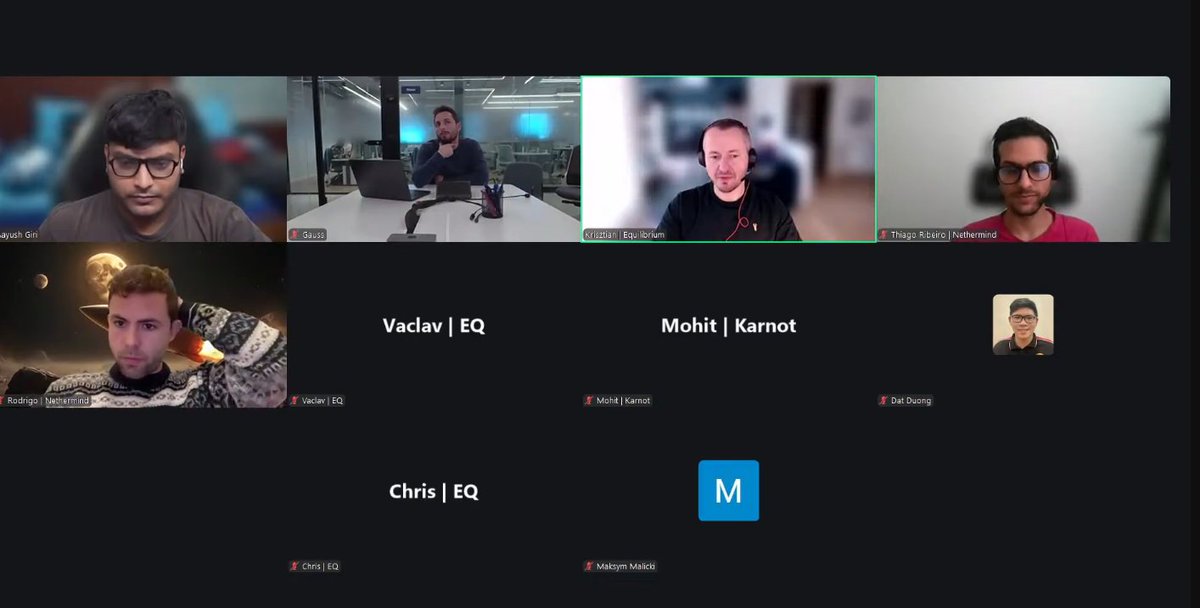
Starknet All Core Devs Call #48 starting in 15 minutes! ⚡
📅 March 26, 12:00 PM UTC
🎥 https://t.co/xcxpun00Jm
📋 https://t.co/AZmRIMmwP3
Key topics:
- March 18th mainnet upgrade results
- RPC final version status
- Propeller implementation timeline
- Karnot mainnet sync milestone
This one's packed with updates ✌️
Starknet All Core Devs Call #47 in 30mins! 🔥
📅 March 12, 12:00 PM UTC
🎥 https://t.co/tUrC5XxCkR
📋 https://t.co/W8yG6M1G1B
Big updates today:
• Did March 8th v0.14.2 integration ship?
• Propeller engineers presenting technical specs
• Karnot mainnet sync results
• Client updates across the board
Open call - join if you're interested ✌️
@Starknet All Core Devs Call #44 takeaways
Network's been stable since the January incident - no issues to report. The focus has shifted entirely to preparing for decentralized validation, and there's a lot happening under the hood.
@StarkWareLtd is deep in conversations with potential stakers to understand what they actually need to run validator nodes. Turns out when you're no longer running everything centrally, you need to think about observability, alerting systems, and key management solutions - things that weren't priorities before.
Sync time is a big consideration now. How long will it take validators to sync initially? What about after upgrades? These are practical questions that need answers before validators can realistically participate.
On the development side, new RPC crates were published today as developer versions. These are compatible with the upcoming RPC spec changes - but they're explicitly for testing only, not production. Stable versions will come closer to the next network release.
Client teams are moving fast:
Pathfinder (v0.21.5) is stable with no sync issues. They're cutting a pre-release for JSON RPC v0.10.1 testing with client-side proofs support. Fair warning: it requires DB migration and you can't roll back without a backup. They're also improving validator mode with concurrent execution and digging into Propeller implementation details from Starkware's code.
Juno's got something big coming - v0.15.18 will include a major DB optimization that cuts storage from ~700GB to ~360GB. That's nearly 50% reduction. They're making it opt-in first (v0.15.18, releasing today/tomorrow) with detailed docs, then default in v0.16 (mid-Feb). The migration is heavy but brings faster sync times and better RPC response times. They're also exposing tuning parameters for those who want to squeeze more performance.
@karnotxyz team synced Madara to Sepolia tip and is working on mainnet. They're seeing 2-3x performance gains with Cairo Native vs CairoVM which is huge for anyone running traces. SNOS v0.14.1 is still waiting on Dojo team review due to v0.14.1's two-proofs feature not being L3-compatible yet. They're focused on downstream pipeline improvements and processed 100K+ blocks across networks. Merkleization is their main bottleneck (60-80% of sync time), so that's the next focus. Working on RPC v0.10.1 compatibility with contributions to starknet-rs.
Small but important detail: JSON RPC v0.10.1 will release before network v0.14.2 compatibility which is a classic case of clients being ready before the network upgrades. Teams are aware.
Next call: Feb 12, 2026, 12:00 PM UTC
The march toward decentralized validation is real. Every team is either implementing consensus or optimizing for validator participation. Q1 2026 is shaping up to be infrastructure-heavy.
Cross-chain intents between EVM chains and @Starknet are now working on testnet.
Nethermind extended the Open Intents Framework to CairoVM, enabling real cross-VM intent execution rather than a bridge-based model.
Details ⤵️
https://t.co/oEZOVJMoxg
https://t.co/nNdMbzWQrI
🧵 Nethermind has built an ERC-7683–compatible intents implementation for @Starknet, extending the Open Intents Framework to CairoVM and enabling cross-chain intent execution between EVM chains and Starknet (testnet).
New Juno release that cut disk storage requirements by half! And if you thought performance was good, now it's better!
New settings for fine-tuning performance as well 🎂
Check it out!
https://t.co/cz3ckKARz1
#starknet best tech :)
This is the kind of tutorial we wish existed more often.
No shortcuts, no abstractions hiding Starknet mechanics, just the full account flow, clearly explained, in Go.
https://t.co/01gSsIOvJt
AuditAgent now supports Cairo.
Scan Cairo contracts on @Starknet.
Review findings with predictable results and less noise.
Built by Nethermind Security.
https://t.co/bFcxWjtHcH
@Starknet Contracts deployed on Sepolia, with factory-based infrastructure and an upgrade path.
Architecture docs, setup and deployment guides, and Go deployment scripts included.
𝗘𝘅𝗽𝗲𝗿𝗶𝗺𝗲𝗻𝘁𝗮𝗹 𝗮𝗻𝗱 𝗻𝗼𝘁 𝗮𝘂𝗱𝗶𝘁𝗲𝗱.
https://t.co/MTe9hoyfNf
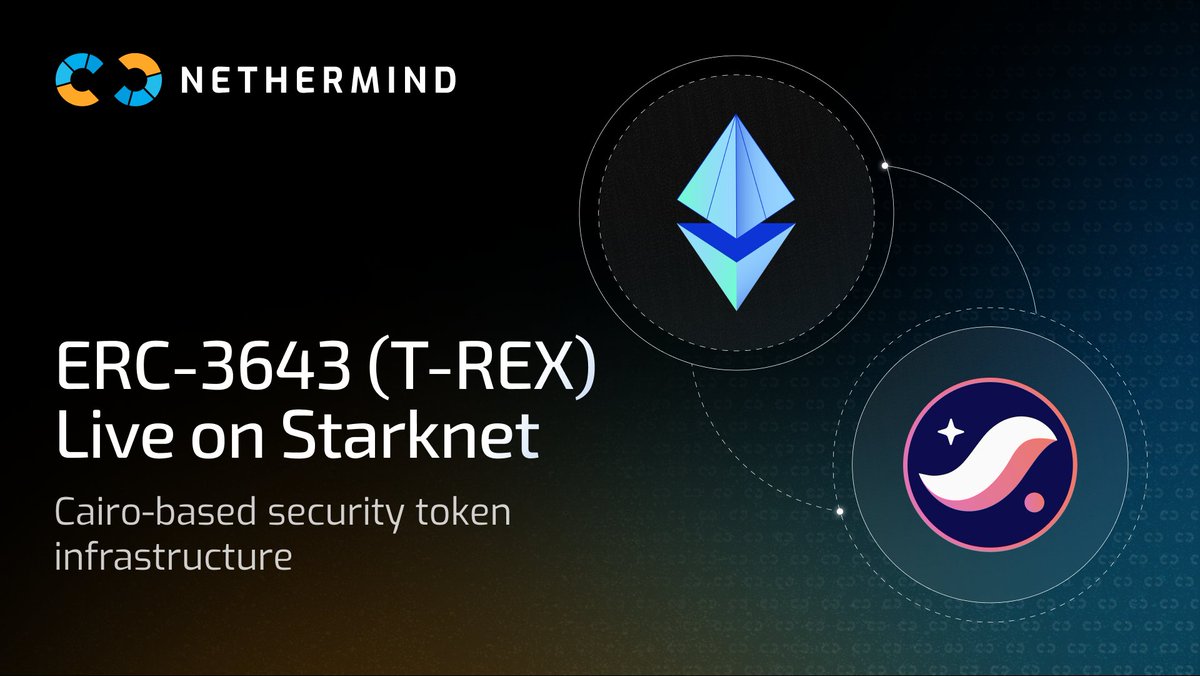
🧵 Compliant security tokens on @Starknet.
This is a Cairo implementation of the ERC-3643 (T-REX) standard, built as a full system, not a single contract: token logic, identity registry, trusted issuers, and modular compliance working together.
@Starknet The system includes modular compliance components, covering:
Identity-based transfers
Country allow / restrict rules
Balance and supply caps
Time- and volume-based transfer limits
Conditional transfers
Add or remove without redeploying your token.
The starknet.go docs are live.
Some things are easier to see than read.
Every Starknet account is a smart contract. In this walkthrough, @AayushStack shows how to create and deploy one in Go using starknet.go.
https://t.co/1eExxrtOp3
https://t.co/ql0A62VbPL
@hyperlane Full technical walkthrough, diagrams, and testnet transactions are documented here:
https://t.co/QjSB5djYcz
Code: https://t.co/4UdaWTOzn6
/end
🧵 For builders and solvers: technical details on the ERC-7683 intents implementation for Starknet (Sepolia) 👇
This thread covers architecture, current flows, and known limitations.
@hyperlane These gaps are known and external to the core intents logic.
Once resolved, the same architecture supports 𝗳𝘂𝗹𝗹𝘆 𝗯𝗶𝗱𝗶𝗿𝗲𝗰𝘁𝗶𝗼𝗻𝗮𝗹 𝘀𝗲𝘁𝘁𝗹𝗲𝗺𝗲𝗻𝘁 without changes to the intent model.