IperionX has entered into an agreement to acquire key assets associated with Covia's Camden silica sand operation located adjacent to IperionX's Titan Project in Tennessee.
The acquisition strategically consolidates IperionX's position in the Big Sandy Critical Minerals Province and brings together four features that are rarely available in a U.S. critical minerals development setting:
1. Province consolidation
2. Stockpile optionality
3. Pre-stripped horizons
4. Established infrastructure
IperionX plans to rapidly advance stockpile surveys, drilling, sampling, mineralogical analysis, metallurgical test work, integration and project development studies.
Full release: https://t.co/xXWjTXPN4a
$IPX $IPX.AX #titanium #rareearths #criticalminerals #Tennessee
IperionX's Covia Camden deal unlocks the largest stacked-critical-minerals play across the 'Big Sandy' province in Tennessee USA
At first glance, it is a disciplined, strategic US$3m bolt-on acquisition next to the $IPX Titan Project
But the opportunity is transformational: IperionX has added a high-grade, lower-cost foundation for its leading American rare earth and critical minerals platform
Historical mining at Camden only targeted the high-purity silica sand horizon. Decades of silica sand operations just separated and stockpiled the heavy rare earth and critical minerals, rather than commercialising them.
That singular focus on high-purity silica sand also left behind the highest-grade mineral horizon across the Big Sandy province, the Lower McNairy seam, and left a pre-stripped horizon over a vast ~140 acres. That is potentially a massive development shortcut.
For IperionX, Camden adds the potential of at-surface rare earth and critical mineral stockpiles, mineral rights, equipment, rail, utilities, owned and leased land, and established industrial infrastructure directly beside Titan in Tennessee. That is important because critical mineral projects are typically hardest at the start: upfront capex, stripping, infrastructure buildout and years of work before valuable feedstock arrives.
For U.S. strategic supply chains, Titan + Camden will strengthen domestic supply across titanium minerals, zircon and heavy rare earth-bearing monazite + xenotime minerals: critical inputs for American defense, aerospace, magnets and advanced manufacturing.
Camden unlocks new opportunities across ‘Big Sandy'
The first strategic opportunity is the pre-concentrated mineral stockpiles: nearly 50 acres of pre-processed critical mineral feedstocks already at surface. These point to a potential high-grade feed source that could deliver lower capex and mining costs.
The next prize is the pre-stripped, higher-grade Lower McNairy rare earth and critical mineral horizon over ~140 acres
At Titan, the Lower McNairy is a powerful critical mineral horizon with ~50% higher grade than the Upper McNairy, but the value uplift is far larger:
Nearly 3x the contained zircon minerals, 2.5x contained high-grade titanium rutile minerals and 14x the contained rare-earth minerals (including Xenotime) per tonne of minerals sands. That is why Covia’s exposed, pre-stripped, and thick Lower McNairy seam could materially shift total project economics.
That could also underpin a superior ‘Big Sandy' development pathway:
Stockpiles first. Minimal mining cost, higher grades
Pre-stripped Lower McNairy second. Lower strip ratio, higher grades
Sale Titan third. Long-life rare earth and critical mineral production backbone
Camden potentially unlocks a faster, lower cost pathway to early high-grade rare earth and critical mineral feedstock. If IperionX confirms tonnage, recoveries and processing performance, this acquisition could become the high-grade front-end that potentially unlocks a larger, more valuable project that is faster to commercialise.
$IPX may have secured a highly valuable shortcut that makes 'Big Sandy' the premier, permitted, heavy rare earth and critical minerals stacked development play in the U.S.
#GRX: Hervorragende Arbeit von @MMichalek91 in Bezug auf das riesige #Kupfer-Silber-Projekt hier bei uns in Deutschland von #GreenX. Das JORC-Target ist demnach nur der Anfang und bietet einen gigantischen Hebel nach oben. Und das alles aktuell fast zum NULLTARIF. #GreenX🚀🚀🚀
Podczas kiedy #GREENX#GRX $GRX przygotowywało się do zakomunikowania rynkowi sprecyzowanego celu eksploracyjnego w ramach swojego Projektu #Tannenberg, ja przez ostatnie dwa tygodnie szukałem alternatywnych źródeł danych geologicznych, które mogłyby zostać wykorzystane do lepszego rozeznania tamtejszej geologii.
Oczywiście sprecyzowany cel eksploracyjny w ramach "południowego zagłębia" jest priorytetowy i to tam należy wykonać pierwsze odwierty bliźniacze względem przedwojennych, by zdefiniować zasoby w JORC. W następnej kolejności będzie można zająć się "północnym zagłębiem", jak pisałem we wcześniejszym komentarzu. To jest rdzeń naszego projektu, ale nie możemy zapominać, że obszar koncesyjny jest znacznie większy i obejmuje 1900km2. Tam też może drzemać potencjał, który przy obecnej siatce wierceń poza "zagłębiami" jest niedostatecznie rozeznany. Spółka komunikowała nam o dysponowaniu danymi z przedwojennych odwiertów oraz tych z lat 80, ale być może to nie wszystko. Przeglądając ogólnodostępną bazę danych geologicznych dla Hesji (https://t.co/V5ASq8ARRF) oraz bazę ogólnoniemiecką (https://t.co/KZjlexyiZv) udało mi się znaleźć kilka ciekawostek. Wszystko, co moim zdaniem może okazać się wartościowe i przydatne, dorysowałem na mapie projektu.
Przede wszystkim cenne mogą być odwierty wykonane w celu rozeznania geologicznego na potrzeby liniowych projektów infrastrukturalnych. Pisałem Wam już o tunelach i wiaduktach - jest co najmniej kilka miejsc, gdzie odwierty te sięgnęły interesujących nas formacji geologicznych, które mogą zawierać mineralizację miedzi. Oprócz tego na całym swoim liniowym przebiegu mogą nam one dostarczyć informacji o uskokach i nieciągłościach, nawet jeśli odwierty nie sięgały dostatecznie głęboko dla naszych potrzeb. Te liniowe inwestycje zaznaczyłem żółtymi liniami.
W ramach obszaru koncesji udało mi się znaleźć kilka dodatkowych otworów, które przewierciły cały cechsztyn, sięgając do niżej zalegających warstw tj. głównie Rotliegend (czerwony spągowiec). Zaznaczyłem je czerwonymi kropkami - te otwory dla których (podobno) zachowały się rdzenie mają dodatkowo czarną kropkę w środku (co nie znaczy, że te nie mające dodatkowej czarnej kropki nie mają dostępnych rdzeni - baza po prostu ich nie widzi). Szczególnie wartościowe mogą być te punkty, które oznaczyłem numerami 1, 2, 3, 4, 9, 14, 16, 17 i 37. Wiele innych znajduje się też poza obszarami koncesji, zwłaszcza na południowym-wschodzie, gdzie operuje kopalnia soli K+S (w swojej analizie wspominałem, że może być to wartościowe źródło informacji, jeśli zgodzą się nam pomóc).
Kolorem turkusowym zaznaczyłem otwory, które nawierciły cechsztyn, ale nie przewierciły się do niższych warstw. Dane z tych otworów mogą nie zawierać miedzi, której spodziewać się powinniśmy tuż nad Rotliegend, do którego nie dotarły. Mogą one jednak być cenne dla rozeznania ogólnej budowy geologicznej obszaru. Turkusowym kwadratem "A" zaznaczyłem natomiast obszar, gdzie takich otworów nawiercających cechsztyn jest całkiem sporo. Nie zaznaczałem więc każdego z osobna, bo zaciemniłby mapę - po lewej jest wycinek w granicach "A". Była tam nawet kopalnia miedzi i barytu Gustav (obecnie obiekt turystyczny). Myślę, że warto poświęcić temu fragmentowi koncesji więcej uwagi w późniejszym czasie.
Nasz projekt zlokalizowany jest przy granicy Hesji. Na wschód mamy Turyngię, której dane geologiczne zebrane są w ogólnoniemieckiej bazie danych. Ta baza ma pewną przewagę nad bazą heską, bowiem pokazuje przekroje całych odwiertów (przynajmniej niektórych). Udało mi się znaleźć kilka ciekawych odwiertów poza granicami nie tylko projektu ale i Hesji, które nawiercają Kupferschiefer. Na północnym wschodzie jest ich kilka, bowiem prowadzono tam w latach 60 kompanię poszukiwawczą ropy i gazu - tam łupki miedzionośne znajdują się głębiej niż u nas, bo są to wielkości rzędu 800-1000 metrów poniżej terenu. Nadal jednak płycej, niż fedruje w Polsce KGHM, o wiele płycej niż zamierza fedrować w Polsce Lumina na złożu Nowa Sól. Warto sprawdzić co tam jest, jeśli zachowały się rdzenie, żeby nikt nam nie zaklepał sąsiedniego obszaru, jak Prairie kiedyś zaklepało K-6-7 Bogdance. Tak samo wiele różowych kwadratów widzicie na południowym-wschodzie, poza obszarem naszej koncesji - to są otwory, które nawierciły Kupferschiefer poniżej pokładów soli kopalni K+S. Nad nimi funkcjonuje kopalnia soli, która ma fedrować do 2060 roku minimum, więc ewentualna miedź pod nią, to melodia przyszłości.
Mam nadzieję, że Spółka z czasem pozyska dodatkowe informacje geologiczne, które równie niskim kosztem jak dotychczas znacznie poszerzą wiedzę o geologii Tannenberg. Oczywiście trzeba mieć świadomość, że zaznaczone przeze mnie otwory i ewentualne rdzenie znajdują się poza określonym dopiero co celem eksploracyjnym - nie przyczynią się do doprecyzowania zasobów w przedziale i obszarze celu. Mogą jednak dać odpowiedź na pytanie "co potem".
Poniżej objaśnienia do numeracji odwiertów:
Otwory nawiercające warstwy poniżej cechsztynu - czerwone kropki (rzędna terenu, głębokość) [nawiercone formacje geologiczne]:
1. 0146 Brg. Gershausen (300.20/421.70) [SZRD]
2. 0466 Bohrung Kleba (259.00/558.00) [SZRD]
3. 0001 Mühlbach I (370.00/259.90) [SZD]
4. 0034 Untergeis 1 Erdöl-Aufschlußbohrung (245.00/500.80]
5. 0360 Geisbachtal Bad Hersfeld (258.30/535.90) [SZD
6. 0063 Buchenau 1 Tiefbohrung (K+S 271) (388.63/891.50 [SZR]
7. 0060 Reckrod 1, Kreis Hünfeld (346.00/1136.50) [SZR]
8. 0070 TB Sieglos 1 (209.57/531.90) [QSZR]
9. 0077 Weisenborn 2 bei Friedewald (387.69/1750.40) [ASZRC]
10. 0043 Bg. Ufhausen1 (363.80/1202.90) [MSZR]
11. 0070 Oberlengsfeld Kreis Hersfeld (345.00/1140.60) [SZR]
12. 0017 Mansbach 2 (413.85/1241.70) [?MSZR]
13. 0207 BK 41.1/82 Baugrund DB-NBS H-W PA14 (176.76/292.00) [QZD]
14. 0110 HKZ 1001 Rotenburg (245.00/1702.00) [SZRD]
15. 0299 CT-NV 23 A Cornberger Tunnel (370.06/197.50) [QSZR]
16. 0058 B 1/65 Baugrund Cornberg (302.00/151.60) [QZR]
17. 0334 Bg."Küchen" (365.00/533.00) [QZD]
18. 0009 Eschwege 4 (237.20/290.70) [QSZX]
19. 0001 I/1895 Großer Kurfürst (195.00/358.00) [SZ?]
20. Holstein Tunnel
21. 0042 Lehnberg (376.00/725.80) [SZR?]
22. 0059 Kleinensee 3 (303.45/910.00) [SZR]
23. 0071 Wildeck (276.00/518.00) [QSZR?]
24. 0079 Heringen/Werra-Kaliwerk Wintershal (216.06/1016.00) [QSZRC]
25. 0015 Wintershall 7 bei Heringen (226.74/597.00) [QSZR]
26. 0050 Hoppberg (K+S 199) (324.70/728.20) [SZR]
27. 0054 Suhlrück (K+S 234) (320.50/629.40) [SZR]
28. 0039 Bohrung Heiligenroda (310.00/159.40) [ZR?]
29. 0055 Kieselbach (K+S 232) (274.37/530.50) [SZR]
30. 0019 B 3 Grubenbohrung Alexandershall 3 (-170.00/156.81) [ZR]
31. 0021 B 5 Grubenbohrung Alexandershall 5 (-170.00/156.81) [ZR]
32. 0020 B 4 Grubenbohrung Alexandershall 4 (-170.00/195.71) [ZR]
33. 0013 Gerstungen (210.00/642.10) [QSZR]
34. 0014 Berka I = Herda Hausbreitenbach (215.00/312.73) [QSZR]
Otwory nawiercające tylko cechsztyn - turkusowe kropki (rzędna terenu, głębokość) [nawiercone formacje geologiczne]:
1. 0020 Vitalis-Brunnen, Bad Hersfeld (202.00/437.00) [QT?SZ]
2. 0001 Lullusbrunnen, Wasser, Bad Hersfeld (202.00/420.00) [QTSZ]
3. 0071 TB Lullus, Wasser, Bad Hersfeld (200.00/412.00) [AQTSZ]
4. 0089 Bad Hersfeld Sorga-Petersberg (235.00/458.00) [SZ]
5. 0721 K+S (845) Wippershain 1 (384.91/698.80) [QSZ]
6. 0021 K+S Fischbach 1 (271.80/935.95) [SZ]
7. 0003 Gustav I Rote-Berg (272.00/606.00) [?SZ]
8. 0013 Dinkelrode I (330.00/680.00) [?SZ]
9. 0022 K+S Wüstfeld 1 (352.80/865.20) [SZ]
10. 0012 Schenksolz I (270.00/847.30) [?SZ]
11. 0076 Friedewald 2 (434.21/868.60) [SZ]
12. 0026 Friedewald 1 (339.00/678.30) [SZ]
13. 0047 Eichhorst I/64 Laugenversenkung (325.00/450.60) [SZ]
14. 0060 Eichhorst 2 (387.00/531.00) [SZ]
15. 0108 Eichhorst 2A (396.83/508.00) [SZ]
16. 0016 Mansfeld Nr. 75 Almushof-Obersuhl (263.00/412.36) [QSZ]
17. 0025 Obersuhl 1942 (215.48/300) [QSZ]
18. 0057 Obersuhl 2 (208.73/327.00) [QSZ]
19. 0026 Untersuhl (210.24/334.90) [QSZ]
20. 0087 Lauchröden 3/99 (217.19/243.20) [QSZ]
21. 0064 B 787 Lauchröden 1 (211.14/99.00) [QSZ]
22. 0005 Untersuchungsbohrung 1/65, Wommen (230.00/66.00) [QZ]
25. Holstein Tunnel
26. Holstein Tunnel
27. Holstein Tunnel
28. 0243 B Gradierwerk Bad Sooden (148.31/280.40) [QSZ]
29. 0103 VB Rodenbergklinik (265.89/104.00) [SZ]
Otwory z bazy Turyngii - różowe kwadraty - (rzędna terenu, głębokość) [głębokość nawiercenia Kupferschiefer lub Rotliegend]:
1. TH_614481 E Küllstedt 3/1966 (333.00/760.80) [754.32]
2. TH_108105 E Hainich-Heyerode 1/1962 (447.80/1075.50) [1059.60]
3. TH_617392 E Hainich-Heyerode 102/1963 (368.70/892.50) [888.40]
4. TH_107644 E Hainich-Heyerode 101/1962 (346.20/842.75) [835.20]
5. TH_617998 E Hainich-Hallungen 1/1962 (386.20/1093.20) [1082.30]
6. TH_617997 E Hainich-Nazza 101/1963 (346.20/1111.90) [1090.30]
7. TH_618002 E Hainich Hallungen 101/1963 (265.90/853.70) [820.00]
8. TH_106935 E Hainich-Mihla 1/1961 (379.90/1251.20) [1032.60]
9. TH_106256 E Hainich-Berka 103/1965 (419.20/1147.80) [1040.20]
10. TH_620016 E Creuzburg 1/1966 (377.0/1090.20) [Rotliegend 1074.95]
11. TH_106004 E Hainich-Berka 101/1963 (328.70/1225.40) [1214.70]
12. TH_621262 E Hainich-Berka 102/1964 (351.02/1188.00) [1158.29]
13. TH_104653 Hy Hütschhof 1/1936 (365.00/100.80) [67.30]
14. TH_622738 Kal Oberellen 1/1906 (249.09/542.00) [256.00 - Rotliegend]
15. TH_118793 Dp Herda 1/1980 (288.06/552.40) [454.05]
16. TH_103989 Kal Dankmarshausen 1/1960 [530.75]
17. TH_624655 Kal Abteroda 1/1960 (269.80/558.30] [556.90]
18. TH_625753 Kal Frauensee 3/1960 (293.20/568.50) [520.70]
19. TH_625750 Kal Frauensee 2/1960 (295.40/510.60) [502.03]
20. TH_102656 Dp Heiligenroda 5/1942 (324.70/728.25) [725.42]
21. TH_626819 COO Martinroda 1/1988 (373.80/923.80) [880.75]
@iperionx Strong DFS for the Titan Project—congratulations to the IPX team. Construction start is even being targeted for as early as January 2027—such a timeline would be entirely impossible without advanced preliminary discussions with major corporations and the U.S. government!
#IPX: Sehr starke DFS von #IperionX - Baubeginn sogar schon für 01/2027 geplant. Ein solcher Zeitplan wäre ohne fortgeschrittene Vorgespräche mit Konzernen -Chemours(?) / Tronox Holdings(?) / Iluka(?) / Rio Tinto(?)/ US-Regierung- gar nicht möglich! Glückwunsch an das Team #IPX🚀
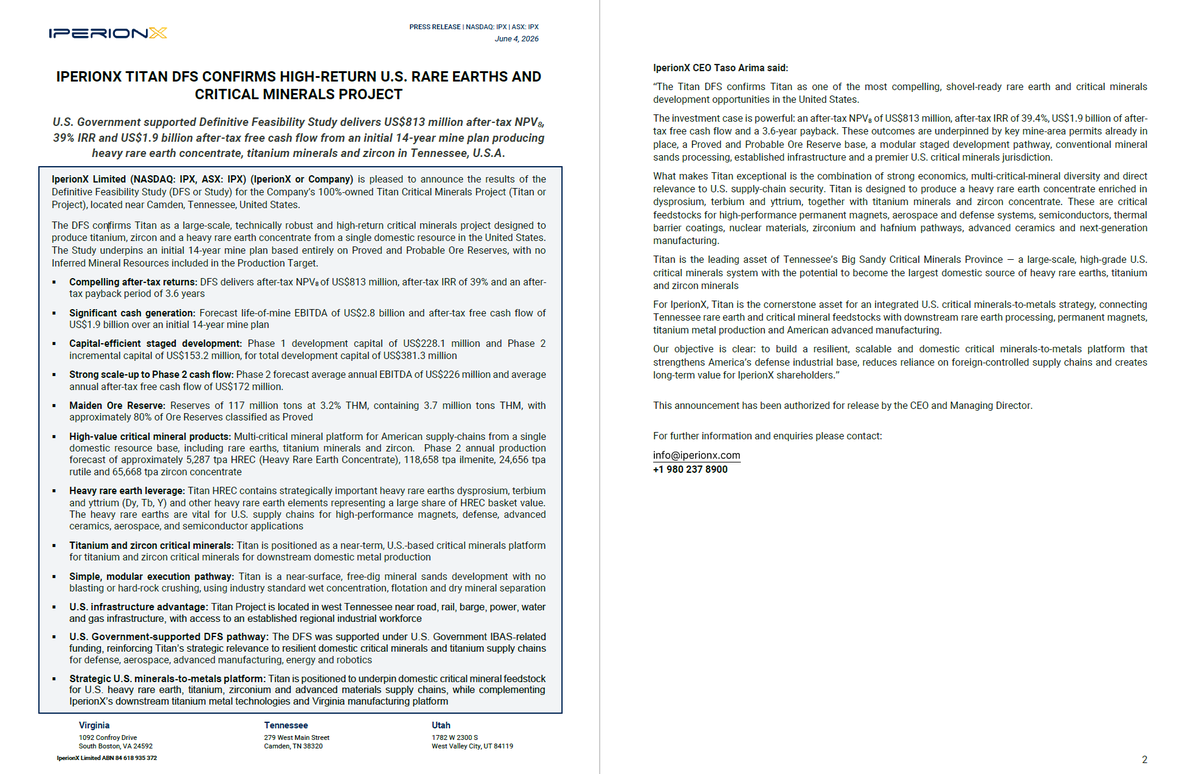
IperionX is pleased to release the Titan Project DFS, one of the most compelling, shovel-ready rare earth and critical minerals development opportunities in the United States.
- NPV8 of US$813 million (post-tax)
- IRR of 39.4% (post-tax)
- 3.6 year payback
The DFS outcomes are underpinned by key mine-area permits already in place, a Proved and Probable Ore Reserve base, a modular staged development pathway, conventional mineral sands processing, established infrastructure and a premier U.S. critical minerals jurisdiction.
The full DFS document can be found at: https://t.co/4ZihFomi40
$IPX $IPX.AX #titanium #rareearths
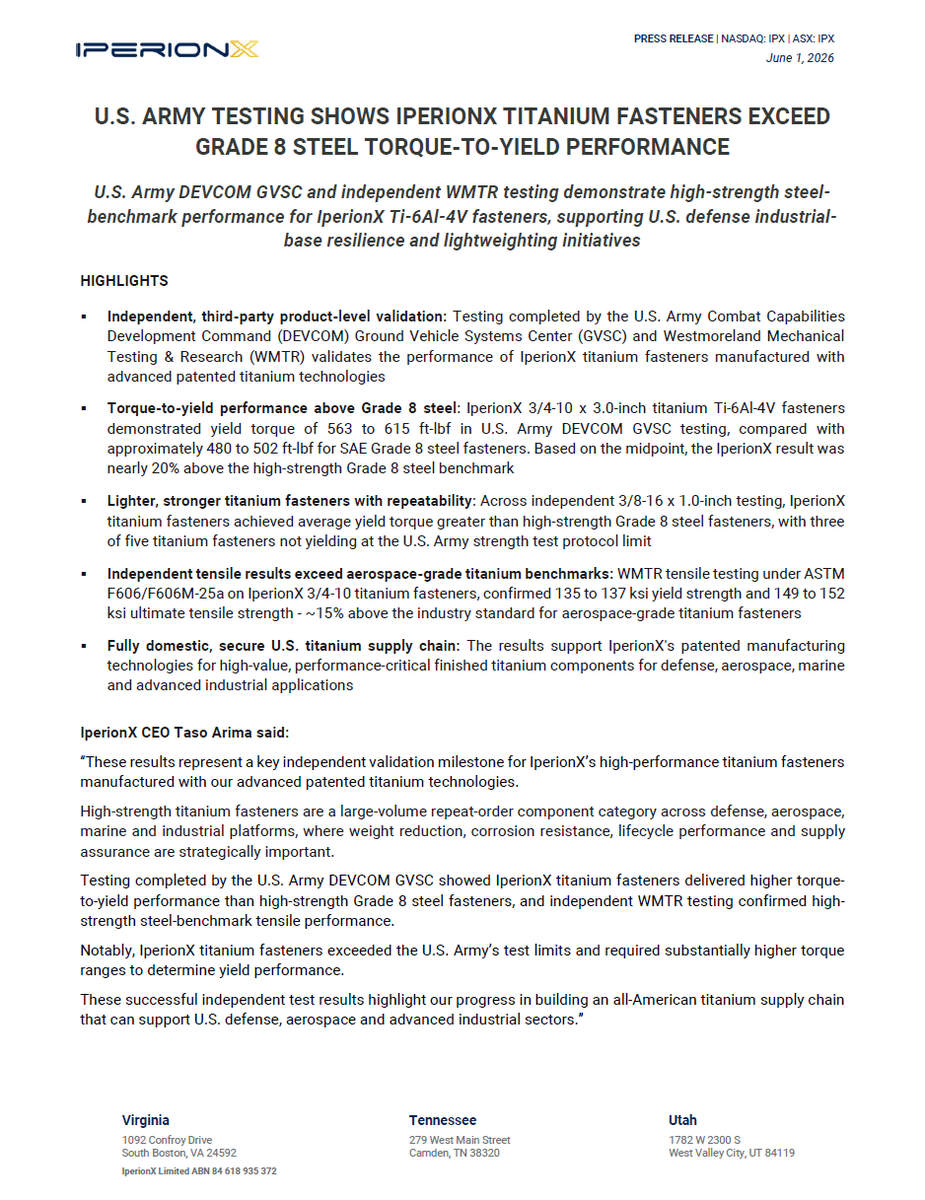
IperionX’s Titan Critical Minerals project is fully permitted and is one of the few domestic projects that can provide a vital, secure, and long-term U.S. critical mineral supply chain within the next few years. At full production, Titan has the potential to produce ~110,000 tons per annum of titanium minerals that would underpin a secure, uninterruptable U.S. titanium mineral to titanium metal supply chain. Further, Titan delivers the potential for more than a ~3x increase in U.S. production of DyTb to supply around 20% of current domestic demand for high-performance permanent magnets.
#IPX: Die "billigen Shortthesen" (u.a. von #Spruce Point Capital 🤥) wackeln nicht nur, sie stürzen hoffentlich auch bald ein 🔥 (#IperionX ⇒ DFS, Carver Pump, Lockheed Martin, Ford, GKN Aerospace, MRL, American Rheinmetall, Canyon Bicycles, Panerai etc.) ⇒ #IperionX🚀🚀🚀
We’ve made strong progress on Titan at Pace under the outstanding leadership of our Nation Builder and COO, Scott Sparks (pictured).
Really excited about the upcoming DFS, exciting times ahead! 🚀
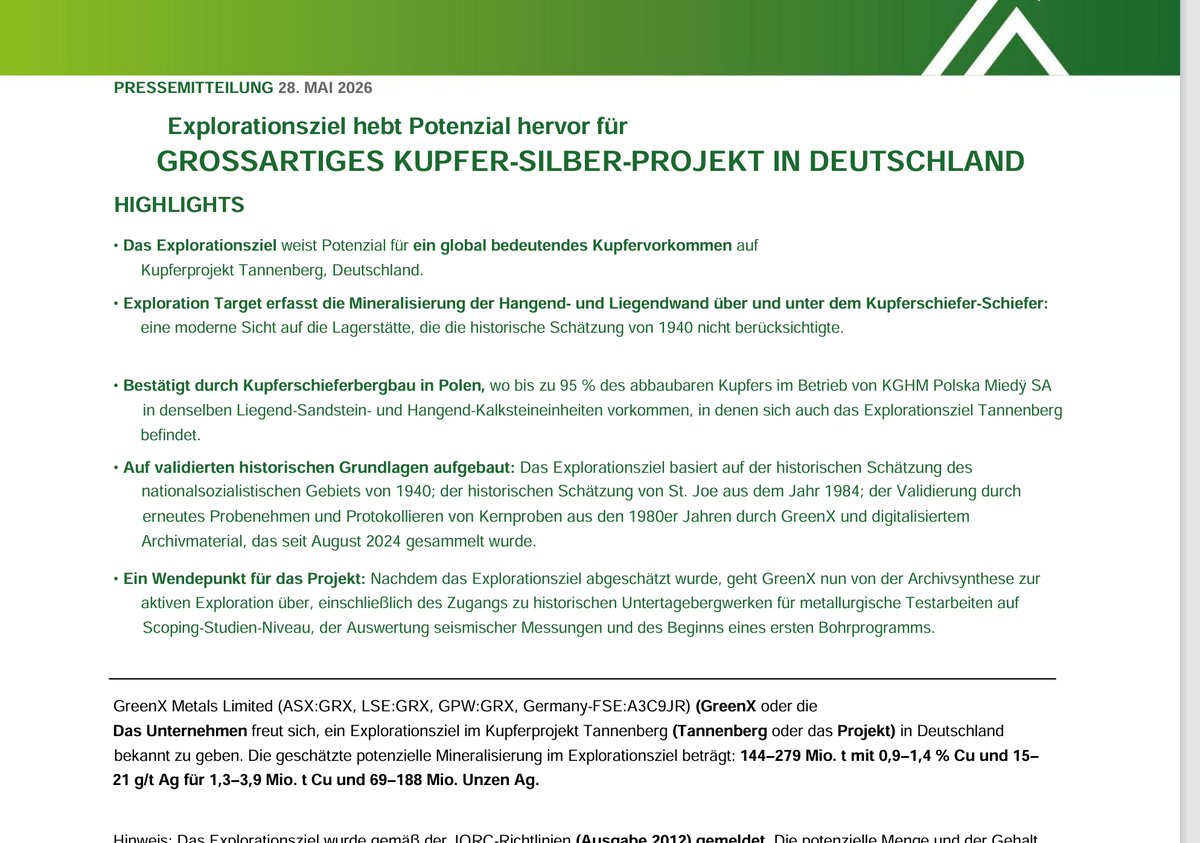
📢 #GreenX reports an Exploration Target at its Tannenberg Project, #Germany.
144–279Mt @ 0.9–1.4% Cu & 15–21g/t Ag for 1.3–3.9Mt contained Cu + 69–188Moz Ag.
👉Potential for a large-scale #copper and #silver deposit.
https://t.co/EjA49POG9J
#GRX#CRMA#CriticalMaterials
#GRX: #GreenX mit sehr starken Kupfer-Silber Ergebnissen/Schätzungen vom Tannenberg-Projekt hier bei uns in Deutschland. Und diese großen Resourcen gibt es aktuell "umsonst", weil der Kurs durch die mögliche Schiedssumme aus Polen abgesichert wird 🚀!!
https://t.co/taZyGCvOH0
IperionX's powder metallurgy scale-up continues at our Virginia Titanium Manufacturing Campus, including optimization of a 100-ton uniaxial press and commissioning of a cold isostatic press for larger-format titanium components. By using traditional powder metallurgy techniques, @iperionx can manufacture a broad range of products with far less waste than is generated by the incumbent supply chain, resulting in significantly lower cost. Any waste that is generated can be recycled back into the process via HAMR.
#IPX: Ob die Shorter bei #IperionX so langsan nervös werden?! Meiner Meinung nach sollten sie das, denn die anstehenden Nachrichten von #IPX könnten die billigen Shortthesen (von #Spruce Point) ins Wanken bringen (DFS, Skalierung, Carver Pump etc.) 🚀🚀🚀
3 | Enter IperionX: Inverting the Titanium Process
IperionX, a U.S.-based advanced materials company, believes that the fundamental problem with titanium isn’t the metal. It’s the production method.
Their solution is not to incrementally improve the Kroll process, but to replace it altogether. Their approach is built upon two proprietary technologies: HAMR and HSPT.
HAMR (Hydrogen-Assisted Metallothermic Reduction) is a breakthrough process that allows titanium metal to be produced directly from either scrap or mineral in a simple, efficient way. HAMR uses a hydrogen-enabled metallothermic reduction to create high-performance titanium powder - ready for downstream manufacturing. It bypasses the most expensive, energy-intensive parts of the legacy chain.
HSPT (Hydrogen Sintering and Phase Transformation) is a forging technology that transforms titanium into high-strength wrought parts with microstructures equal to or better than forged titanium. Combined with conventional powder metallurgy manufacturing, it eliminates the need for hot-working and dramatically reduces the amount of machining to produce a final titanium part.
The economic implications are dramatic. Instead of losing ~90% of the metal to swarf, IperionX can achieve greater than 90% yield. Instead of three vacuum arc melts and high-cost forging, parts can be pressed and sintered as near-net-shapes. A component that once cost $1,000 to make might soon cost $200. For small, complex parts, the savings could be even higher.
⸻
4 | Lower Costs, Higher Productivity, Higher Yields
IperionX doesn’t just reduce cost. It reduces waste, carbon and shortens the supply chain.
HAMR can utilise both titanium scrap and upgrade titanium minerals, and it eliminates many energy-intensive stages inherent in the Kroll process, reducing total energy input by more than 60% compared to the legacy process. It also enables a circular, closed-loop titanium economy: aerospace scrap, 3D printing rejects, and consumer product returns can all be reprocessed into new, high-performance titanium.
The company’s Virginia Titanium Campus now operates a commercial-scale HAMR furnace and has produced full end-to-end demonstration parts for customers in the defense, mobility, and electronics sectors. For scale and secuity, IperionX has a fully permitted critical mineral project in Tennessee - the largest in the U.S. - to supply titanium mineral feedstock that will underpin decades of titanium metal production.
Critically, all of this is in the United States. At a time when more than 70% of global titanium sponge comes from China and Russia, and when defense supply chains are under increased pressure, a domestic, high-efficiency alternative is matter of national security.
⸻
5 | What Happens When Titanium Is Lower Cost?
As IperionX scales, titanium will follow the same arc as aluminum did in the 20th century - from laboratory to mass engineering staple. When costs fall by 75% and yield improves tenfold, the design calculus will change and product substitution will occur on an accelerating rate.
You could see titanium in crash-resistant EV battery enclosures. In high-performance corrosion-proof humanoid robotics. In thin, nearly indestructible laptop casings. In low-cost, 3D-printed implants for knees, hips, and medical applications. In defense systems that demand high strengths at low weight, and zero-reliance on foreign materials.
It is not just that titanium becomes cheaper. It becomes the default high-performance solution.
⸻
6 | The Titanium ‘Bessemer Moment’
In steel, it was the Bessemer converter that changed everything. In aluminum, it was the Hall-Héroult breakthrough. For titanium, the arrival of HAMR and HSPT is revolutionary.
These technologies don’t make titanium better. Titanium was always exceptional. What they do is remove the friction between the metal’s potential and the world’s ability to use it.
IperionX
$IPX
The Future of Titanium
⸻
1 | A Metal Still Trapped in a 1940s Flow-Sheet
Titanium is one of the most capable metals in modern engineering. Pound for pound, it’s stronger than steel and aluminum, yet resistant to corrosion in ways that make stainless steel look vulnerable. It’s biocompatible, immune to saltwater, and only melts at 1,670°C. Yet despite these extraordinary properties, titanium remains a niche material - expensive, difficult to process, and often restricted to high-performance aerospace, military, and medical applications.
The reason isn’t the metal. It’s the high-cost and low yield manufacturing process.
Since the 1940s, nearly all commercial titanium has been produced using the Kroll process - a multi-step, high-temperature, high-cost method that feels more like artisanal alchemy than modern metallurgy. It starts with titanium ore, usually rutile, which is chlorinated at high temperatures to form titanium tetrachloride (TiCl4). This is then reduced with molten magnesium to produce titanium sponge. The titanium sponge is crushed, pressed, and melted - not once, but often three times - under vacuum to produce large titanium ingots. Only then does the journey begin to forge, roll, machine and finish the final titanium part.
Each step requires its own high-cost equipment, large energy inputs, and quality controls. The supply chain is not just complex and long - it’s fragile. And by the time a finished titanium part emerges, most of the original titanium is gone through yield losses. Boeing’s internal data, supported by Oak Ridge National Laboratory, shows that on a modern airframe like the 787, up to 90% of the titanium purchased is lost as machining swarf. Half the cost of the final titanium part, in many cases, is not the metal itself but what it took to manufacture it into a final part.
Even if titanium sponge were free, titanium parts would still be expensive.
⸻
2 | A Process Designed for Steel, Ill-suited for Titanium
The current titanium production chain didn’t evolve in a vacuum. It borrowed heavily from the mid-century playbook of the steel industry. The rolling mills, forging protocols, and even machining standards were adapted from carbon and stainless steel production. But titanium isn’t steel. It’s much harder to deform, much more sensitive to oxygen contamination, and responds poorly to the multiple reheating cycles typical in hot-working lines.
Steel can be forged in massive passes with continuous throughput. Titanium must be shaped slowly, reheated often, and treated with care. It doesn’t like to flow. That resistance to movement - so useful in its final form - makes it a high-cost nightmare in manufacture. The Kroll process’s affinity to oxygen also makes it very difficult to recycle titanium scrap.
The net result is a production system that is highly capital intensive, low-yield yield, and difficult to scale. One that has limited the growth in titanium market.
⸻
3 | Enter IperionX: Inverting the Titanium Process
IperionX, a U.S.-based advanced materials company, believes that the fundamental problem with titanium isn’t the metal. It’s the production method.
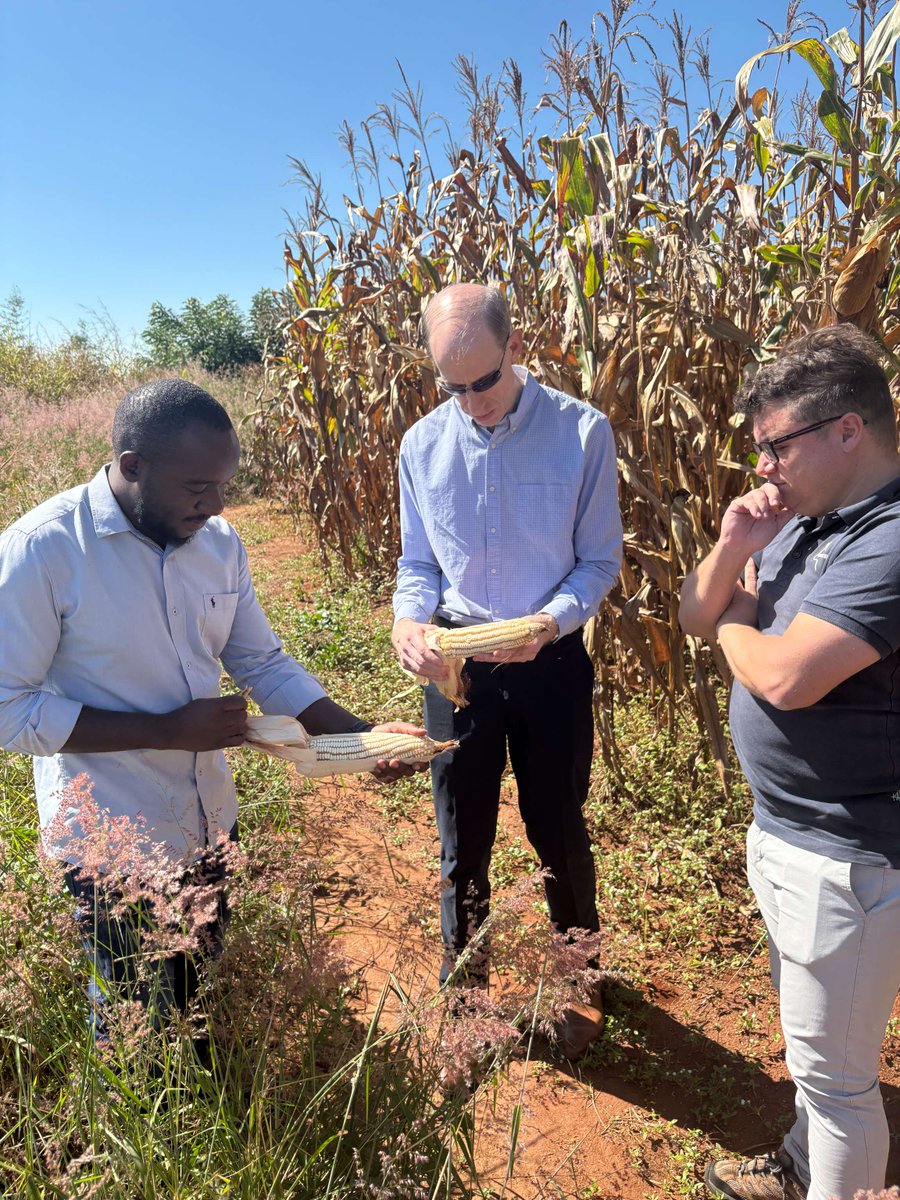
Chargé d’Affaires Fischer visited Sovereign Metals’ Kasiya mining project to see firsthand how it is already supporting farmers in the area. 🌱
Through agricultural extension support, maize yields are increasing fivefold — from 1 ton to over 5 tons per hectare. #USAinMalawi
Simple powder metallurgy processes using the uniaxial press and our HSPT technology enables the rapid production of low-cost, high-performance titanium parts. @iperionx's uniaxial press can run at up to 12 cycles per minute, representing the potential to manufacture over 4.5 million of washers - pressed into green parts and sintered to a final product - each year.
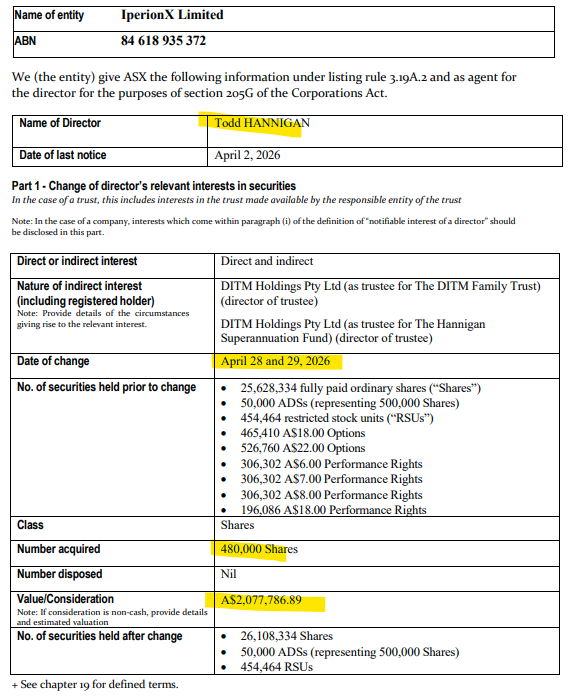
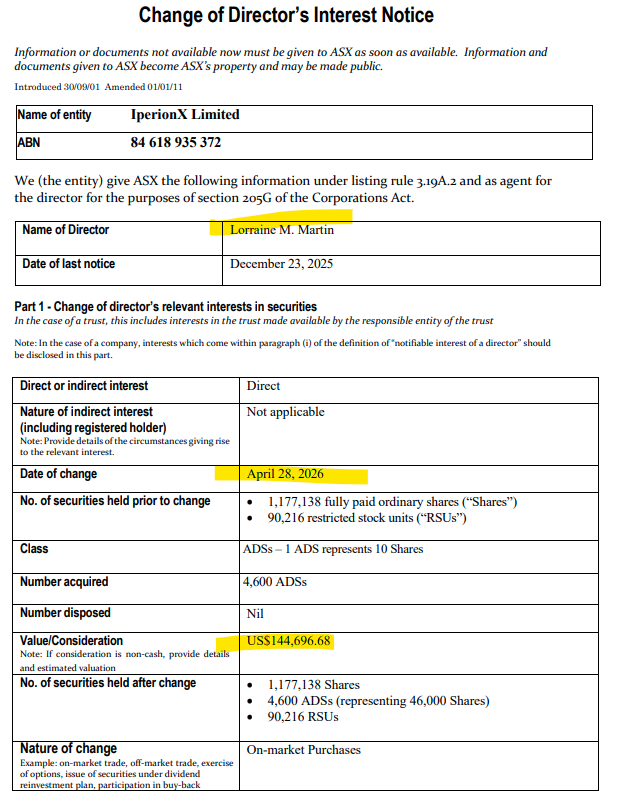
They've done it again! Three IperionX insiders have struck again, buying more shares: Lorraine M. Martin purchased shares worth $144,000, CEO Taso Amira bought shares worth nearly half a million AUD, and Chairman Todd Hannigan bought shares for well over 2 million AUD. All purchases were made on the open market. This is the second such buying spree by insiders in just a few weeks! $IPX $IPX.ax #IperionX








![MMichalek91's tweet photo. Podczas kiedy #GREENX #GRX $GRX przygotowywało się do zakomunikowania rynkowi sprecyzowanego celu eksploracyjnego w ramach swojego Projektu #Tannenberg, ja przez ostatnie dwa tygodnie szukałem alternatywnych źródeł danych geologicznych, które mogłyby zostać wykorzystane do lepszego rozeznania tamtejszej geologii.
Oczywiście sprecyzowany cel eksploracyjny w ramach "południowego zagłębia" jest priorytetowy i to tam należy wykonać pierwsze odwierty bliźniacze względem przedwojennych, by zdefiniować zasoby w JORC. W następnej kolejności będzie można zająć się "północnym zagłębiem", jak pisałem we wcześniejszym komentarzu. To jest rdzeń naszego projektu, ale nie możemy zapominać, że obszar koncesyjny jest znacznie większy i obejmuje 1900km2. Tam też może drzemać potencjał, który przy obecnej siatce wierceń poza "zagłębiami" jest niedostatecznie rozeznany. Spółka komunikowała nam o dysponowaniu danymi z przedwojennych odwiertów oraz tych z lat 80, ale być może to nie wszystko. Przeglądając ogólnodostępną bazę danych geologicznych dla Hesji (https://t.co/V5ASq8ARRF) oraz bazę ogólnoniemiecką (https://t.co/KZjlexyiZv) udało mi się znaleźć kilka ciekawostek. Wszystko, co moim zdaniem może okazać się wartościowe i przydatne, dorysowałem na mapie projektu.
Przede wszystkim cenne mogą być odwierty wykonane w celu rozeznania geologicznego na potrzeby liniowych projektów infrastrukturalnych. Pisałem Wam już o tunelach i wiaduktach - jest co najmniej kilka miejsc, gdzie odwierty te sięgnęły interesujących nas formacji geologicznych, które mogą zawierać mineralizację miedzi. Oprócz tego na całym swoim liniowym przebiegu mogą nam one dostarczyć informacji o uskokach i nieciągłościach, nawet jeśli odwierty nie sięgały dostatecznie głęboko dla naszych potrzeb. Te liniowe inwestycje zaznaczyłem żółtymi liniami.
W ramach obszaru koncesji udało mi się znaleźć kilka dodatkowych otworów, które przewierciły cały cechsztyn, sięgając do niżej zalegających warstw tj. głównie Rotliegend (czerwony spągowiec). Zaznaczyłem je czerwonymi kropkami - te otwory dla których (podobno) zachowały się rdzenie mają dodatkowo czarną kropkę w środku (co nie znaczy, że te nie mające dodatkowej czarnej kropki nie mają dostępnych rdzeni - baza po prostu ich nie widzi). Szczególnie wartościowe mogą być te punkty, które oznaczyłem numerami 1, 2, 3, 4, 9, 14, 16, 17 i 37. Wiele innych znajduje się też poza obszarami koncesji, zwłaszcza na południowym-wschodzie, gdzie operuje kopalnia soli K+S (w swojej analizie wspominałem, że może być to wartościowe źródło informacji, jeśli zgodzą się nam pomóc).
Kolorem turkusowym zaznaczyłem otwory, które nawierciły cechsztyn, ale nie przewierciły się do niższych warstw. Dane z tych otworów mogą nie zawierać miedzi, której spodziewać się powinniśmy tuż nad Rotliegend, do którego nie dotarły. Mogą one jednak być cenne dla rozeznania ogólnej budowy geologicznej obszaru. Turkusowym kwadratem "A" zaznaczyłem natomiast obszar, gdzie takich otworów nawiercających cechsztyn jest całkiem sporo. Nie zaznaczałem więc każdego z osobna, bo zaciemniłby mapę - po lewej jest wycinek w granicach "A". Była tam nawet kopalnia miedzi i barytu Gustav (obecnie obiekt turystyczny). Myślę, że warto poświęcić temu fragmentowi koncesji więcej uwagi w późniejszym czasie.
Nasz projekt zlokalizowany jest przy granicy Hesji. Na wschód mamy Turyngię, której dane geologiczne zebrane są w ogólnoniemieckiej bazie danych. Ta baza ma pewną przewagę nad bazą heską, bowiem pokazuje przekroje całych odwiertów (przynajmniej niektórych). Udało mi się znaleźć kilka ciekawych odwiertów poza granicami nie tylko projektu ale i Hesji, które nawiercają Kupferschiefer. Na północnym wschodzie jest ich kilka, bowiem prowadzono tam w latach 60 kompanię poszukiwawczą ropy i gazu - tam łupki miedzionośne znajdują się głębiej niż u nas, bo są to wielkości rzędu 800-1000 metrów poniżej terenu. Nadal jednak płycej, niż fedruje w Polsce KGHM, o wiele płycej niż zamierza fedrować w Polsce Lumina na złożu Nowa Sól. Warto sprawdzić co tam jest, jeśli zachowały się rdzenie, żeby nikt nam nie zaklepał sąsiedniego obszaru, jak Prairie kiedyś zaklepało K-6-7 Bogdance. Tak samo wiele różowych kwadratów widzicie na południowym-wschodzie, poza obszarem naszej koncesji - to są otwory, które nawierciły Kupferschiefer poniżej pokładów soli kopalni K+S. Nad nimi funkcjonuje kopalnia soli, która ma fedrować do 2060 roku minimum, więc ewentualna miedź pod nią, to melodia przyszłości.
Mam nadzieję, że Spółka z czasem pozyska dodatkowe informacje geologiczne, które równie niskim kosztem jak dotychczas znacznie poszerzą wiedzę o geologii Tannenberg. Oczywiście trzeba mieć świadomość, że zaznaczone przeze mnie otwory i ewentualne rdzenie znajdują się poza określonym dopiero co celem eksploracyjnym - nie przyczynią się do doprecyzowania zasobów w przedziale i obszarze celu. Mogą jednak dać odpowiedź na pytanie "co potem".
Poniżej objaśnienia do numeracji odwiertów:
Otwory nawiercające warstwy poniżej cechsztynu - czerwone kropki (rzędna terenu, głębokość) [nawiercone formacje geologiczne]:
1. 0146 Brg. Gershausen (300.20/421.70) [SZRD]
2. 0466 Bohrung Kleba (259.00/558.00) [SZRD]
3. 0001 Mühlbach I (370.00/259.90) [SZD]
4. 0034 Untergeis 1 Erdöl-Aufschlußbohrung (245.00/500.80]
5. 0360 Geisbachtal Bad Hersfeld (258.30/535.90) [SZD
6. 0063 Buchenau 1 Tiefbohrung (K+S 271) (388.63/891.50 [SZR]
7. 0060 Reckrod 1, Kreis Hünfeld (346.00/1136.50) [SZR]
8. 0070 TB Sieglos 1 (209.57/531.90) [QSZR]
9. 0077 Weisenborn 2 bei Friedewald (387.69/1750.40) [ASZRC]
10. 0043 Bg. Ufhausen1 (363.80/1202.90) [MSZR]
11. 0070 Oberlengsfeld Kreis Hersfeld (345.00/1140.60) [SZR]
12. 0017 Mansbach 2 (413.85/1241.70) [?MSZR]
13. 0207 BK 41.1/82 Baugrund DB-NBS H-W PA14 (176.76/292.00) [QZD]
14. 0110 HKZ 1001 Rotenburg (245.00/1702.00) [SZRD]
15. 0299 CT-NV 23 A Cornberger Tunnel (370.06/197.50) [QSZR]
16. 0058 B 1/65 Baugrund Cornberg (302.00/151.60) [QZR]
17. 0334 Bg."Küchen" (365.00/533.00) [QZD]
18. 0009 Eschwege 4 (237.20/290.70) [QSZX]
19. 0001 I/1895 Großer Kurfürst (195.00/358.00) [SZ?]
20. Holstein Tunnel
21. 0042 Lehnberg (376.00/725.80) [SZR?]
22. 0059 Kleinensee 3 (303.45/910.00) [SZR]
23. 0071 Wildeck (276.00/518.00) [QSZR?]
24. 0079 Heringen/Werra-Kaliwerk Wintershal (216.06/1016.00) [QSZRC]
25. 0015 Wintershall 7 bei Heringen (226.74/597.00) [QSZR]
26. 0050 Hoppberg (K+S 199) (324.70/728.20) [SZR]
27. 0054 Suhlrück (K+S 234) (320.50/629.40) [SZR]
28. 0039 Bohrung Heiligenroda (310.00/159.40) [ZR?]
29. 0055 Kieselbach (K+S 232) (274.37/530.50) [SZR]
30. 0019 B 3 Grubenbohrung Alexandershall 3 (-170.00/156.81) [ZR]
31. 0021 B 5 Grubenbohrung Alexandershall 5 (-170.00/156.81) [ZR]
32. 0020 B 4 Grubenbohrung Alexandershall 4 (-170.00/195.71) [ZR]
33. 0013 Gerstungen (210.00/642.10) [QSZR]
34. 0014 Berka I = Herda Hausbreitenbach (215.00/312.73) [QSZR]
Otwory nawiercające tylko cechsztyn - turkusowe kropki (rzędna terenu, głębokość) [nawiercone formacje geologiczne]:
1. 0020 Vitalis-Brunnen, Bad Hersfeld (202.00/437.00) [QT?SZ]
2. 0001 Lullusbrunnen, Wasser, Bad Hersfeld (202.00/420.00) [QTSZ]
3. 0071 TB Lullus, Wasser, Bad Hersfeld (200.00/412.00) [AQTSZ]
4. 0089 Bad Hersfeld Sorga-Petersberg (235.00/458.00) [SZ]
5. 0721 K+S (845) Wippershain 1 (384.91/698.80) [QSZ]
6. 0021 K+S Fischbach 1 (271.80/935.95) [SZ]
7. 0003 Gustav I Rote-Berg (272.00/606.00) [?SZ]
8. 0013 Dinkelrode I (330.00/680.00) [?SZ]
9. 0022 K+S Wüstfeld 1 (352.80/865.20) [SZ]
10. 0012 Schenksolz I (270.00/847.30) [?SZ]
11. 0076 Friedewald 2 (434.21/868.60) [SZ]
12. 0026 Friedewald 1 (339.00/678.30) [SZ]
13. 0047 Eichhorst I/64 Laugenversenkung (325.00/450.60) [SZ]
14. 0060 Eichhorst 2 (387.00/531.00) [SZ]
15. 0108 Eichhorst 2A (396.83/508.00) [SZ]
16. 0016 Mansfeld Nr. 75 Almushof-Obersuhl (263.00/412.36) [QSZ]
17. 0025 Obersuhl 1942 (215.48/300) [QSZ]
18. 0057 Obersuhl 2 (208.73/327.00) [QSZ]
19. 0026 Untersuhl (210.24/334.90) [QSZ]
20. 0087 Lauchröden 3/99 (217.19/243.20) [QSZ]
21. 0064 B 787 Lauchröden 1 (211.14/99.00) [QSZ]
22. 0005 Untersuchungsbohrung 1/65, Wommen (230.00/66.00) [QZ]
25. Holstein Tunnel
26. Holstein Tunnel
27. Holstein Tunnel
28. 0243 B Gradierwerk Bad Sooden (148.31/280.40) [QSZ]
29. 0103 VB Rodenbergklinik (265.89/104.00) [SZ]
Otwory z bazy Turyngii - różowe kwadraty - (rzędna terenu, głębokość) [głębokość nawiercenia Kupferschiefer lub Rotliegend]:
1. TH_614481 E Küllstedt 3/1966 (333.00/760.80) [754.32]
2. TH_108105 E Hainich-Heyerode 1/1962 (447.80/1075.50) [1059.60]
3. TH_617392 E Hainich-Heyerode 102/1963 (368.70/892.50) [888.40]
4. TH_107644 E Hainich-Heyerode 101/1962 (346.20/842.75) [835.20]
5. TH_617998 E Hainich-Hallungen 1/1962 (386.20/1093.20) [1082.30]
6. TH_617997 E Hainich-Nazza 101/1963 (346.20/1111.90) [1090.30]
7. TH_618002 E Hainich Hallungen 101/1963 (265.90/853.70) [820.00]
8. TH_106935 E Hainich-Mihla 1/1961 (379.90/1251.20) [1032.60]
9. TH_106256 E Hainich-Berka 103/1965 (419.20/1147.80) [1040.20]
10. TH_620016 E Creuzburg 1/1966 (377.0/1090.20) [Rotliegend 1074.95]
11. TH_106004 E Hainich-Berka 101/1963 (328.70/1225.40) [1214.70]
12. TH_621262 E Hainich-Berka 102/1964 (351.02/1188.00) [1158.29]
13. TH_104653 Hy Hütschhof 1/1936 (365.00/100.80) [67.30]
14. TH_622738 Kal Oberellen 1/1906 (249.09/542.00) [256.00 - Rotliegend]
15. TH_118793 Dp Herda 1/1980 (288.06/552.40) [454.05]
16. TH_103989 Kal Dankmarshausen 1/1960 [530.75]
17. TH_624655 Kal Abteroda 1/1960 (269.80/558.30] [556.90]
18. TH_625753 Kal Frauensee 3/1960 (293.20/568.50) [520.70]
19. TH_625750 Kal Frauensee 2/1960 (295.40/510.60) [502.03]
20. TH_102656 Dp Heiligenroda 5/1942 (324.70/728.25) [725.42]
21. TH_626819 COO Martinroda 1/1988 (373.80/923.80) [880.75]](https://pbs.twimg.com/media/HKHIIxPWgAE2YB6.jpg)