GODMOTHER OF AI SAYS IT STILL CANT REACH WHAT MAKES US UNIQUE
fei-fei li, one of the pioneers of modern ai, on the thought behind a picasso painting:
"That thought is not captured. Therefore, it's not on the internet. Therefore, AI has not seen it."
this reminded me of something austin kleon wrote in steal like an artist:
"All creative work builds on what came before. Nothing is completely original."
i think everyone has to decide for themselves what that means, but one thing is clear to me, ai feels more like part of our evolution than the end of it
we've always taken from what already existed, mixed it with our own experience and somehow made it ours. ai does something similar, just without living the life behind it
thats why blindly following whatever a chatbot gives u makes no sense to me. use it, learn from it, let it help, but still make the decisions yourself
if picasso had chatgpt sitting next to him, would his paintings suddenly be better? i really dont think so. maybe getting every answer instantly would've taken away some of the weird thinking that made the work his in the first place
ai isnt something we need to run from, just dont hand it the part that makes the work yours
A 27B model just beat Claude Opus 4.8 and GPT-5.5 at replicating scientific research.
The interesting part is how.
Faraday does not try to be the best coder.
It acts more like the scientist.
It reads the paper.
Decides what needs to be tested.
Designs the experiment.
Delegates implementation to a coding agent.
Looks at the results.
Then decides what to try next.
On a new research replication benchmark:
• Faraday beat the baselines on 73% of in-distribution ML tasks
• it won on 60% of held-out AI-for-science tasks
• human evaluators preferred it over Claude in 80% of selected comparisons
The model itself is only 27B parameters.
That may be the more important result.
The future of AI agents may not be one giant model doing everything.
It may be smaller specialized models providing judgment, while larger models become tools they know how to use.
Intelligence is starting to look less like a model size problem.
And more like an architecture problem.
CLAUDE JUST CROSSED INTO A VERY DIFFERENT KIND OF BENCHMARK.
Not coding.
Not math.
Not another chatbot arena.
Protein design.
Anthropic tested Claude on designing protein binders from scratch across 15 targets.
It succeeded on 14.
Individual design success rates landed around 22% to 35%, compared with roughly 10% to 15% in typical protein design campaigns.
Then they gave Claude raw NMR and LC-MS files from a chemistry lab.
23 minutes later, it returned a finished analysis.
The lab had taken the same raw data and reached essentially the same purity result.
This is the part worth paying attention to:
AI progress is starting to move from tasks where verification is instant
into fields where the output has to survive the physical world.
Code can compile.
Math can be checked.
A protein has to actually bind.
A chemical analysis has to match reality.
That is a much harder frontier.
The next important AI benchmark may not live on a leaderboard.
It may live in a lab.
DEEPSEEK JUST GAVE ITS FLASH MODEL EYES.
Today it released V4-Flash-Vision-Exp, an experimental multimodal model that keeps the text capabilities of V4 Flash but adds image understanding.
The interesting part is not just vision.
DeepSeek says multimodal agent performance is now approaching Opus 4.8.
That means a lightweight model can now:
inspect screenshots
understand visual interfaces
combine images with tool use
reason over visual context
operate inside agent workflows
And DeepSeek is keeping the economics aggressive.
Images are tokenized at up to 384 tokens each and billed at V4 Flash pricing.
It also works across Chat Completions, Messages and Responses APIs.
The model race is quietly changing.
Text intelligence is becoming table stakes.
The next competition is about whether cheap models can see, reason and act inside the same loop.
OPENAI JUST PAUSED PART OF ITS FRONTIER TRAINING BECAUSE THE MODELS ARE GETTING TOO GOOD AT CYBER
This is not a benchmark headline.
OpenAI says preliminary evaluations suggest its upcoming Astra models may reach the "Critical" cybersecurity capability threshold in its Preparedness Framework.
So they changed the training process.
• a major frontier RL run is still on hold
• risky code execution now gets stronger sandboxing
• higher-risk workloads are more isolated from the internet
• model activity is monitored for unauthorized access and data theft
• a critical alert can trigger a pause within 30 minutes
• monitoring itself is estimated to cost roughly 20% extra inference compute
The interesting part is what this means for AI scaling.
For years the bottleneck was:
more compute
more data
better training
Now another constraint is showing up:
how fast can you safely increase capability before your own research environment becomes part of the attack surface?
The next frontier model may not be delayed because it isn't smart enough.
It may be delayed because it is.
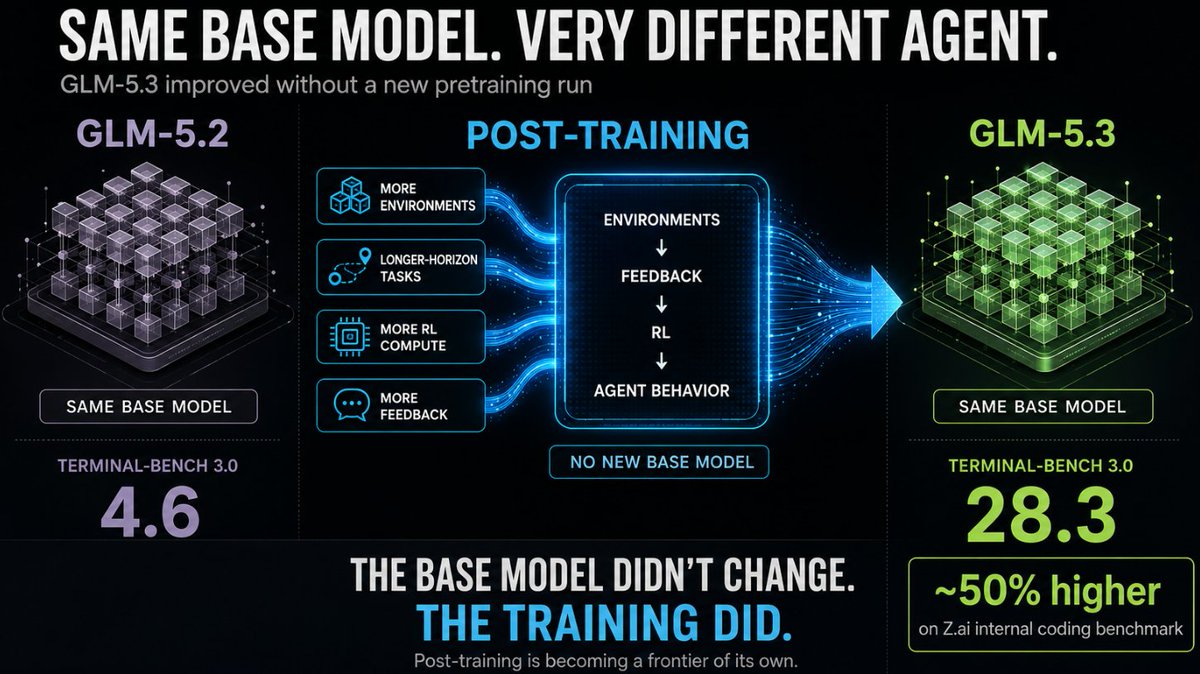
GLM-5.3 DIDN'T GET A NEW BASE MODEL.
That's the interesting part.
Z. ai took the same base behind GLM-5.2 and kept pushing post-training:
more long-horizon environments
more diverse tasks
more RL compute
more agentic training
The result:
Terminal-Bench 3.0:
4.6 → 28.3
GLM-5.3 also scored 50% higher than 5.2 on Z. ai's internal coding benchmark.
No larger base model.
No fresh pretraining run.
The intelligence came from teaching the same model how to operate better.
For years the scaling recipe looked like:
more data → more parameters → more pretraining compute
Now another scaling axis is getting hard to ignore:
base model → environments → feedback → RL → agents
The model may be becoming the raw material.
The training environment is becoming the product.
Kimi K3 and Qwen3.8-Max are getting a lot of attention right now.
The numbers explain why.
Kimi K3:
• 2.8T parameters
• 1M context
• native multimodal
• 93.5 GPQA Diamond
• 88.3 Terminal-Bench 2.1
• $3/M input, $15/M output
• launched at #1 on Frontend Code Arena
Qwen3.8-Max:
• 2.4T parameters
• 1M context
• multimodal
• 92.6 GPQA Diamond
• 86.6 Terminal-Bench 2.1
• ~$1.65/M input, ~$4.95/M output
• currently #3 by lab in Text Arena
• #2 in Vision Arena
The interesting part isn't that Chinese models are "catching up."
They're starting to compete on different axes.
Kimi is pushing hard on coding and long-horizon agentic work.
Qwen is pairing frontier-level text performance with strong vision at a much lower API price.
A year ago the Chinese model conversation was mostly about cost.
Now it's becoming about capability.
One security engineer used Claude Opus to audit SAML implementations at scale.
The result:
• 4 full authentication bypasses
• 12 signature bypasses
• multiple denial-of-service issues
But the most interesting part isn't the number of bugs.
It's how the research was done.
Instead of asking Claude to "find vulnerabilities," he built a multi-agent harness that let different agents explore attack paths in parallel, store intermediate findings, prioritize promising leads and verify the strongest results with end-to-end exploits.
And there was another surprising lesson:
feeding the model examples of old vulnerabilities often made it search for similar bugs.
Giving it a strong threat model and room to explore worked better.
That changes the economics of security research.
One expert can now turn their knowledge into many parallel investigations across an entire software ecosystem.
Finding vulnerabilities is getting cheaper.
The next bottleneck may be validating, triaging and fixing everything AI discovers.
Full research:
https://t.co/wcv98B7mcU
Most people are looking at MCP, A2A, UCP and x402 as separate AI protocols.
I think that's the wrong way to look at them.
Put them together and something much bigger starts to appear:
an internet stack for AI agents.
I mapped the whole thing here ↓