#ApplyNow
🗓 Scuola Sant'Anna, @scuolanormale e @IMTLucca bandiscono 3 borse di studio per l'attività di ricerca post-laurea della durata di 24 mesi nell’ambito del Progetto VISION @regionetoscana@giovanisi
📆 Deadline: 1 dicembre 2024.
➡️ Info: https://t.co/ECgoW7xfl6
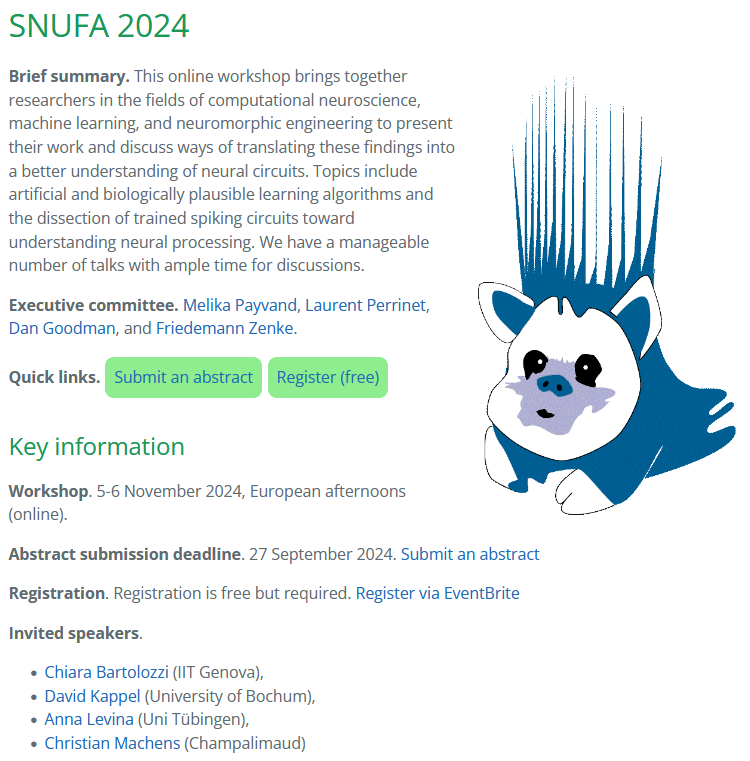
The #SNUFA24 spiking neural network online workshop is taking place tomorrow and Wednesday afternoon (EU time zone). 686/1000 spaces are taken, so we've still got space for more to join (free).
#SNUFA24 starting at 14:00 CET (in just over 2 hours). Say no to doomscrolling, and yes to a free online workshop on spiking neural networks.
https://t.co/9aOMHNCLkU
16th #DSABNS2025 Conference on #DynamicalSystems applied on #Biology and #NaturalSciences at #Naples#Italy. Deadline for submissions of abstracts: 15 Nov. 2024. The conference will feature public lectures and plenary talks by world-leaders! Dont miss it! https://t.co/eArMTAxEjn
.
23 authors have published more than one article every day in 2024.
We have just clicked over to 01 Nov 2024. That is, we have done 10 months of this year, which is 305 days.
At various points during the year, we have looked at who has published a lot of papers, or "hyper productive authors" as we have called them.
1️⃣ The left hand side shows all the authors that have published more than 305 articles this year. That is they have published more than one article a day throughout 2024.
The data comes from @Scopus and it includes all articles types. The #Scopus search term is 'PUBYEAR = 2024' and then we just took all the authors that had more than 305 articles.
2️⃣ When we have posted these type of posts in the past, we were criticised as we included all article types. We held the view that it's indexed in Scopus, so we included it. But we do recognise that some of the articles were "Letters" (for example) which may not be recognised as a "proper" article. We know, for example, that when QS Ranking extracts articles from Scopus, it disregards letters.
So, we carried out another search that only looked at articles that were of type 'article'. The Scopus search term is 'PUBYEAR = 2024 AND ( LIMIT-TO ( DOCTYPE , "ar" ) )'
The table on the right hand side shows this data. We have listed the same number of authors as shown in the left hand table.
Nobody has published an 'article' every day in 2024, but not far from it. The top listed author (Tanihuchi) has published 269 "proper" articles. That is, 0.88 articles each day.
Any thoughts, views, comments?
@neuralreckoning Our paper "Discrete synaptic events induce global oscillations in balanced neural networks" with @divolo_matteo & DS Goldobin will appear soon in @PhysRevLett - come to #SNUFA24 poster session 5/11 at 17.30 to see its presentation
https://t.co/XvVerX0ipv
This award is very hard to respond to. I have received many hundred congratulatory notes, from former students, post-docs, Princeton University juniors and seniors, funding agencies and foundations, authors, signature collectors, amateurs, elementary school neural network followers, and on and on. An astonishing fraction of them has found their way into useful and interesting Neural Network careers by a casual interaction in class, at a meeting, hearing what I had to say about their ideas, learning from thinking about how I worked with a class, or from being my teaching assistants... There are some whom I remember well, and others for whom my reaction is “are they certain that our interaction sparked a single usable thought?” Yet they go on and comment “you changed my life” and follow on to explain that they heard me lecture when they were 15, and have been a member of the Neural Network brigade of the research army ever afterward.
I cannot make detailed comments to most of my letter writers. In sum I can only say that I tremendously enjoyed the interactions that the Neural Network community provided me with; that the mutual interactions have given me much pleasure over the years; that the community interested both in brain and in artificial brain has proved a good way for science to develop even if institutions have not always been sympathetic. Often these institutions found the enthusiasm infectious, after a period of doubt. In short, we often have won--. No, perhaps all we know is that we have not yet lost. I still believe that finding mind lodged in biological matter is the most profound question that physics can pose. And that the breadth of physics is a good base from which to begin.
SPIKING NEURAL NETWORKS!
If you love them, join us at SNUFA24. Free, online workshop, Nov 5-6 (2-6pm CET). Usually ~700 participants.
Invited speakers: Chiara Bartolozzi, David Kappel, Anna Levina, Christian Machens
Posters + 8 contributed talks selected by participant vote.
The #SNUFA24 final program is out and the event is next Tue-Wed! If you love spiking neural networks, click on the link below to check it out and register (free).
https://t.co/U7TGfWN815
Please join us at #SNUFA 2024, where we will present 2 posters on 5th November at 17.30 :
A new nonlinear mechanism to dynamically balance excitation and inhibition
Collective oscillations in balanced neural networks induced by discrete synaptic events
https://t.co/HE01iw58nm
Poster at #SNUF24 on A new nonlinear mechanism to dynamically balance excitation and inhibition with A. Politi on 5/11 at 17.30
https://t.co/HE01iw58nm
#SNUFA24 poster on with D. S. Goldobin
and @divolo_matteo on Collective oscillations in balanced neural networks induced by discrete synaptic events 5/11 at 17.30 join us
https://t.co/HE01iw58nm
L’assalto alle spiagge libere del Governo Meloni:
solo il 15% contro l’80% della Francia.
Stop privatizzazione, Si Mare Libero!
Firma la nostra proposta https://t.co/hIhrBlid6T
@days_europe Bremen -- Join tomorrow at 11 the last session Nonequilibrium phase transitions and critical collective behavior in networks - chair Simona Olmi with @math_martens@CestnikRok Pau Clusella & M. Anvari @NeuroFirenze@CNRsocial_





![russo_eleon's tweet photo. 📢New work on hippocampal assemblies & theta!
https://t.co/NQ3jdNVD0U
It was a pleasure to work with @AleksDomanski, Nadine, Tim, @kipp_freud, @DurstewitzLab, and Matt Jones (@SleepDetectives).
@SantAnnaPisa @BristolNeurosci @zi_mannheim @BernsteinNeuro
🧵[1/11] https://t.co/qtfSZfsRBT](https://pbs.twimg.com/media/Gak0VXpX0AApAwG.jpg)