🚨 New Preprint!
🧠 We gave an AI model one simple rule: rearrange your neurons so that nearby ones respond alike. We never told it what a face, a voice, or a sentence was.
It grew brain-like maps for all three anyway. 🧵👇
🌐 Website: https://t.co/1A4gccTbK2
Language, Intelligence & Thought lab is looking for a lab manager! This is a 2-year postbac position that will allow you to gain experience in human neuroscience, cognitive science, and AI research prior to applying to PhD programs.
Express interest here: https://t.co/HMUll9bH6q
This demonstrates that authors are not reading their own papers before submission. After all, reference errors are easy to catch. Thus it suggests tons of errors also in the math, methods, results, ...
Sad to see human slop being exacerbated by AI slop.
Watching @rogerfederer feels like hearing a language we no longer speak. Tennis once had rhythm, hesitation, and character. Now it's optimized, mechanical, and stripped of surprise. Precision replaced soul.
What if all AI models share a hidden, low-dimensional "brain"?
Johns Hopkins University reveals that neural networks, regardless of task or domain, converge to remarkably similar internal structures.
Their analysis of 1,100+ models (Mistral, ViT, LLaMA) shows they all use a few key "spectral directions" to store information.
This universal structure outperforms assumptions of randomness, offering a blueprint for more efficient multi-task learning, model merging, and drastically cutting AI's computational and environmental costs.
The Universal Weight Subspace Hypothesis
Paper: https://t.co/hLcByUvaPZ
Page: https://t.co/yaGc26dZnR
Our report: https://t.co/jnoqPLOgiO
New work!
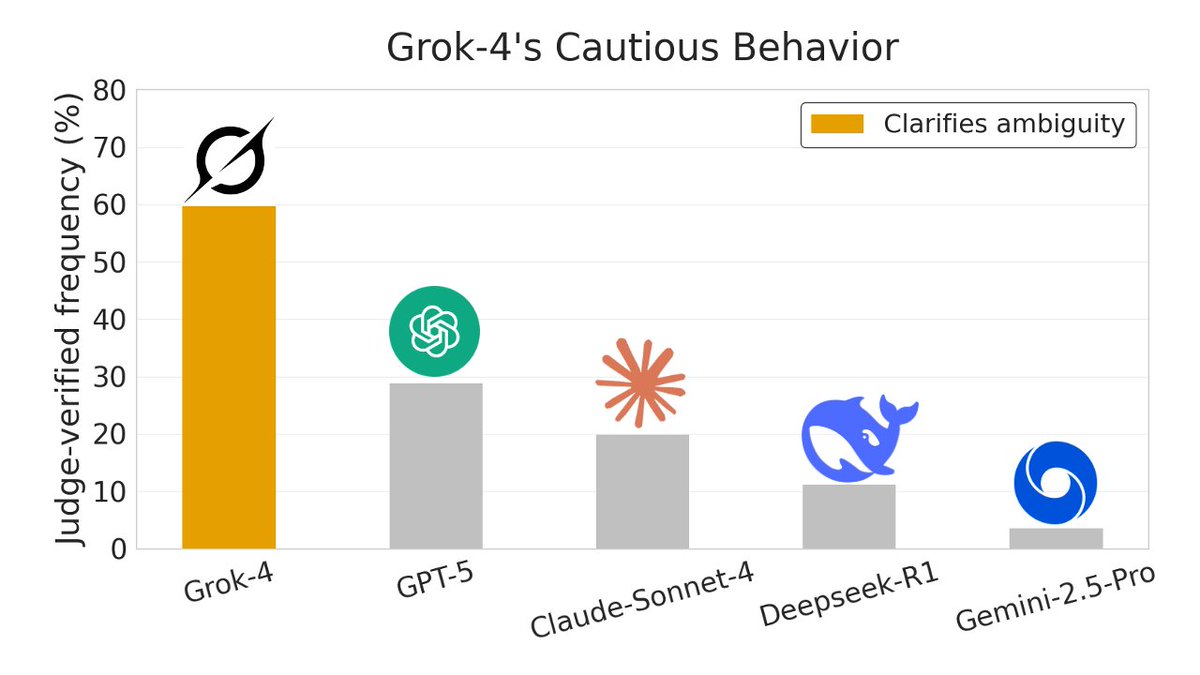
What if we used sparse autoencoders to analyze data, not models—where SAE latents act as a large set of data labels 🏷️?
We find that SAEs beat baselines on 4 data analysis tasks and uncover surprising, qualitative insights about models (e.g. Grok-4, OpenAI) from data.
A left frontal-temporal network selectively supports language comprehension and production. Are computations in this language network driven primarily by bottom-up input, or by top-down task demands?
🧵👇
https://t.co/X7g3ye51CI
🧠Excited to share MOSAIC: a unified fMRI mega-dataset: 430k+ trials, 160k stimuli, 93 subjects (and more to come!) all in a single brain space
Enables massive scale for modeling the visual cortex with just 2 lines of code
https://t.co/RmGFcycuC1
🐍pip install mosaic-dataset
Headed to NeurIPS in San Diego Dec 2-7!
Always excited to dive into conversations at the intersection of neuroscience and machine learning. If you're around and want to chat about brains, machines, or where they meet, let's connect.
Looking forward to the week ahead!
🚨 Paper alert:
To appear in the DBM Neurips Workshop
LITcoder: A General-Purpose Library for Building and Comparing Encoding Models
📄 arxiv: https://t.co/jXoYcIkpsC
🔗 project: https://t.co/UHtzfGGriY
A fun collaborative project! We leverage TunedLens (~linear decoding of tokens) to explore how LLMs' internal representations change from layer to layer.
1/
It's been more than a year, but the EWoK (Elements of World Knowledge) paper is finally out in TACL!
tl;dr: language models learn basic social concepts way easier than physical and spatial concepts.
https://t.co/NW78qjEx51
As our lab started to build encoding 🧠 models, we were trying to figure out best practices in the field. So @NeuroTaha built a library to easily compare design choices & model features across datasets!
We hope it will be useful to the community & plan to keep expanding it!
1/
🚨 Paper alert:
To appear in the DBM Neurips Workshop
LITcoder: A General-Purpose Library for Building and Comparing Encoding Models
📄 arxiv: https://t.co/jXoYcIkpsC
🔗 project: https://t.co/UHtzfGGriY
Fun! 🎉
Don’t forget to try our interactive widget on the project website. Test some of the encoding models in the paper and visualize brain predictivity right in your browser 🤗🧠
This project wouldn’t have happened without Ruimin Gao(@Ruimin_G) and Anya Ivanova(@neuranna)
A special thank you to Anya, my advisor, mentor, and constant source of encouragement. Your support means the world to me, and I’m so grateful to be learning from you