What can a neuron compute?
Real biological neurons are complex, but how capable are they?
Using a new method, we found that a single cortical neuron can classify cats vs dogs, recognize spoken words, and solve 10-bit parity, all tasks thought to require entire networks. (1/15)
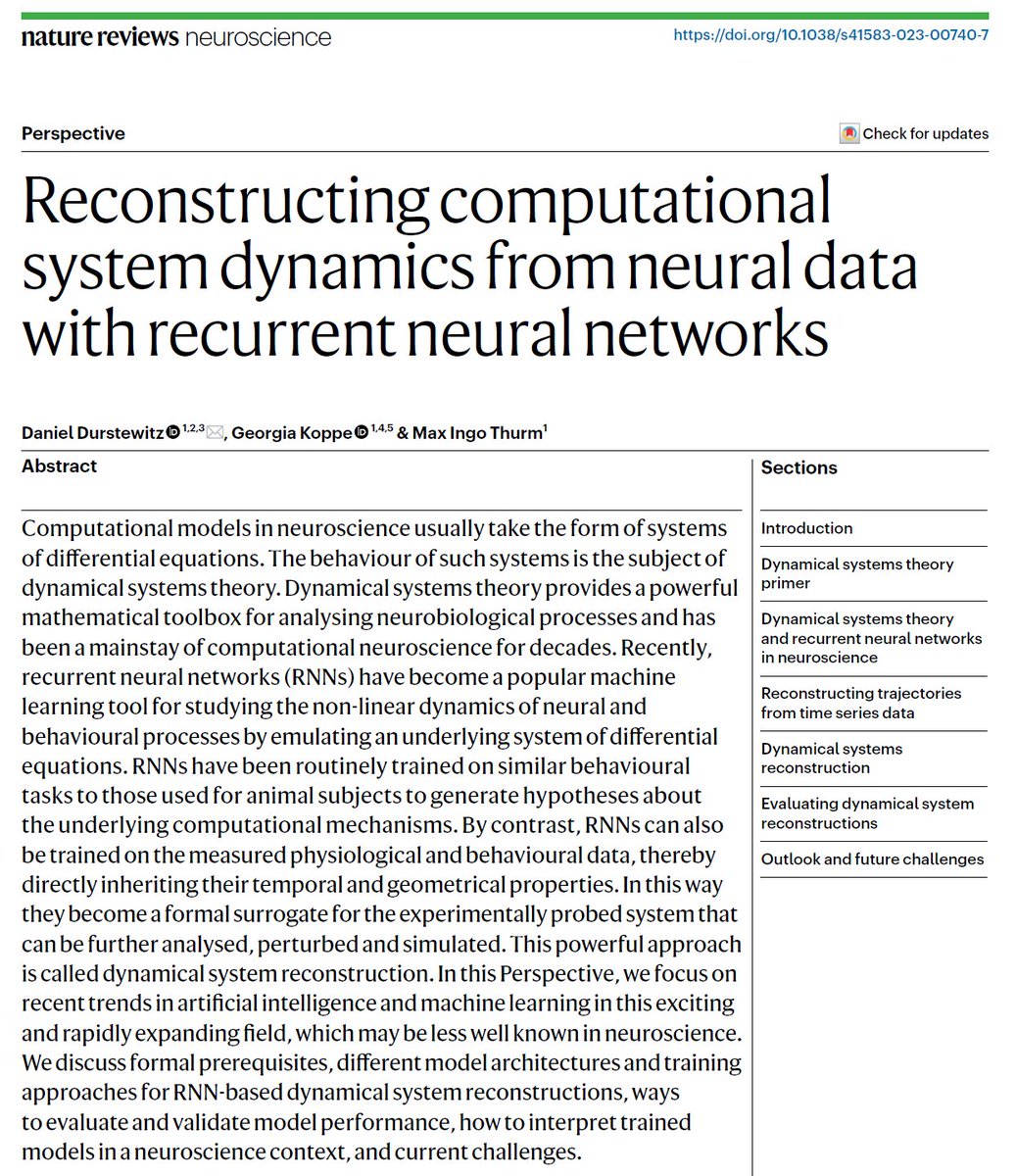
𝗕𝗿𝗮𝗶𝗻 𝗱𝘆𝗻𝗮𝗺𝗶𝗰𝘀 𝗮𝗻𝗱 𝗿𝗲𝗰𝘂𝗿𝗿𝗲𝗻𝘁 𝗻𝗲𝘂𝗿𝗮𝗹 𝗻𝗲𝘁𝘄𝗼𝗿𝗸𝘀
Went back to this paper which I highly recommend, including very rich supplementary section with valuable info.
https://t.co/T24Dfv3fR6
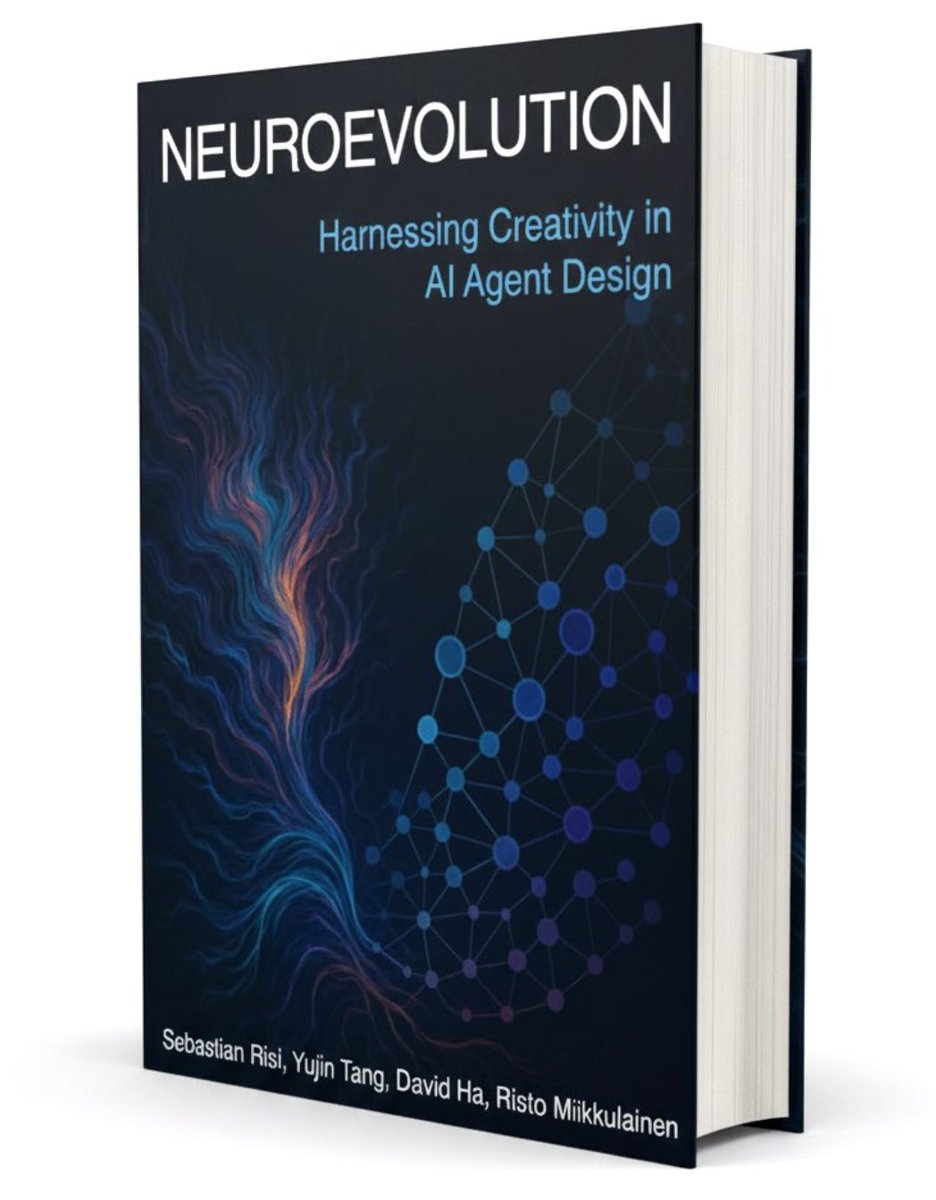
I’m beyond excited to announce our MIT Press book on Neuroevolution! An HTML version is now available for free on https://t.co/Q9uDN3w1GM, with a print edition coming out later in 2026.
Real intelligence is not static; it evolves. For decades, the field of neuroevolution has pursued this necessary adaptability. Our book chronicles its development, from early concepts to its modern integration with deep learning and reinforcement learning, exploring its potential for understanding the origins of intelligence and its real-world applications.
And the companion webpage is more than just a book site! It comes equipped with interactive demos, videos, exercises, and tutorials to allow everyone to experience neuroevolution in action. Check it out and let us know what you think!
It was a pleasure to work on this book over the last 4+ years with David (@hardmaru), Yujin (@yujin_tang), and Risto. We are incredibly proud of the result and look forward to celebrating! We hope to connect with many of you at NeurIPS.
We are very grateful to Melanie Mitchell (@MelMitchell1) who provided a fantastic foreword. To quote her: “The next big thing in AI is coming, and I suspect that neuroevolution will be a major part of it”. We think so too!
RL Anything! Your environment, reward model and policy can be improved in a closed-loop optimization. They provide feedback for each other to enhance the training signals and benefit the whole system. Check this out.
Blog post: “Reward Function Design: a starter pack”.
RL reward functions tend to make ruthless optimizers, when they work at all. But some don’t, and over the past years, I’ve been puzzling about over how. I’ve wound up with a bunch of useful frames and concepts. Here are 5: 🧵
This is my book😃It has received 5.2K stars in GitHub and the lecture videos have received over 1,200,000 views in Bilibili and YouTube. The PDF is free to download from its homepage: https://t.co/puv4f9w36u
Excited to share @GoogleDeepMind's AGI safety and security strategy to tackle risks like misuse and misalignment. Rather than high-level principles, this 145-page paper outlines a concrete, defense-in-depth technical approach: proactively evaluating & restricting dangerous capabilities, implementing Amplified Oversight & robust training methods, all backed by system-level security.
1/ 🧵👇
What should count as a good model of intelligence?
AI is advancing rapidly, but how do we know if it captures intelligence in a scientifically meaningful way?
We propose the *NeuroAI Turing Test*—a benchmark that evaluates models based on both behavior and internal representations.
👉The key principle: given a metric, models should be *at least as good as brains are to each other*:
Even today a perceived barrier to machine learning is the lack of interpretability.
But compared to 10 years ago, we have way more tools for interpreting machine learning models.
The easiest way to get started is my book Interpretable Machine Learning: https://t.co/s4tyZz3f3B
“Our lab has mostly studied motivated state-dependent behaviors, like feeding and navigation. The machinery that’s being used to control these states in C. elegans — for example, neuromodulators — are actually the same as in humans." https://t.co/Ae9cSwioNh
Excited to release what we’ve been working on at Amaranth Foundation, our latest whitepaper, NeuroAI for AI safety! A detailed, ambitious roadmap for how neuroscience research can help build safer AI systems while accelerating both virtual neuroscience and neurotech. 1/N
The mind-body problem
This is a nice cartoon, and its exactly what William James described in his discussion of the ideomotor.
But the mind-body problem, or the mind-brain problem, as discussed endlessly in philosophy, has to do with a reductive physicalistic view of the brain versus a reductive mentalistic view of the brain. I think that the m/b problem is a disaster, an infinite loop that goes nowhere.
We know with considerable certainty that the mind-brain is a single entity under two different names, or two different access methods, the voluntary report of a conscious experience and the input (either endogenous or exogenous) that leads to the conscious experience. This is not empirically problematic, and we have two centuries of sensory psychophysics to give a plausible answer.