🚨 Just tried to visit @RonHira ‘s X page….leading expert on H-1B abuse, Howard Univ professor who’s testified to Congress for 25+ years exposing how the visa program displaces American tech workers & suppresses wages.
Now it just says “Something went wrong. Try again.” 😳
Why is a top defender of U.S. workers silenced? @X@nikitabier do we know what’s happened?
🚨 Congress has a FULL ARSENAL of America-First bills to finally crush H-1B abuse, kill the OPT loophole, and punish job-killing outsourcing...
But NOT ONE has gotten a single vote. All still rotting in committee.
Real reform — or just political theater? The only way to know is to FORCE your reps to act NOW.
Here are the major bills (sponsors + intro dates):
✅ **S.2940** (Sen. Tom Cotton, R-AR — 9/30/25) → Ends FICA tax exemptions for OPT workers
✅ **H.R.2315** (Rep. Paul Gosar, R-AZ — 3/25/25) → Completely ELIMINATES the OPT program
✅ **S.2821** (Sen. Jim Banks, R-IN — 9/16/25) → American Tech Workforce Act: $150k H-1B wage floor + ends OPT
✅ **S.2928** (Sen. Chuck Grassley, R-IA — 9/29/25) → H-1B and L-1 Visa Reform Act: cuts fraud/abuse, protects American workers
✅ **H.R.8443** (Rep. Eli Crane, R-AZ — 4/22/26) → 3-year PAUSE on new H-1B visas
✅ **H.R.6937** (Rep. Marjorie Taylor Greene, R-GA — 1/2/26) → End H-1B Now Act: full elimination of the H-1B program
✅ **S.2976 (HIRE Act)** (Sen. Bernie Moreno, R-OH — 10/6/25) → 25% excise tax on outsourcing payments (funds American worker training)
✅ **H.R.6225 (PAUSE Act)** (Rep. Chip Roy, R-TX — 11/20/25) → FREEZES most legal immigration until H-1B is abolished + OPT scrapped
✅ **H.R.995 / S.409 (No Tax Breaks for Outsourcing Act)** (Rep. Lloyd Doggett, D-TX & Sen. Sheldon Whitehouse, D-RI — 2/5/25) → Ends corporate tax incentives for offshoring jobs
✅ **Assimilation Act** (Rep. Andy Ogles, R-TN & Sen. Tommy Tuberville, R-AL — 5/15/26) → Ends OPT + drastically reforms/curbs H-1B as part of major immigration overhaul
Zero floor action. Zero excuses.
American tech grads and workers are getting replaced daily. Pick up the phone and demand votes on these bills.
Which one are you hammering your reps on hardest? Tag them below and let’s make this REAL 👇
@RepGosar@SenEricSchmitt@RepOgles@RepEliCrane@chiproytx
Elon just open-sourced the new X algorithm … and it explains why so many accounts (including mine) saw impressions collapse overnight.
The “For You” feed now runs almost entirely on Phoenix, a Grok-based transformer model from xAI.
Here’s exactly what changed today:
• Pulls posts from accounts you follow + ML-discovered content (via two-tower embeddings)
• Ranks everything by predicting 15+ real actions: likes, replies, reposts, clicks, video views, dwell time, follows… PLUS negatives like “not interested,” mute, block, or report
• Final score = simple weighted sum. Positives boost it hard. Negatives tank it.
• New Grox service for real-time spam detection & content classification
• Author diversity scoring (post too often = automatic downrank)
Old hand-engineered rules are gone. It’s now pure ML driven by predicted engagement.
This is why short replies and low-effort posts get almost zero reach now. Thoughtful content that sparks replies + reading time wins big.
Premium + native media still get 10× distribution.
Huge transparency move from Elon.
How has the new algo hit YOUR impressions? Drop your before/after numbers or what you’re changing 👇 Let’s discuss!
“You’d be hard-pressed to design a worse system.”
—- @RonHira on the H-1B visa program.
Corporations don’t hire H-1Bs to fill real shortages.
“They hire them because guest workers have fewer rights, can be paid less, and are easier to control.”
It’s a no-brainer for companies.
Sold as a merit-based program for the “best and brightest.”
Delivered as a cheap, controllable labor arbitrage tool.
“It has nothing to do with merit or competence. And it’s not the best and brightest. These are ordinary skilled workers.”
America First means American workers first.
Time to fix this rigged system.
@SecRubio@realDonaldTrump@SenEricSchmitt@gosar@tommcclintock@americanmoment
H-1B has displaced hundreds of thousands of American tech workers with cheaper foreign labor.
Poll: Should Congress abolish the H-1B visa program?
Vote & RT — this debate is overdue.
@JDVance@POTUS@SenEricSchmitt@RepGregSteube@RepBrandonGill
I get DMs all the time asking:
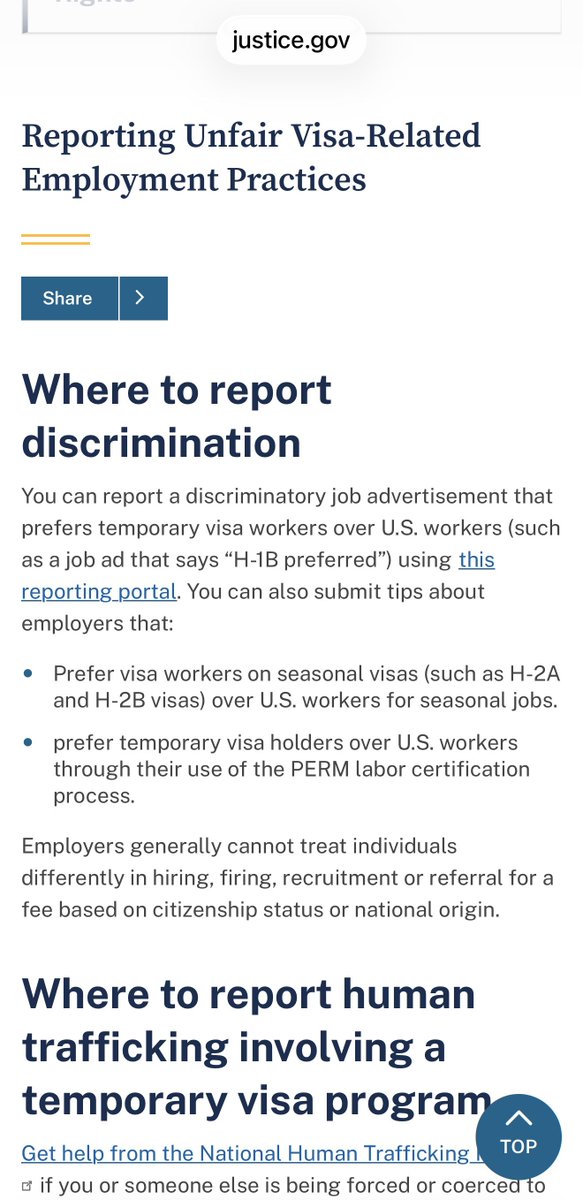
“Where do I report H-1B abuse or hiring discrimination?”
Here’s the official DOJ link:
https://t.co/T4sXPyTuq6
If you’ve seen:
• jobs restricted to visa holders
• Americans passed over or replaced
• questionable hiring practices
This is where you report it.
Please share.
Behind the scenes in tech recruiting, emails like this are everywhere.
This staffing firm claims they have 220+ developers “on the bench.”
Many listed as H-1B / OPT / H-4 EAD.
Let’s think about that.
Are we supposed to believe a small staffing company is:
• Paying 220 tech salaries
• While they sit with no client project
• And none of the H-1B workers exceed the 60-day grace period if they aren’t actively employed?
Because under Department of Labor rules, “benching” H-1B workers without pay is illegal.
So what exactly does “on the bench” mean here?
Or is this fraud hiding in plain sight?
@USCIS@HarmeetKDhillon@StephenM@SusieWiles@howardlutnick
Follow the money.
Companies donating to Sen. John Thune while also benefiting from immigration labor pipelines include:
• Goldman Sachs — $150,000
• Comcast / NBCUniversal — $120,000
• Chevron — $111,000
• Merck — $100,000
• Wells Fargo — $90,000
• American Express — $75,000
• Google / Alphabet — $75,000
• Meta / Facebook — $72,500
Many of these companies are major H-1B users, immigration lobbyists, or businesses that profit from expanded foreign labor pipelines.
Corporate immigration policy isn’t random.
It’s lobbied.
It’s funded.
And it’s extremely profitable.
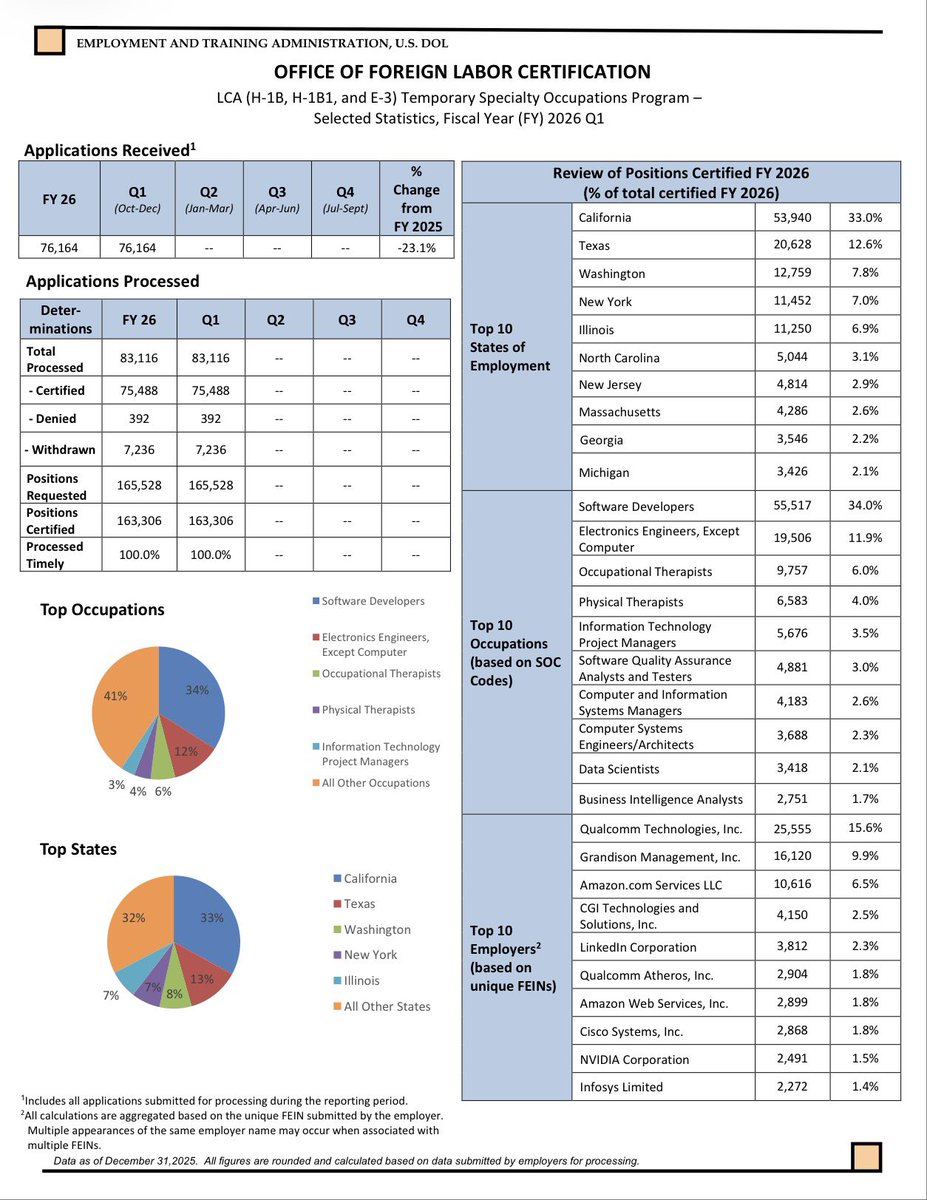
🚨 Q1 2026 H-1B LCA data is out.
76,164 applications received.
That’s -23.1% vs FY2025.
But here’s the part no one mentions:
163,306 positions certified in just one quarter.
Software Developers = 34% of all certified roles.
California alone = 33% of total.
Top employers include Qualcomm, Amazon, Infosys, NVIDIA, Cisco.
Now zoom out:
• Entry-level tech hiring down 50%+ from 2019
• White-collar openings near pandemic lows
• CS and Computer Engineering among the highest unemployment rates on the degree chart
Applications are down year over year.
The volume is not.
If the market is softening and new grads are struggling, why are 160,000+ positions still being certified in Q1 alone?
Shortage.
Or structural substitution?
@StephenM@Eric_Schmitt@chiproytx@howardlutnick@RepGosar
Don’t sleep on South Africa 🇿🇦
A small country. Outsized impact.
•CEO of Tesla, SpaceX, X — Elon Musk 🇿🇦
•CEO of SkillStorm — Justin Vianello 🇿🇦
One is building rockets and reshaping global tech.
One is building America’s AI and cloud workforce from the ground up.
Not the same scale.
Same grit.
@elonmusk 🇿🇦 @justinvianello 🇿🇦
Mr. President (@realDonaldTrump),
If tech employment is cooling, if non-healthcare job growth is slowing, and if companies are expanding headcount overseas while our visa pipelines remain intact here, then we are not addressing a shortage.
We are maintaining a system that still tilts toward imported labor and outsourced jobs instead of investing first in American workers.
The American workforce should not be an afterthought while policies continue to prioritize mobility of capital and labor over stability at home.
Before anyone argues for preserving the status quo, we should ask a basic question:
Have we fully tapped the talent already here?
Because if the answer is no, then the path forward is obvious.
Put American workers first.
Close outsourcing loopholes.
Stop pretending labor arbitrage is economic necessity.
@JDVance@DonaldJTrumpJr@StephenM@SecScottBessent@Eric_Schmitt
Harvard economists studied H-1B wages.
The result: employers save $25K–$30K per worker per year vs Americans.
Key Findings from the NBER Study (2026)
1) H-1B workers earn significantly less than comparable U.S. workers
•After adjusting for education, age, occupation, location, and gender:
•H-1B workers earn about 16% less than comparable Americans.
•In dollar terms:
•Roughly $25K to $30K lower annual earnings on average.
•Employers capture large payroll savings over a 6-year visa term.
•Those savings create strong incentives to hire H-1B labor even with higher visa fees.
2) Wage gaps are largest in outsourcing-style firms
•Major U.S. tech companies show small wage differences.
•Outsourcing and staffing firms show much larger gaps, sometimes exceeding 30% below comparable U.S. wages.
•The study notes that most H-1B hires are actually spread across thousands of smaller firms, not just big tech.
3) Demand for H-1Bs remains strong even with high visa fees
The model estimates:
•A $118K to $264K visa fee could maximize government revenue.
•Even high fees may have little impact on total hiring because employers still save on payroll costs.
Projected outcomes:
•$6.2B to $22.4B in potential annual fee revenue.
4) H-1B workers cluster heavily in tech roles
•~38% are software developers alone.
•Nearly two-thirds are concentrated in just five occupations.
•Many are located in a few high-wage metros like San Jose, Seattle, Dallas, NYC, and San Francisco.
5) Skill level vs pay level mismatch
•Employers often classify H-1Bs in lower wage categories.
•Yet the study finds:
•Nearly 75% of H-1B workers rank above the median skill level of comparable U.S. workers.
•Highest-skill H-1Bs actually show the largest relative pay gaps.
6) Labor market dynamics behind the wage gap
The paper argues the visa structure creates a quasi employer-worker lock-in:
•H-1B workers change jobs at about 9.4% annually, far lower than the 20% to 25% turnover seen among comparable U.S. workers.
•Reduced mobility can give employers bargaining power, which suppresses wages.
7) Policy takeaway from the study
•Because employers save money on wages, raising visa fees alone may not reduce demand much.
•Instead, higher fees may:
•Increase government revenue
•Shift hiring toward more highly skilled workers rather than reduce overall usage.
Harvard economists just blew up the “skills shortage” narrative.
H-1Bs are cheaper …not better labor.
@RonDeSantis@Eric_Schmitt@RepGregSteube@RepGosar@StephenM@chiproytx
https://t.co/BVvXuRU8SR
Texas Governor Greg Abbott ordered all Texas state agencies and public universities to freeze new H-1B visa petitions while the state investigates alleged abuse of the program.
Key details:
•The freeze applies to new H-1B petitions only and runs through May 31, 2027.
•Exceptions require written approval from the Texas Workforce Commission.
•Agencies must submit a full audit by March 27, 2026, detailing:
•Number of new and renewal H-1B petitions filed
•Number of visa holders sponsored
•Countries of origin
•Job classifications
•Abbott cited documented abuse of the H-1B program and said the goal is to ensure “American jobs are going to American workers.”
•The move follows broader federal scrutiny of H-1Bs and comes as:
•H-1B demand far exceeds supply
•Vetting standards tighten
•Employers face increased enforcement risk
•Florida’s public university system is considering a similar pause.
Texas just became the largest state to halt H-1B growth inside government and higher education, signaling a shift from passive participation to active enforcement and transparency.
https://t.co/aDRxwGKjiZ
If Elon is even close to right about $700B a year in government fraud, here’s the math nobody is talking about.
$700B = about 2.3% of U.S. GDP.
That’s money pumping demand into the economy without adding supply.
Textbook fuel for inflation.
For context:
The pandemic stimulus ran about 10–12% of GDP and was tied to roughly 2–4 points of inflation.
Scale that down.
$700B alone could be adding roughly 1–2 points to inflation every year.
Not because of growth.
Not because of productivity.
But because waste and fraud act like permanent stimulus.
So here’s the real question.
If this money is distorting demand, how much of the inflation the Fed has been fighting isn’t “economic overheating” at all…
but artificial inflation from free money leaking into the system?
And how different would the inflation picture look if that $700B simply didn’t exist?
@BillAckman@elonmusk@realDonaldTrump@JDVance@federalreserve
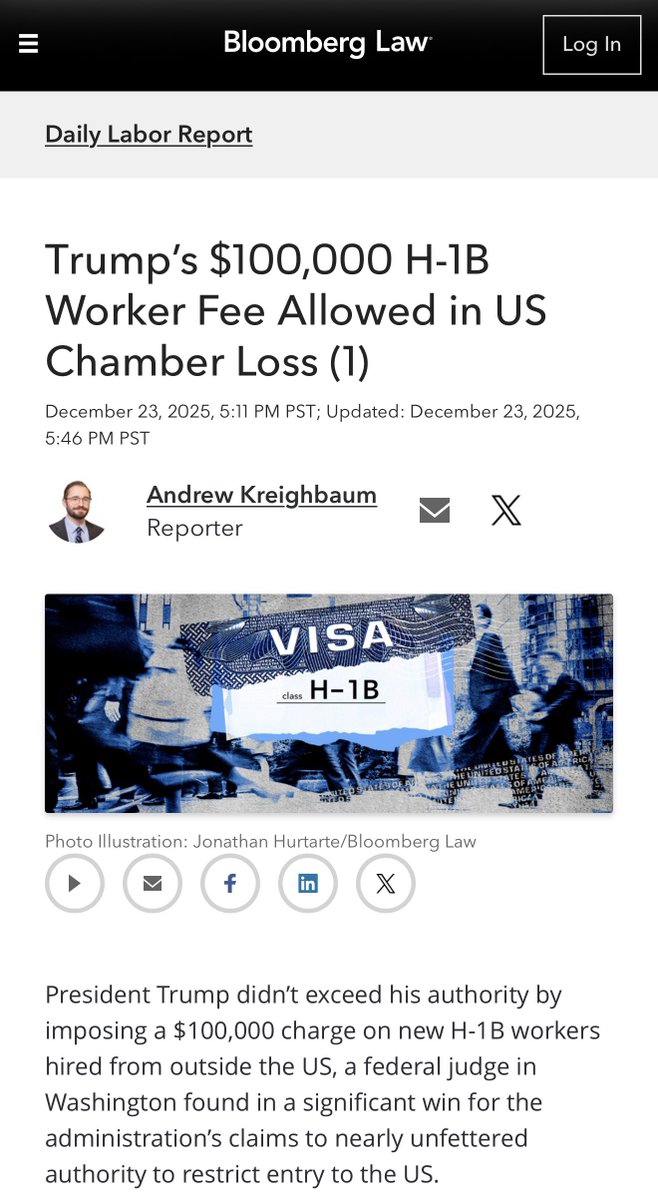
🚨 Big ruling.
A federal judge just upheld Trump’s $100,000 H-1B fee…rejecting the U.S. Chamber of Commerce challenge.
This confirms the executive branch has real authority to deter low-wage visa abuse …even over corporate objections and sets the stage for broader visa reform …without waiting on Congress.
https://t.co/Ev6vQvKOwK
🚨 Unpublished but finalized: DHS has quietly rewritten the H-1B lottery.
Before this rule even hits the Federal Register, here’s what actually changes … in plain English … based directly on the final rule text (2025-23853).
1. The H-1B lottery is no longer purely random
USCIS is replacing the random lottery with a wage-weighted selection system.
Registrations are still beneficiary-based, but higher wages now get better odds.
2. Wage level determines lottery odds
Each H-1B registration is entered into the selection pool based on the offered wage:
•Wage Level IV → entered 4 times
•Wage Level III → 3 times
•Wage Level II → 2 times
•Wage Level I → 1 time
Every worker is still counted once toward the cap, but higher wages dramatically increase selection probability.
3. Employers must disclose wage details up front
During registration, employers must now submit:
•The OEWS wage level
•The SOC code
•The area of intended employment
These same details must later match the filed petition exactly.
4. USCIS can deny or revoke petitions for manipulation
USCIS explicitly adds authority to:
•Deny amended or new petitions
•Revoke approvals
If the agency believes changes were made to game the lottery (job title, location, wage level, or entity swapping).
5. Entry-level and lower-wage H-1Bs are heavily disadvantaged
DHS estimates a sharp drop in Wage Level I selections.
The rule openly acknowledges that past abuse centered on:
•Lower-paid roles
•IT staffing and outsourcing firms
•Wage suppression of U.S. workers
This rule is designed to reverse that trend.
6. The cap size does not change
•65,000 regular cap
•20,000 advanced degree cap
What changes is who wins, not how many.
7. Effective timeline
•Final rule
•Effective for FY 2027 registration season
•Applies to all cap-subject registrations after the effective date
Bottom line
This rule:
•Explicitly admits the H-1B program has been abused
•Prioritizes higher wages over volume hiring
•Makes entry-level and low-wage H-1Bs far harder to secure
•Gives USCIS stronger enforcement tools
It does not end H-1Bs, but it fundamentally reshapes who benefits from them.
Curious what people think ….does this go far enough?
https://t.co/4i4u2GE1JK
Genuine questions for @StephenM on this analysis:
If the objective is truly to stop displacement, why is the focus almost entirely on H-1Bs?
• OPT has no prevailing wage
• OPT workers are exempt from payroll taxes
• OPT has no cap, no lottery
• OPT allows broad third-party placement
• And per recent reporting, OPT → H-1B conversions are not subject to the $100K fee
That’s where the real labor discount exists today.
On top of that, the $100K H-1B fee only applies to future, overseas filings.
FY 2026 cap-subject H-1Bs are already allocated, and many employers already hold multi-year approvals.
So in practice, this doesn’t materially change hiring behavior until FY 2027 at the earliest … while firms can simply reroute through OPT, L-1s, or offshoring in the meantime.
Honest question:
When does this actually reduce displacement for American workers?
Because if the pressure just shifts channels … or the impact is delayed by years … the model isn’t “blown up.”
It’s just re-plumbed.
And without addressing OPT, offshoring, and labor-brokerage structures, replacement doesn’t stop.
It just adapts.
@IngrahamAngle@RepGosar@chiproytx@realDonaldTrump
https://t.co/dwPti5uSN8