While I was off the app, two pieces of data came out that I thought were absolutely eye-watering.
1) In June alone, total premium traded across U.S. options came in at just under $1.3 trillion.
For perspective, that is roughly 50% of U.S. monthly GDP.
Read that again!
It tells you just how massive the derivatives ecosystem has become. The options market is turning into an absolute behemoth, to the point where even sophisticated derivatives trading firms are struggling to keep up with the sheer size and breadth of the opportunity set.
2) Schwab brought in $119 billion in new assets in Q2 alone.
To put that number into perspective, that is roughly the combined TOTAL AUM of four well-known and highly respected multi-strategy hedge funds.
Two very different data points, but both tell a similar story: the sheer amount of capital flowing through U.S. financial markets has reached a scale that is difficult to fully appreciate.
BREAKING: The Nasdaq 100 ETF, $QQQ, has attracted +$10.9 billion in inflows so far in August, now on track for its largest monthly inflow on record.
This is already more than double the +$4.9 billion recorded during the full month of July.
By comparison, the previous monthly record was set in March 2022, at +$9.2 billion.
Meanwhile, the semiconductor ETF, $SMH, has seen -$2.8 billion in outflows month-to-date, putting it on track for its largest monthly withdrawal on record.
At the same time, the software ETF, $IGV, has posted -$610 million in outflows so far in August, on pace for its 3rd consecutive monthly outflow.
Investors are rotating from semiconductors and software into the broader tech sector.
I found two George Soros documents that explain how a guy who arrived in New York with roughly $5,000 ended up building a $7.5 billion fortune
inside, Soros explains why being wrong is not the problem - staying wrong is. his entire process starts with building a hypothesis, watching how the market reacts, and changing the view the moment reality stops confirming it
the interesting part is how little of his framework depends on predicting the future perfectly
no fixed forecasts. no attachment to one thesis. no need to be right from the beginning
bookmark this and read both documents below
The entire world wants US stocks.
Foreign investors outside the US purchased +$181.4 billion of US equities in June.
The private sector alone bought a record +$144.7 billion, bringing an annualized rate to +$1.74 trillion, an all-time high.
Over the past 3 months, private purchases have totaled +$351.1 billion, equivalent to an annualized pace of +$1.4 trillion, also an all-time high.
This surpasses the 2025 annualized record by ~$400.0 billion.
By comparison, foreign official institutions, such as central banks and sovereign wealth funds, purchased +$36.7 billion in June.
As a result, private investors accounted for ~80% of all foreign equity purchases over this period.
The appetite for US stocks is stronger than ever.
Hey! There's a bubble. Yep, the largest company on earth needs to borrow $500B, that's right, a $5T needs the largest financing deal in WallSt history to fund itself. The whole thing smell like dog shit. It's over. All of it.
My thanks to LS for alerting me to this eye-popping chart from Goldman Sachs.
The Good News: There is no mechanism as powerful as the US capital markets for mobilizing investment, drawing both domestic and foreign capital.
The Challenge: All else being equal, financing needs of this magnitude would exert structural upward pressure on US economy-wide borrowing costs that would also spill over internationally.
#economy #tech #ai #markets @GoldmanSachs
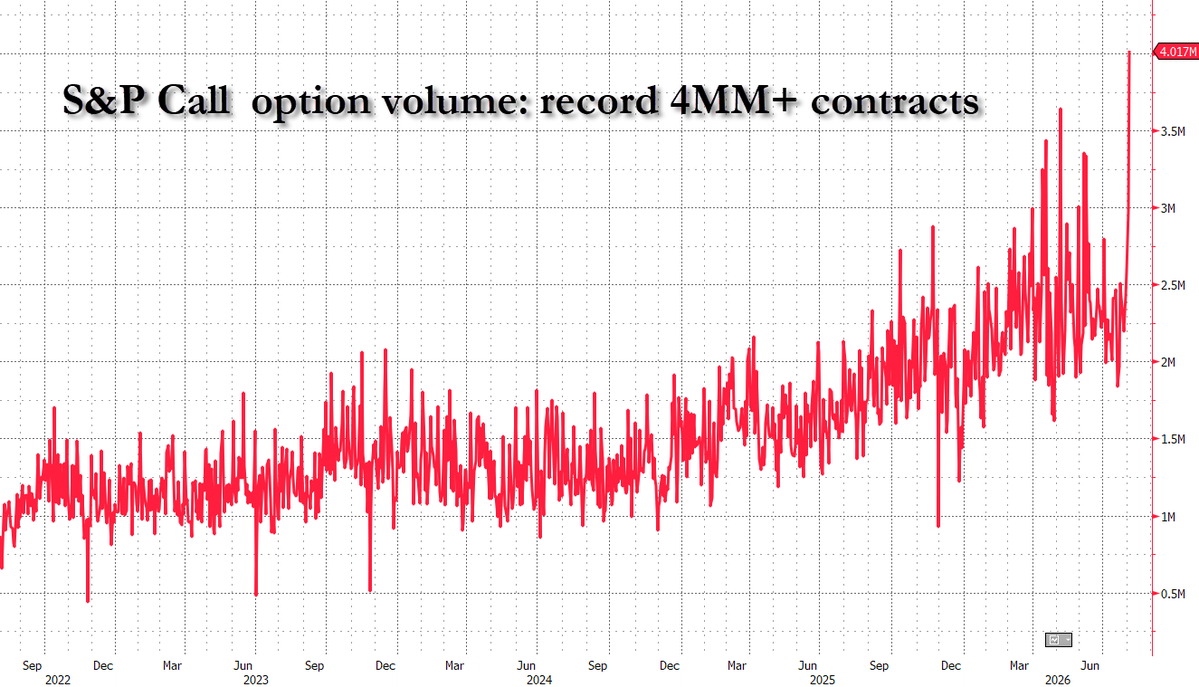
BREAKING: Call option volume in the S&P 500 spiked to a record 4.0 million contracts on Tuesday.
This figure has more than doubled over the last several weeks.
By comparison, daily call option volume never exceeded 2 million contracts until Q4 2023.
Furthermore, call option volume averaged ~700,000 contracts a day in 2020-2021.
Meanwhile, the S&P 500 put/call skew, measuring the relative demand for downside protection versus upside exposure, posted its largest two-day decline since 2017.
Risk appetite is absolutely exploding.
Corporate insiders have rarely been this bearish:
Just 14.8% of US companies have recorded more insider purchases than sales so far in July, on track for the lowest monthly reading in at least 21 years.
This percentage has declined -12.0 points since February and now stands ~7.0 points below the 10-year average of ~25%.
By comparison, ~44% of firms saw insider purchases exceed sales in January 2022.
The weakness is broad-based, with only 3 sectors, consumer staples, materials, and utilities, seeing net executive purchases.
Among large-cap companies specifically, just 3.2% recorded net purchases.
Corporate executives are becoming increasingly cautious.
Doesn’t the market usually start finding a bottom when somebody finally blows up?
Now we have Situational Awareness, a levered AI/infrastructure book with big losses in weeks and a public stock portfolio sold to Citadel, and the AI complex ripping immediately after. UBS AI winners Stock Index is up over 10% today.
• 1998: LTCM
• 2018: Volmeggeon - XIV / short-vol unwind
• 2020: Treasury basis trade / forced deleveraging
• 2021: Archegos, more idiosyncratic, but same forced-liquidation pattern
2022: UK LDI pension/gilt crisis
Add in Korea’s emergency response after Samsung/SK Hynix-driven volatility, and it feels like we may have just seen the forced seller finally get cleared.
Of course there were the Lehman/Bear blowups that revealed a bigger credit problem, not bottoms.
But when the issue is crowded positioning with leverage resulting in margin calls, the blowup often marks the point where the selling becomes visible, concentrated, and exhaustible.
So the question for today’s rally: is this just a bounce, or was Situational Awareness the AI-trade liquidation event that marked the bottom?
Spending a week with my family and working most of it! Being a few hours ahead of US markets has given me some time to digest a lot of incredible markets discourse on X - there is too much to try and consume about AI but not enough about leverage. We are seeing a classic head hunt of the most levered players in the equity and convert market re AI globally. Hyperscaler and associated credit spreads in IG are wider as they should be (portfolio construction by notional and duration matter in credit because we don’t have the payout that equity does) and debt is being added to compute and power as another constraint on the AI theme. Govt regulation remains a massive wildcard but a longer cycle isn’t necessary a worse one. I would look for the forced sellers of assets trading at or below contract value with counterparties you feel good about that have positive optionality on growth opportunities. Think about the impact on spot and next 1-2 year curves for compute, power, and shell - those who are long and don’t need financing + can term out contracts now are materially advantaged. If this is the whole cycle being elongated and the curve flattened there are a lot of interesting securities to buy from forced sellers. More time for competition and technology to emerge in the intermediate term isn’t necessarily a bad thing for many infrastructure assets. I started my career in the middle of the early 2000s telecom cycle - Nortel, Lucent, Cisco, etc were financing their customers. There have been some very astute comments on this platform from people who understand the AI echosystem far better than I do about Nvidia and Broadcoms business model decision to become the working capital bank of the AI build - bridging the industry to revenue and cash flow. My sense is the focus in credit markets right now is too much on Meta Google Amazon etc and not enough on that business model change which liquifies the compute roll out in the near term and shifts the credit risk to those large semiconductor companies. It’s fun to seeing liquidity having a price again and god forbid IG companies cost of debt having to compete with their cost to equity.
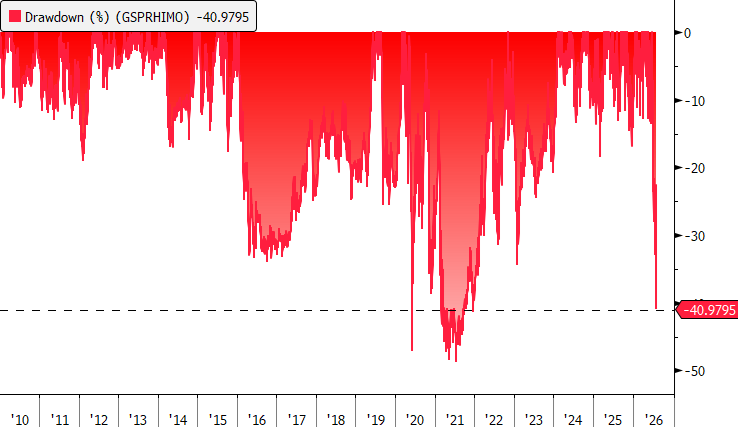
It’s official. If you’ve been a high-beta investor since 2000, you’ve lived through the dotcom crash, the 2008 crisis, and the 2022 Nasdaq crash, and this would still be your worst month.
Literally the worst month for high-beta stocks in modern history.
Nothing about the quality AI businesses is broken. Only the market is.
Hedge funds are dumping US tech stocks at a record pace:
Hedge funds have sold information technology stocks in 6 of the last 8 weeks.
This brings total 8-week sales to the largest in at least 10 years.
Last week alone, technology was the most-sold US sector among hedge funds.
As a result, tech exposure as a % of total market exposure is down to its lowest since February 2026.
At this rate, tech exposure could fall to its lowest in at least 5 years as early as next week.
Hedge funds are rapidly moving to the sidelines.
Institutional investors are extremely bullish on US stocks:
Last week, hedge funds recorded their largest weekly purchases of US equities since November 2025.
This was primarily led by short covering rather than outright long purchases.
This also marks the 4th consecutive weekly purchase.
As a result, the information technology sector now accounts for ~22% of total US hedge fund equity exposure, near the highest in 5 years.
This percentage has surged +6 points since January, significantly outpacing the increase following the 2022 bear market recovery.
Hedge funds are benefiting from the tech rally.