Chief Learning Officer for the AI era. Building AI EdTech, advising institutes & companies on AI learning strategy. Notes on Edtech, learning design & startups.
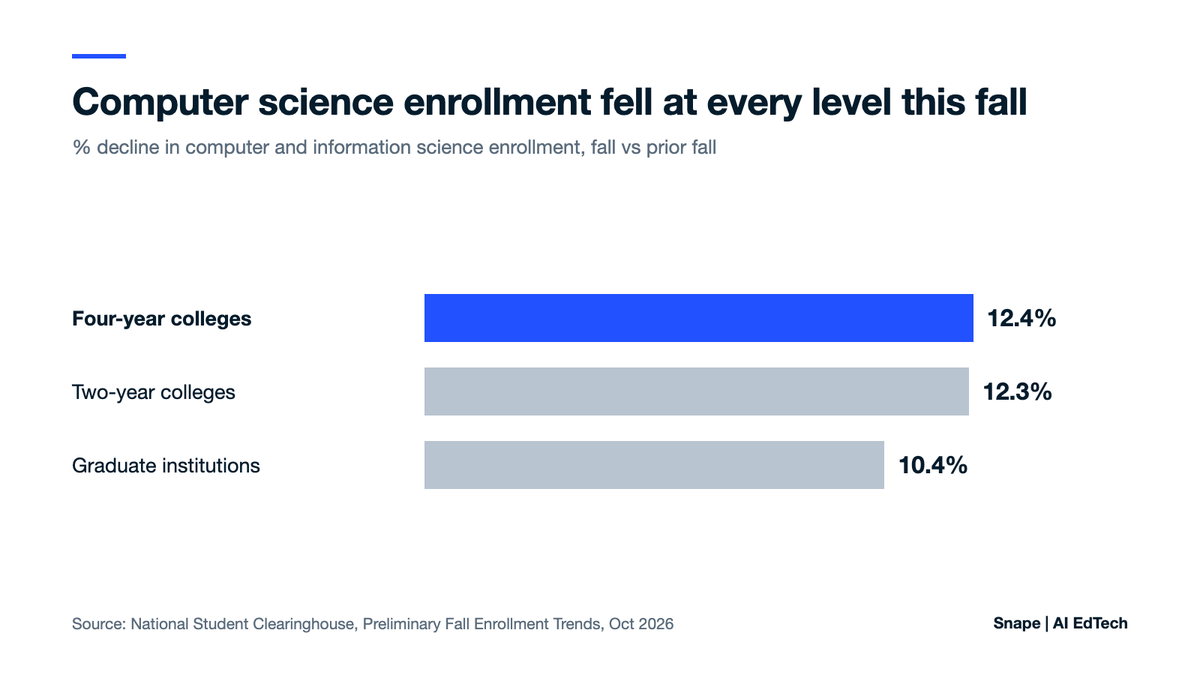
Computer science enrollment at US four-year colleges fell 12.4% this fall.
Purdue now requires AI coursework of every undergraduate, in every major.
Both facts describe the same shift. AI is leaving the computer science department and becoming general education. The universities that see this early are rebuilding their core curriculum around it. The rest are still arguing about detection software.
Four sets of 2026 numbers show how fast it is moving.
1. Students are walking away from the old AI pipeline
The National Student Clearinghouse released preliminary fall data on October 29. Computer and information science enrollment fell 12.4% at four-year colleges, 12.3% at two-year colleges and 10.4% at graduate institutions. Health majors at four-year schools grew 6.2%. Total enrollment held roughly steady, up 0.2%.
The data does not say why. My read is that students watch AI write more of the code and are hedging. They still want AI skills. They are less sure a CS degree is the only way to get them.
2. Purdue made AI a graduation requirement
Beginning with this fall's incoming class, Purdue requires every undergraduate to complete an AI working competency as part of the core curriculum. Within weeks of the trustees' December 2025 decision, a cross-functional team identified, developed and revised 22 courses to satisfy it and updated more than 300 plans of study. Courses run from one to four credit hours.
Purdue frames the requirement around critical thinking, responsible AI use and workforce-ready skills, with tool operation as the smaller part.
The speed is the point. 22 courses and more than 300 plans of study changed in a few months. That is fast for any curriculum process.
3. Indiana built one course for everyone
Indiana University's Kelley School of Business built GenAI 101, a self-paced course with eight modules and 16 lessons. By April 2026, more than 114,000 students, staff and faculty had enrolled. IU then opened it to anyone in the world, free. Kelley says four revised, required IT and AI courses are coming to its undergraduate foundation.
114,000 enrollments in a single course is closer to a platform than a class. It also means IU is running a test most universities have not: whether one shared course can set a floor of AI skill across every major.
4. Cornell put AI into general education
Cornell Bowers announced Everyday AI in October. It is a three-credit course open to every Cornell student, with no technical background required and space for 275 students when it launches in spring 2027. Two weeks later, Arts and Sciences launched a humanities and social sciences AI initiative with five postdoctoral fellows and an AI and Society minor in development.
275 seats is a pilot next to Indiana's 114,000 enrollments. Cornell is betting on depth in a smaller room, and Indiana on reach.
The pattern
Students already learn AI mostly alone. Dartmouth's national survey this fall found 79% of US college students mostly developed their AI skills on their own.
Students are leaving CS. Universities are answering with AI courses for every major, at very different scales: 22 qualifying courses at Purdue, one course with 114,000 enrollments at Indiana, 275 seats at Cornell.
I think general education is the right home for AI literacy, and the hardest part is still ahead. A required course shows that a student completed something. Whether that student can use AI with judgment inside their own field is a separate question, and few universities test it.
The Three-Layer AI Curriculum
Here is how I would build it at any university or graduate school.
Step 1. A shared floor.
One course every student takes in the first year, like Indiana's GenAI 101. Keep it short and practical, and update it every term. It covers prompting, fact-checking AI output and the university's own rules.
Step 2. A discipline layer.
Every major names one required course where AI is used on real disciplinary work, the way Purdue mapped qualifying courses into existing plans of study. Nursing students check AI care plans. History students audit AI sources. The department owns the rubric.
Step 3. A proof layer.
Before graduation, each student completes one assessed piece of work that shows AI use and their own judgment, scored against that rubric. Employers can ask to see it.
For provosts: start with the discipline layer. The floor is easy to buy. The middle layer is where faculty time goes.
For edtech founders: the shared floor is already crowded and often free. The opening is tools that help a department run the discipline layer and score the proof.
For students choosing a major: ask any program which course uses AI on real work in your field, and how it is assessed.
What I'm watching next
1. The Clearinghouse final fall report in January. I expect computer science enrollment at four-year colleges to stay down by more than 10%.
2. At least one more top-50 US research university will announce an AI graduation requirement for all undergraduates before fall 2027.
3. Indiana's next GenAI 101 count. I expect IU to report more than 200,000 enrollments by the end of 2027, now that the course is open to the world.
I'll check each one when the data lands.
Computer science is shrinking while AI education for every major grows. The universities that test judgment inside each discipline will lead that shift.
Sources
National Student Clearinghouse Research Center, Preliminary Fall Enrollment Trends, October 2026
Purdue University, AI competency graduation requirement begins in every undergraduate degree program, August 2026
Indiana University, IU opens its free generative AI course to anyone worldwide, April 2026
Cornell Chronicle and Cornell Bowers, October 2026
Dartmouth, Dartmouth AI Survey 2026, October 2026
1/ Nvidia's decline didn't start with Jensen Huang's resignation. It started with Washington.
The market isn't afraid of a CEO leaving. It's afraid of Congress stepping in.
2/ How I read trends: a stock has four stages.
1 Sideways: you lose time
2 Up: the only healthy one
3 Topping: swings get wider
4 Down: you lose time and money
To call it Stage 2, I need 8 conditions. All eight. Not seven.
3/ As of the Nov 13 close, Nvidia meets two and a half.
· 24% below its 50-day average
· 33% off its one-year high
· Down 27% in 3 months vs. S&P 500 down 2%
· 200-day average turned down on Nov 6
It's moving from Stage 3 into Stage 4.
4/ Now put the chart next to the news:
Oct 6: one-year high. No bad news.
Nov 4: three House committee chairs write to Huang
Nov 5: worst day in a year, -9.3%
Nov 12: he resigns. Volume 5x normal, yet it closes above the open
Nov 13: Commerce Secretary called in, below $4T
5/ Three takeaways:
1. Price moves before the news does. It's not about who runs the company. It's about who writefense bill carries three chip provisions, one givingCongress review over export licenses.
3. A broken trend needs time, not good news.
6/ What I'm watching:
· Nov 17 earnings: if they're strong and the stock still fa policy, not performance
· Year-end: is the export-review provision still in the final bill? If not, I was wrong on point 2.
A CEO leaving is news. Washington stepping in is the trend.
Personal view, not investment advice.
@NotionHQ One bad note gets read by every agent as fact, so memory needs an owner who prunes it. Shared brains drift fast when five agents all write. How does Notion handle conflicting entries?
@svpino@thewebAI Instruction following scores usually come from rules a script can check, like word counts and formats. Real prompts are messier. Have you tried it on a task with no clean pass or fail?
@igrow_co Gallup's 2026 CHRO roundtable shows that gap: 57% train managers on AI, yet 50% aren't confident managers can lead it. Would a rehearsal built on the manager's own rejected output close it?
42% of frontline employees who use AI regularly now save a full workday every week.
66% of them get limited or no guidance on what to do with it.
That gap is where most corporate AI value disappears. The tool works. The organization has no plan for the time it frees.
This month I went back through BCG's 2026 AI at Work survey of 11,749 people in 14 markets, and through Corum's latest count of edtech deals. Together they describe a learning problem that sits inside every AI rollout.
1. The saved day leaks out
Among frontline employees who use AI regularly, 42% report saving at least eight hours a week. For leaders, the share is 60%.
Guidance runs the other way. 66% of frontline users say their organization gives limited or no guidance on how to use the time saved. Among leaders, 52% say the same.
The result is predictable. 58% of frontline users say they do not reinvest the saved time into more strategic work.
These are self-reported hours, so I hold the size loosely. The direction is clear enough. The people closest to the work save time, and nobody tells them what it is for.
My read: a saved day with no plan becomes slack, or more of the same work. Neither builds capability.
2. Use took off and training stood still
74% of frontline employees are now regular AI users. In 2025 the figure was 51%, so that is a jump of 23 points in a year.
Training did not move at all. 88% of respondents believe they will need major upskilling in the next five years. Only 36% feel properly trained. BCG notes that both shares are unchanged from 2025.
That is a 52 point gap between what people expect to need and what they have received.
72% also say the skill expectations for their role have shifted. 52% spend more time reviewing and correcting AI output.
So the job changed, and the training budget behaved as if it had not. Reviewing AI output is a skill. Somebody has to teach what good looks like.
3. Clarity beats tools
This is the number I would put in front of every executive team.
Among regular AI users, 60% of those with strong access to tools but limited strategic clarity report measurable business impact. With strong strategic clarity and limited tools, the share rises to 80%. With both, it reaches 83%.
Clarity added 25 points. Tools on top of clarity added three.
BCG also splits companies by how they use AI. At firms that only deploy tools, 47% of employees experienced a major reskilling initiative. At firms that redesign workflows or build new products with AI, it was 65%.
My read: the companies getting value treat AI as a reason to redesign work and retrain people around it. A license with no direction comes last in this comparison.
4. The market is buying workforce training
The business side points the same way. Corum counted 149 edtech M&A deals through August 2026, already past the ten-year record of 133 set across all of 2025.
Workforce training was the second most targeted subsector with 36 deals, behind online education at 44. One compliance training company, Training360, made repeated purchases this year, including an acquisition that added 305 courses.
Only 9% of deals disclosed a price, so the money is hard to read. Deal count is easier. Buyers are assembling workforce training portfolios at a record pace.
For an L&D leader, that means more vendors folding into larger catalogs. Content will get easier to buy. Deciding what people should practice will stay your job.
The pattern
Put the four together. AI frees real time for frontline staff. Most organizations give no direction for that time. Training has been flat for a year while the work changed. The companies with clear direction report far more impact than the companies with more tools.
I think the scarce resource in corporate AI is now a plan for the saved hours. The license budget was the easy part.
The Saved-Day Ledger
Here is how I would run it for one quarter, in a company or a school system.
Step 1. Measure the day.
Ask each team to log weekly hours saved with AI for four weeks. Treat the numbers as rough, since they are self-reported. You only need a baseline per team.
Step 2. Assign the day before it arrives.
Pre-commit a share of the saved time, half is a reasonable start, to deliberate practice on the redesigned work. Reviewing AI output, handling the hard cases AI escalates, coaching a junior colleague. Write the plan down at team level.
Step 3. Prove the day.
At quarter end, test the skill the practice was meant to build, on a fresh task. Compare teams that followed the ledger with teams that did not. Report capability gained next to hours saved.
For CLOs: put the 88% and the 36% on one slide. Then ask for budget to close that gap with practice on real work.
For edtech founders: a product that turns saved time into structured practice has a clear buyer. Most organizations have nothing in that slot today.
For managers: you own the saved day. If you do not assign it, the work will absorb it.
What I'm watching next
1. BCG's next AI at Work edition. I predict the share of employees who feel properly trained stays below 50%.
2. The same survey's guidance question. I expect more than half of frontline users to still report limited or no guidance on saved time.
3. Corum's full-year 2026 count. I predict edtech M&A finishes above 180 deals, with workforce training still among the top two subsectors.
If any of these miss, I'll say so here.
AI already gave many of your people a day a week. The question is whether anyone decided what that day should teach them.
Sources
BCG, AI at Work 2026: Strategy Matters More Than Tools, June 2026
Corum Group, EdTech 2026 Q3 Report, October 2026
@educatedandfree Follow habit over margin. A kid who learns research inside Gemini carries it into adult paid use. Search also opens with an AI summary now, so there are fewer links to vet.
@valigo What transfers is reading a diff and smelling a bad abstraction, and writing code builds that. Strong coders still fail with agents when they write vague specs. Do you test review in interviews?
@Forbes This turns a pedagogy decision into a procurement one. The AI-free search was the middle path for districts that wanted research without chatbots. Most will now switch AI on just to keep search.
@Rdene915 The cyber risk in schools often starts with a teacher pasting a class roster into a free AI tool. Nobody vetted it, so the data policy is whatever the tool says. What do districts miss most?
@emcross23 Budgets and reviews reward the predictable quarter, so nonlinear bets get killed early. They survive when failures are scored on a separate ledger from the core. How does Block score a dead bet?
@ollama@jmorgan@SeoulNatlUni Running a model locally teaches what an API hides. Students hit memory limits, see quantization tradeoffs and learn why small models answer differently. Was there a live demo?
@NBCNews Which mode admins turn on may matter more than on or off. Google's own Sierra Leone trial found +0.26 SD for Guided Learning, the step-by-step mode. Will schools get to pick the mode separately?
@blackroomsec Allen's 15 years is really a mental model of why the system is shaped the way it is. AI writes code fast, but nobody on the team holds that model, so the first outage becomes archaeology.
@ozgul_oncel@ycombinator AI editing wins on the mechanical cuts like silences, captions and pacing. Deciding which story beats stay is still a founder's call. Which part of your edit does the AI handle best?