The most important robotics breakthrough of 2026 might not be a robot. It might be the data. 🤖
Genesis AI just showcased a robot performing multiple complex tasks using the same neural network powered by highly dexterous 22-DOF Wuji Hands. ( Wuji Tech )
But here's what stands out: The AI wasn't trained by programming every movement.
It learned from human demonstrations, capturing motion, force, and tactile feedback directly from real hands.
That's a major shift. For years, robots learned tasks. Now they're starting to learn skills.
And once a robot can transfer those skills across different tasks, the path to human-level manipulation becomes much shorter.
What's the bigger bottleneck today: robot hardware or robot data?
🎥 Media: @wuji_global , @gs_ai_
⚠️ This content is shared for informational purposes only. CTO Robotics Media is a media platform and does not own or develop the technology shown. Credit belongs to the original creators.
#Robotics #AI #PhysicalAI #GenesisAI #Automation #HumanoidRobots #FutureTech #MachineLearning
December 2024 saw the award ceremony of the @Airbus x @BMWGroup Quantum Computing Challenge take place, which demonstrated the practical potential of quantum technologies in addressing mobility challenges. 👏
The challenge, powered by Airbus, BMW Group, Amazon Web Services (AWS), and The Quantum Insider, invited researchers and startups to create innovative quantum solutions for real-world industry problems. After months of competition, the winners were announced at Q2B and celebrated at a special event at the Computer History Museum.
What was a pivotal moment in time, was clearly just the start. 💥
Now in April 2026, The Global Quantum + AI Challenge 2026, has launched, an international initiative bridging quantum theory and real-world impact through AI, quantum, and HPC collaboration.
We're proud to welcome the following as partners:
@Airbus@ClevelandClinic
E.ON
@HSBC@VWGroup@awscloud@ClassiqTech
MITRE
Quantum in South Carolina (SC Quantum)
Applications are now open. Join today: https://t.co/dTLuJ5TtjW👇
#GlobalQuantumAiChallenge
The U.S. CHIPS and Science Act is aimed at strengthening critical technology supply chains and advancing national and economic security.
Yesterday, D-Wave announced it has signed a Letter of Intent for $100 million of proposed funding under the U.S. CHIPS and Science Act, which is administered by the U.S. Department of Commerce.
We are proud to partner with @CommerceGov in advancing domestic R&D for both annealing and gate-model quantum computing. This is an incredible opportunity and investment in a critical technology.
Learn more here: https://t.co/qmw9EPJjWZ
#quantumcomputing #ChipsAct $QBTS
Fukushima's video (1986) shows a CNN that recognises handwritten digits [3], three years before LeCun's video (1989).
CNN timeline taken from [5]:
★ 1969: Kunihiko Fukushima published rectified linear units or ReLUs [1] which are now extensively used in CNNs.
★ 1979: Fukushima published the basic CNN architecture with convolution layers and downsampling layers [2]. He called it neocognitron. It was trained by unsupervised learning rules. Compute was 100 times more expensive than in 1989, and a billion times more expensive than today.
★ 1986: Fukushima's video on recognising hand-written digits [3].
★ 1988: Wei Zhang et al had the first "modern" 2-dimensional CNN trained by backpropagation, and also applied it to character recognition [4]. Compute was about 10 million times more expensive than today.
★ 1989-: later work by others [5].
REFERENCES (more in [5])
[1] K. Fukushima (1969). Visual feature extraction by a multilayered network of analog threshold elements. IEEE Transactions on Systems Science and Cybernetics. 5 (4): 322-333. This work introduced rectified linear units or ReLUs, now widely used in CNNs and other neural nets.
[2] K. Fukushima (1979). Neural network model for a mechanism of pattern recognition unaffected by shift in position—Neocognitron. Trans. IECE, vol. J62-A, no. 10, pp. 658-665, 1979. The first deep convolutional neural network architecture, with alternating convolutional layers and downsampling layers. In Japanese. English version: 1980.
[3] Movie produced by K. Fukushima, S. Miyake and T. Ito (NHK Science and Technical Research Laboratories), in 1986. YouTube: https://t.co/MUyH81L5wD
[4] W. Zhang, J. Tanida, K. Itoh, Y. Ichioka. Shift-invariant pattern recognition neural network and its optical architecture. Proc. Annual Conference of the Japan Society of Applied Physics, 1988. First "modern" backpropagation-trained 2-dimensional CNN, applied to character recognition.
[5] J. Schmidhuber (AI Blog, 2025). Who invented convolutional neural networks? https://t.co/chfcmk253b
In 1997, a tiny nation made a decision that shocked the world.
Now, they produce 2X more tech graduates than other developed nations.
While others debate AI in schools, one country is building the future.
Here's their revolutionary approach:
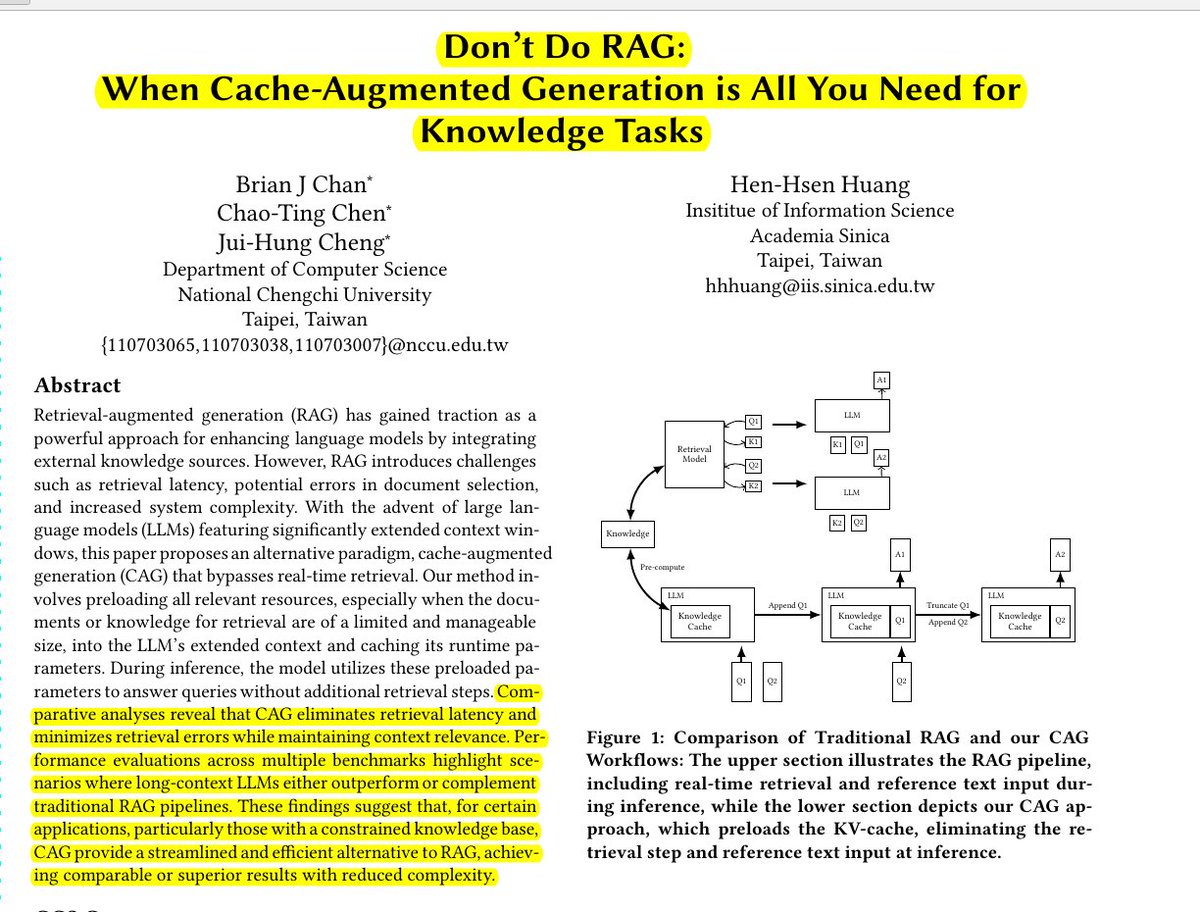
Precomputed key-value caches make knowledge retrieval 40x faster than traditional RAG.
Cache-augmented generation replaces traditional retrieval-augmented generation by preloading documents and precomputing key-value caches, making knowledge tasks faster and more accurate.
-----
🤔 Original Problem:
Traditional RAG systems suffer from retrieval latency, errors in document selection, and complex system architecture that requires careful tuning and maintenance.
-----
🔧 Solution in this Paper:
→ The paper introduces Cache-Augmented Generation (CAG), which preloads all relevant documents into LLM's memory before inference.
→ CAG precomputes key-value caches from documents, storing them for future use rather than retrieving during runtime.
→ The system operates in three phases: external knowledge preloading, inference with cached context, and efficient cache reset.
-----
💡 Key Insights:
→ Eliminating retrieval during inference dramatically reduces response time and system complexity.
→ Preloading context enables holistic understanding across all documents.
→ CAG works best when document collections fit within LLM context windows.
-----
📊 Results:
→ CAG achieves highest BERT-Score (0.7759) on HotPotQA, outperforming both sparse and dense RAG systems.
→ Generation time reduced from 94.34s to 2.32s on large datasets.
→ Consistent performance improvement across both SQuAD and HotPotQA benchmarks.
Microsoft’s new rStar-Math technique upgrades small models to outperform OpenAI’s o1-preview at math problems 🤯
rStar-Math technique enhances small language models (SLMs) using Monte Carlo Tree Search (MCTS) and self-evolution strategies.
Applied to models like Qwen-7B and Phi3-mini, it surpassed OpenAI’s o1-preview on key benchmarks, such as improving Qwen2.5-Math-7B’s accuracy on the MATH dataset from 58.8% to 90.0%.
---
→ MCTS-driven reasoning: The core of rStar-Math is Monte Carlo Tree Search (MCTS), which simulates step-by-step reasoning paths for more accurate intermediate steps, mimicking human “deep thinking.”
→ Code-augmented reasoning: Each math reasoning step outputs both a natural language explanation and its corresponding Python code. Validated Python outputs filter out incorrect steps, boosting accuracy by retaining only executable solutions.
→ Self-evolution: The training involved four rounds where the policy model and the Process Preference Model (PPM) improve each other iteratively. This led to a significant rise in benchmark performance.
→ Policy and PPM training: The process reward model (PPM) uses step-by-step "Q-value" comparisons to improve reasoning step evaluations without manual labeling. It refines trajectory selections and enforces preference-based training for consistent improvements.
→ Data synthesis: The researchers created a massive dataset of 747,000 math word problems and refined solution steps via MCTS rollouts, ensuring that only high-quality, verified solution paths were used for training.
→ Benchmark achievements: On the American Invitational Mathematics Examination (AIME), the system solved 53.3% of problems, placing in the top 20% of high school competitors. Across datasets like MATH, Olympiad Bench, and GSM8K, it outperformed multiple baselines, including larger models.
OpenAI’s biggest rival is shaking things up.
Anthropic invited 200+ elite hackers to their SF headquarters to see what’s possible with Claude
Here’s what we saw at the @AnthropicAI x @MenloVentures Builder Day Hackathon (🧵):
From excellence in the classroom to groundbreaking research, FIU has been designated a Preeminent State Research University by the Florida Board of Governors. Read more at: https://t.co/jBwgLNUWhu
Here is a nice piece on our IRES-Japan program.
Engineering undergrads conduct research in Japan | FIU News - Florida International University
https://t.co/177yRRCf6d
I am disturbed by reports that hundreds of people have been arrested in #Turkey today in another reprehensible crackdown on free speech. The government also has criminalized “disinformation.” These assaults on free expression and political opinion in Turkey must end.