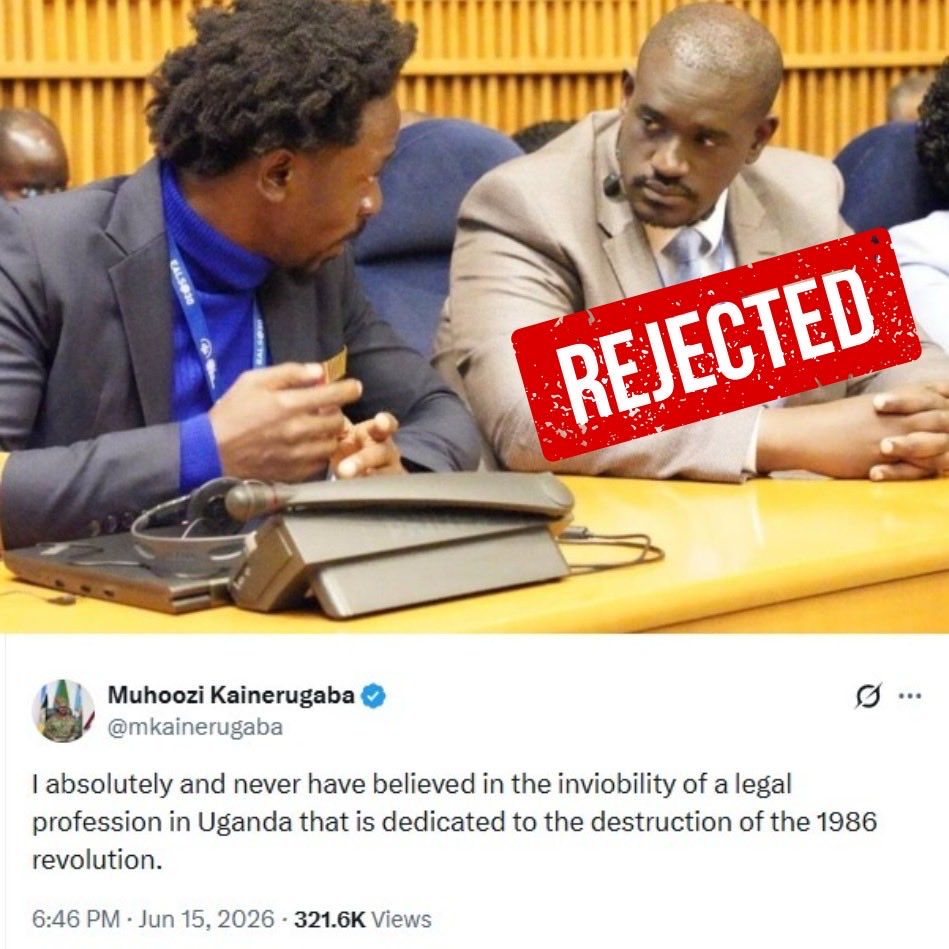
Lawyers wake up. We need an urgent audit at @ug_lawsociety
Theft of members money here is terrible:
- They went to Kenya mbu to visit Late Raila Odinga's widow spent Shs. 93M the team was led by the VP
- The Rapid Response mbu for elections: 0ver 180M was signed off, they gave the legal aid dept Shs. Less than 10M and the only activity done was Bail Application in Butambala
- The trips done are spent on over 20M on an indivdual
- They did country level up meeting of the legal aid clinics and over Shs. 40M was spent.
- When the president is traveling from his place to either Kenya or TZ (where he usually goes:) Shs. 20M is spent.
- They recruited a guy called Edris (PA to President) who's paid Shs. 3M net salary and his main role is to book flights.
- They increased allowance of Shs. 100k per hour to whoever Council member is at Secretariat. They give themselves Shs. 1M fuel allowances plus 100k for hours one spends at Secretariat.
- They encroached on the ULS House money, the reason they stopped giving updates on the ULS House.
- The three, President, VP Anthony and Treasurer Isiko Arthur need a robust investigation on their expenditure on the TRIPS, Allowances, Procurement, etc.
- Payment of the service providers is currently futile and ULS is known as an institution that doesnt pay. This is because Treasurer frustrates payment of several service providers, wanting a certain percentage in commission.
- ULS is their full-time job.
- The internal auditor can give a report on how many people are brought in as service providers without MOUs.
It is TIME UP for these guys and we need an audit.
WHY UGANDA LAW SOCIETY MUST REMAIN ABOVE POLITICS
Quote from:- Omar FaFa M'Bai.
"When a Bar Association tilts towards the Ruling Party it becomes a handmaiden of power, it's declarations are read as echoes of the Executive and it's silence as complicity. Equally when it bends towards the Opposition, it forfeits it's moral authority becoming little morethan the extension of the Party machinery. In both cases it ceases to be trusted".
" To be impartial is not to be neutral in the face of injustice, it is to denounce injustice without regard to who commits it and to defend justice without regard to who benefits from it".
Uganda Law Society is critical in defending, protecting and promoting rule of law, justice and human rights therefore as Members, we should fortify it rather than tear it down because of political differences or differences in opinion!
I pray that ULS emerges out of the current impasse stronger and more united.
Ba who are you to REJECT. oluvaayo ngogaamba dictator museveni and his family. You over strech your powers. Ba who am i to even question. Gwe oli'nakyemalila 😀
REBELS: There is no neutrality in a militarized state. I regret my attempt to serve as a bridge-builder between defenders of the rule of law & the Doubting Thomases, “pragmatists” & fence-sitters. That alliance has failed. I disassociate💯. I was wrong to associate with @elisonk.
Tuswadde'ekimala, gundi ate totuweebuulanyo. Atleast respect our tradition, we respect elders, we disagree with respect, thats the meaning of african society.
@DaudiKabanda through you sir incharge office of the chairman,please inform the CDF @mkainerugaba that abakazi'nibashaba obahireho ejjugano' bagwa'ahamahega.
Regards.
@mkainerugaba our chairman @DaudiKabanda@BalaamBarugahar there is another idiot spreading fake tweets, we need our mighty @MODVA_UPDF to bring him to basement, i will personally administer classes that holding out to be CDF is death sentence.
NO TO THE STRIKE. YES TO CONSTITUTIONALISM AND THE RULE OF LAW.
Article 126(1) of the Constitution provides that judicial power is exercised by courts established under the Constitution, while Article 128 guarantees judicial independence.
If matters concerning arrest, detention, criminal prosecution or national security are already before competent courts, what constitutional or statutory basis justifies a strike over issues awaiting judicial determination? Should lawyers not be the first to insist that due process takes its course?
While Articles 20 and 44 protect fundamental rights and freedoms, the Constitution equally recognizes the legitimate interests of the State. National sovereignty under Article 1, together with the National Objectives and Directive Principles of State Policy, requires the State to preserve security, public order, national unity and socio-economic development.
Why then are issues touching on national security often reduced exclusively to a human rights narrative before courts have established the facts? Constitutionalism requires balancing rights with other legitimate constitutional interests, including security and public order.
Article 21 guarantees equality before and under the law. If equality is the standard, why does extraordinary legal activism emerge only when specific individuals are affected while thousands of ordinary Ugandans remain on remand, face delayed trials, or lack access to legal representation?
Why are there no nationwide strikes over case backlog, delayed justice and limited access to legal services for vulnerable citizens?
The Uganda Law Society was established to advance the administration of justice and represent the legal profession. Its legitimacy depends upon public confidence in its neutrality, independence and fidelity to the law.
Where actions and public positions create perceptions of political alignment, legitimate questions arise as to whether institutional decisions reflect the interests of the entire legal fraternity or particular causes.
The questions are simple:
Is the strike authorized by law?
Is it necessary when courts are already seized of the matter?
Does it advance the administration of justice under Article 126?
Does it uphold equality before the law under Article 21?
Or does it risk substituting public pressure for judicial determination?
Article 2 binds all persons and authorities to uphold constitutional supremacy. That obligation applies equally to government institutions, professional bodies and legal practitioners.
No to selective constitutionalism.
No to politicized legal activism.
No to pressure tactics where due process is already underway.
Yes to the courts.
Yes to judicial independence.
Yes to equal justice for all Ugandans.
#SayNoToStrike #RuleofLaw
Arrest, abduction and detention are distinct legal concepts and should never be deliberately conflated for political convenience.
Where State agents seize a person without lawful authority, conceal their whereabouts, and deny them access to family, counsel or court, that is an abduction and must be condemned.
Where security agencies apprehend a suspect under the law, process the arrest, and subject the suspect to judicial oversight, that is an arrest. Sections 10, 14, 17 and 18 of the Criminal Procedure Code Act recognize and regulate such arrests.
In the case of Cnsl. @EriasLukwago, the facts as publicly known point to an arrest, not an abduction. Defending the Rule of Law requires us to oppose illegal arrests and abductions alike, but it also requires us to call lawful arrests by their proper name.
The Constitution demands fidelity to facts, not political narratives. The law loses meaning when every arrest is branded an abduction and every abduction is dismissed as an arrest.
#RuleOfLaw #Constitutionalism
The greatest threat to the Rule of Law is not the violation of law by ordinary citizens; it is the selective application of law by those who claim to be its custodians.
The Uganda Law Society leadership was elected in September 2024. To date, serious questions remain regarding the legality of the continued tenure of its leadership following the purported six-month extension granted in September 2025. Under Article 2 of the Constitution, the Constitution is supreme and binds all persons and authorities. No institution, however noble its mandate, is above the law.
If legality is the standard by which ULS measures Parliament, the Executive, the Judiciary, security agencies and every public authority, then what legal instrument expressly authorized the extension of its own mandate? What provision of the Uganda Law Society Act or governing regulations superseded the principle that leadership derives legitimacy from lawful election rather than administrative convenience?
More fundamentally, by what legal reasoning does a leadership whose own legitimacy is being questioned mobilize lawyers into a strike over matters actively before competent courts of law? Is this not an attempt to litigate through public pressure what ought to be determined through due process and judicial proceedings?
The Constitution under Article 28 guarantees every person a fair hearing before an independent and impartial court or tribunal. If proceedings are already underway, what justified calls for industrial action instead of confidence in the judicial process? Does this not risk prejudicing ongoing proceedings while simultaneously demanding respect for judicial independence?
The legal profession should know better.
A strike cannot substitute a court order.
A press conference cannot substitute evidence.
Public outrage cannot substitute due process.
And activism cannot substitute legality.
Even more disturbing is the growing tendency to attach every political disagreement, criminal prosecution, or security operation exclusively to the language of human rights while ignoring the broader constitutional framework within which the State operates.
The Constitution does not exist solely to protect rights. It also establishes political authority, national security, public order, social stability and economic transformation as legitimate state objectives. Rights are protected within a constitutional order; they do not exist in a vacuum detached from the interests of the nation.
Where is the outrage for thousands of Ugandans languishing on remand?
Where are the strikes for ordinary prisoners whose files have gathered dust in the justice system?
Where is the emergency activism for citizens denied access to legal representation due to poverty?
Why does extraordinary legal activism emerge only when particular individuals are arrested, while countless others remain invisible?
Article 21 guarantees equality before and under the law. Equality means the law must neither favour the powerful nor ignore the ordinary citizen. Selective outrage is not justice. Selective constitutionalism is not Rule of Law.
The legal profession must answer a simple question:
Which Rule of Law is being defended?
The Rule of Law that binds everyone equally, including ULS leaders themselves?
Or the Rule of Law that becomes loud when allies are arrested and silent when questions arise about the legality of its own conduct?
A society governed by law cannot be built on selective legality. Those who speak most loudly about constitutionalism must be prepared to submit themselves to the same constitutional standards they demand of others.
Anything less is not advocacy.
It is hypocrisy dressed in legal robes.
@ug_lawsociety@IsaacSsemakadde
#RuleofLawStartsinULS
The greatest threat to the Rule of Law is not the violation of law by ordinary citizens; it is the selective application of law by those who claim to be its custodians.
The Uganda Law Society leadership was elected in September 2024. To date, serious questions remain regarding the legality of the continued tenure of its leadership following the purported six-month extension granted in September 2025. Under Article 2 of the Constitution, the Constitution is supreme and binds all persons and authorities. No institution, however noble its mandate, is above the law.
If legality is the standard by which ULS measures Parliament, the Executive, the Judiciary, security agencies and every public authority, then what legal instrument expressly authorized the extension of its own mandate? What provision of the Uganda Law Society Act or governing regulations superseded the principle that leadership derives legitimacy from lawful election rather than administrative convenience?
More fundamentally, by what legal reasoning does a leadership whose own legitimacy is being questioned mobilize lawyers into a strike over matters actively before competent courts of law? Is this not an attempt to litigate through public pressure what ought to be determined through due process and judicial proceedings?
The Constitution under Article 28 guarantees every person a fair hearing before an independent and impartial court or tribunal. If proceedings are already underway, what justified calls for industrial action instead of confidence in the judicial process? Does this not risk prejudicing ongoing proceedings while simultaneously demanding respect for judicial independence?
The legal profession should know better.
A strike cannot substitute a court order.
A press conference cannot substitute evidence.
Public outrage cannot substitute due process.
And activism cannot substitute legality.
Even more disturbing is the growing tendency to attach every political disagreement, criminal prosecution, or security operation exclusively to the language of human rights while ignoring the broader constitutional framework within which the State operates.
The Constitution does not exist solely to protect rights. It also establishes political authority, national security, public order, social stability and economic transformation as legitimate state objectives. Rights are protected within a constitutional order; they do not exist in a vacuum detached from the interests of the nation.
Where is the outrage for thousands of Ugandans languishing on remand?
Where are the strikes for ordinary prisoners whose files have gathered dust in the justice system?
Where is the emergency activism for citizens denied access to legal representation due to poverty?
Why does extraordinary legal activism emerge only when particular individuals are arrested, while countless others remain invisible?
Article 21 guarantees equality before and under the law. Equality means the law must neither favour the powerful nor ignore the ordinary citizen. Selective outrage is not justice. Selective constitutionalism is not Rule of Law.
The legal profession must answer a simple question:
Which Rule of Law is being defended?
The Rule of Law that binds everyone equally, including ULS leaders themselves?
Or the Rule of Law that becomes loud when allies are arrested and silent when questions arise about the legality of its own conduct?
A society governed by law cannot be built on selective legality. Those who speak most loudly about constitutionalism must be prepared to submit themselves to the same constitutional standards they demand of others.
Anything less is not advocacy.
It is hypocrisy dressed in legal robes.
@ug_lawsociety@IsaacSsemakadde
#RuleofLawStartsinULS