@pbljung @realBertBlocken I saw his response, which was rather disrespectful, but it’s since disappeared so perhaps he deleted it. It’s not the kind of response you’d expect from a researcher to a reasonable question about their work. It makes me wonder whether this Bert Blocken guy is another Hambini.
My latest roller testing to measure MTB tyre rolling resistance coefficients.
Confirms that Schwalbe’s Super Race casing is indeed the faster than the Super Ground version.
My latest off-road tyre testing using the Chung method.
New data (the green points in the plot) obtained with good quality 33mm cyclocross clinchers with tyre inserts installed. Mainly done to check the CRR doesn’t ramp up at low pressures, due to the inserts.
Finished my Frankenbike off-road build. 2.3” MTB tyres combined with drop bars. Not pretty, but fun and fast, and better than most gravel bikes for the kind of mixed off-road trails we have here in the UK.
Had to check my torque wrench calibration, after stripping a Shimano bolt thread at a few Nm below the recommend torque setting.
The wrench seems fine. Probably Shimano’s quality control then. Not the first time either.
I love my Garmin Varia but I never liked the crappy O-ring mounts. It never fitted properly onto my aero-profiled seatpost and looks untidy.
I modified my seatpost clamp so I could bolt a Garmin mount directly onto that.
@rpenn57@zwiftinsider Actually, the interesting (but counterintuitive) thing about aero improvements is that everyone benefits. Riding at 150W, instead of the 300W done by @zwiftinsider, saves 11.2s or 0.29%, so a similar saving, although the total time for 2x Tempus Fugit laps would be ~30% slower.
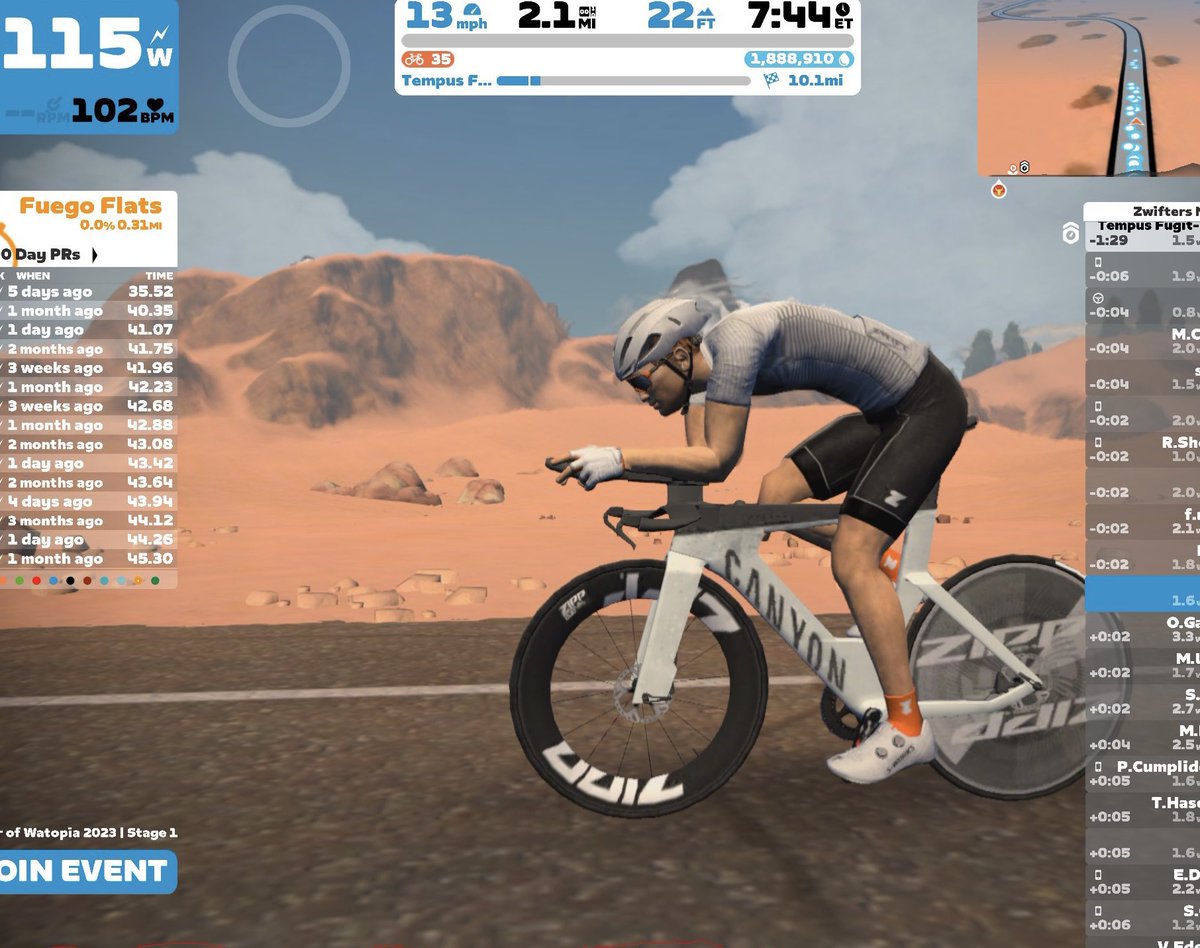
Unlocked the Zipp rear disc in Zwift.
According to @zwiftinsider this saves me 9s (0.3%) over 50 mins. From some quick calcs, this is a 0.0025 CdA reduction or -2.5W (0.8%) at 41 kph. Fairly small, but not negligible, so not just a skin.
Not that I care much about Zwift speeds.
My homemade ‘cat ear’ wind-noise reducing devices.
Surprisingly, the best bit is not the noise reduction as such, but that it never seems like you’re cycling into a headwind - and that’s priceless! I guess we must perceive a headwind from the wind noise.
The beauty of this test method is that it doesn’t care whether the benefit come from aero, rolling resistance or weight changes, but instead only shows the net effect. Also, as with all VE testing, there’s no need to target a fixed power output and then look for changes in speed.
Used Chung testing today to find which bike was fastest, for my cyclocross race tomorrow. CdA, Crr and weight set the same for the analysis of both bikes. The rising elevation for Bike B then shows it’s slower than Bike A, by about 6W at 15mph.
@markflorence11 Great episode, one of my favourites. Very clear and balanced explanations from Marc about the inherent difficulties that these devices and the methods need to somehow overcome.