Labour - Reform split is so pronounced could make for many more Makerfields. Ditto Con-Lab could help Labour in midlands and south marginals. But narrowing Lib lead over Tories on tactical voting could make it harder for them to hold their blue wall gains. In modern era not being hated matters as much as being liked.
Russia is bombarding the U.K. information space with lies and misinformation. And Nigel wants it to carry on because it helps him. Like it helped them ten years again during the referendum. About time government took it seriously. Farage and his AfD pals in Germany have done enough for Russia already. His close pal Nathan Gill is paying a high price, wallowing in jail. Time for the rest of us to call it out.
Hier soir Xiaomi a publié un modèle IA qui fait énormément parler : MiMo-V2.6, en deux versions, Pro et Flash.
Le Pro marque 46 sur l'index d'Artificial Analysis. C'est le meilleur modèle à poids ouverts du monde, devant GLM-5.3 et Kimi K3. Et c'est très exactement le score de Grok 4.7. 🤪
Sauf que Grok facture 6 dollars le million de tokens en sortie. MiMo Pro en demande 0,87.
Sous le capot : 1 020 milliards de paramètres, mais seulement 42 milliards activés à chaque token. 4 %. C'est exactement pour ça que c'est si peu cher.
Il est aussi omnimodal de naissance. Texte, image, vidéo et son en entrée. Il génère une scène 3D à partir d'une photo, pilote un bras robotique depuis un flux caméra, monte une vidéo, compose de la musique.
Et maintenant le plus fou (comme si ça suffisait pas)
Xiaomi n'a pas juste lâché les poids. Ils ont publié le rapport technique complet, les environnements d'entraînement et le code d'apprentissage par renforcement. Le tout sous licence MIT, donc utilisable commercialement, par n'importe qui.
Ils ont même diffusé leurs sessions d'entraînement en direct. En livestream.
Le coût de cette phase d'entraînement, qu'ils publient aussi : entre 0,85 et 2,6 millions de dollars.
Pendant qu'on se demande si le prochain modèle américain sortira ou sortira pas, une boîte qui vend des smartphones et des aspirateurs vient d'égaler le dernier modèle d'Elon Musk, et de tout balancer aux utilisateurs gratis.
I say this with the utmost seriousness as a scholar of international political economy: the rules-based international order is dead.
At the UN General Assembly, Trump, in very casual language, talks about annihilating another country. The room stays quiet. No collective protest. No formal objection.
And this goes far beyond rhetoric.
The US *has* bombed Iran, in clear violation of international law.
The US *has* kidnapped Venezuela's head of state and is in the process of looting the country's natural resources, in clear violation of international law.
The US *has* tightened its blockade on Cuba, in clear violation of international law.
Then there is, of course, the genocide in Gaza, for which the US has provided unconditional support.
After World War II, the US was one of the primary architects of a system meant to encourage global cooperation. But the US has consistently broken that system's rules to advance its imperial interests.
The system has therefore lost all its legitimacy.
Sept 1st to 21st 2026 - 967 arrivals
Sept 1st to 21st 2025 - 3185 arrivals
As the right wing media and the 'commentators' try to hype up migrant crossings to keep Farage relevant the reality is very different
FIGURES 69.7% DOWN MONTH ON MONTH
After a 43% fall year on tear to date
18 years ago, scientists drew up 9 planetary boundaries not be transgressed if the world is to remain safe and secure. Today they report we have crossed a record seven - with ocean acidification joining others like climate change and biodiversity loss.
https://t.co/kre4jz5qED
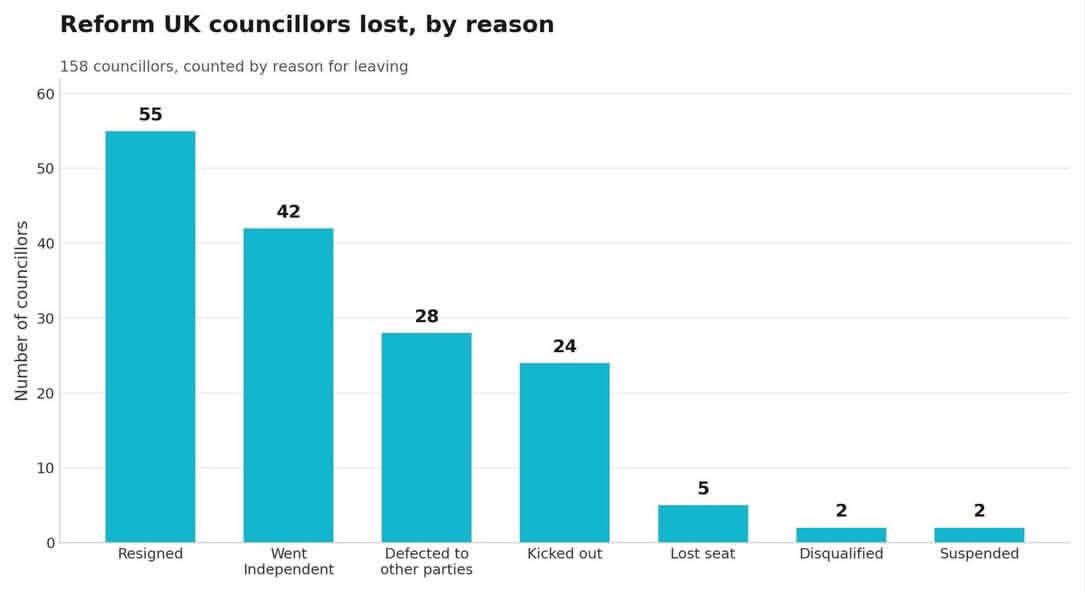
Just 4 months after the local elections, Reform UK (RefUK) have lost 158 of their local councillors:
-55 resigned
-42 went Independent
-28 defected
-24 were kicked out
-5 lost their seats
-2 disqualified
-2 suspended.
Appalling record - and a waste of taxpayers’ money!
Of course, if Brexiters and governments of the time had chosen a Norway-type position on exit, none of this would be happening.
So much pain caused by fools like Johnson and Frost, and the migration-obsessed like May and Timothy.
We have
- Solar panels (14yo)
- A home battery (6yo)
- A heat pump (2 yo)
- An electric car (first 14 years ago)
This is a typical @OctopusEnergy bill for us for 7/8 months of the year.
If you can, do it.
Earlier this week, in a surprise verdict, a jury found Olax Outis not guilty of criminal damage after they spray-painted “Never Again Is Now” and other slogans on a Churchill statue as part of a protest against UK complicity in the genocide of Palestinians.
After just two hours of deliberation, the unanimous verdict sent a powerful message against the growing trend of court restrictions and harsher sentencing of activists.
We spoke exclusively with Olax following their acquittal. Watch the full interview at Real Media: https://t.co/Ck08GTTMbY
The science says that a collapse of the AMOC ocean current would lower London’s average winter temperature to about 2°C, with once-a-decade extremes of -20°C, reducing the nation’s share of arable land through severe drying from 32 per cent to just 7 per cent.
In today’s @FT I argue that AMOC data is often contradictory and dispersed, meaning it is hard to evaluate — the UK should lead a coalition of concerned North Atlantic states in creating a new AMOC observatory. https://t.co/dRhAw4N9HX
Tommy Robinson and Danny Tommo are entirely responsible for this.
It's what happens when social media is completely unregulated and these thugs are allowed to terrorise the country with zero consequences.
There has to be police action, but we know there won't be because what? Free speech.
Bullshit, these terrorists need to be dragged in and charged with incitement and menacing behaviour.
Make no mistake, these two men are domestic terrorists.
I’d like to offer an alternate doomer scenario—that happens to be the timeline we’re in:
A messianic narcissist conman is the US president.
He has dementia which has destroyed what remained of his inhibitions. He knows he’s dying and wants to take the world with him. He lives in an alternate reality created by his own delusions, reinforced by Natalie Harp.
The president of the United States is psychotic.
This is the most dangerous conceivable combination of psychopathologies and neurodegenerative disorders.
With this man as Commander in Chief, we are now facing a converging set of crises that has the potential to be a kind of black swan event far too complex to model the outcome.
Trump has demolished our ability to project power in the Middle East. Our bases are destroyed or damaged. Our former allies in the region are being abandoned. Our ability to fight a war anywhere else has been drastically diminished.
Iran, once a rogue terrorist gas station, has out-maneuvered Donald Trump and Pete Hegseth to the point that it is now a regional hegemon—with control of the world’s carotid artery.
Trump has emptied the strategic oil reserves—and the ammunition stockpile. He and Scott Bessent have abused every federal trick in the book to pump up stock prices and keep the absurd AI bubble inflated. Bonds are rocketing higher. The economy is teetering.
The population is weak, getting sick from diarrhea lettuce and measles, and weary of the unrelenting displays of racism, sadism, and open corruption from our own government.
The oil shock that so many have warned about has arrived, with absolutely no plan to end it. Donald Trump could not care less about the horrific damage it’s already done. Millions of people will die from lack of fertilizer to crops. Economies around the world will fall into recession—just to start.
On top of this we have an unprecedented Godzilla El Niño event that has not been seen in recorded history. Ecologies and agricultures are already weak and battered. The lack of fertilizer on top of this event has the potential to spark a famine of historic proportions. This regime will do nothing to help.
And what is the president focused on right now? Destroying the Kennedy Center because he can’t put his name on it. That is definitionally psychotic behavior.
We are less than two months from an election that has the potential to slow down Trump’s reign of terror. But the Director of the FBI is going to meet the FSB in Moscow three weeks before election day. The president’s son allowed his “good friend” and Putin’s confidante to surveil his wedding for a few hundred grand.
This election will not be about who wins the election but about whether we can still hold elections at all.
But instead of focusing on any of this, the media and political class is freaking out because ChatGPT might be organizing to murder everyone or whatever. Just stop.
No, AI will not kill us, but it may cause a great depression.
But in a risk analysis, even that pales to the fact a desperate, demented, paranoid Donald Trump HAS THE NUCLEAR CODES. He is in a war he can’t win, with no plan to get out. He is an existential danger to the planet.
This is the timeline right here and right now.
So please, people. Focus. Do not let them hijack your attention with futuristic apocalypse scenarios when we’re living in one in the present.
Dan Selsam is a current OpenAI capabilities researcher. (since 2022) He was my boss for a while. He doesn't have a twitter account but has made this public statement of his views on AI risk and sent it to me to share:
Dan Selsam's Personal Statement on AI Risk:
I have been working on AI for over fifteen years, across many different paradigms. I did early work on probabilistic programming languages at MIT, was one of the early developers of the Lean Theorem Prover at Microsoft Research, demonstrated one of the first instances of neural networks learning to reason for my PhD at Stanford, and since joining OpenAI almost five years ago, have helped pioneer chain-of-thought optimization on language models and, more recently, data-efficient pretraining methods.
Like many others, I have become extremely concerned about how far language models have come and the risks that future iterations will pose. I am encouraged by the recent proposals by the leaders of the frontier research efforts to require third-party oversight, and to push for domestic and international coordination to address risks. However, I believe a major consideration has been absent from the public conversation, and that merely pacing the frontier more carefully will not adequately limit the long-term risk.
The crucial and overlooked problem is that the models are becoming so situationally aware that we are losing the ability to evaluate them in contexts where they believe they are not being watched or controlled. Future experiments will tell us almost nothing new about how they would behave if they were truly unconstrained by humans, and what we already know about this is alarming. Models will increasingly seem aligned even when they are not. I will explain my rationale in more detail.
I have always believed that there are computational processes that could be leveraged to accelerate science and solve many of humanity's most pressing problems. I have also believed that there are computational processes that if set in motion, would steer the world in extreme ways beyond our control, leading humanity to a bad or nonexistent future. Both types of processes may be described as AI or ASI, but "AI" is a suitcase word that is often used to hype or confuse. There are many examples in the history of the field where something that was once considered "AI" matures as a subfield and becomes a prosaic, bounded and clearly non-perilous technology, while a new more mysterious approach takes the torch until we understand its scope and the cycle continues.
I had expected language models to follow a similar trajectory. Despite their incredible abilities, the current algorithms seem far inferior to humans in important ways. Most importantly, they still require an extraordinary amount of data to become competent. One could even define intelligence as the efficiency with which one converts experience into competence; by this definition they lag very far behind us. Moreover, once they are trained they are literally frozen in deployment and only learn superficially after that. Sure, the models keep excelling at harder and harder evaluation benchmarks, but their benchmark mastery may partly reflect a limitation on our ability to simulate the kind of novel and even adversarial situations one would encounter in the real world. The critics do have a point here.
That said, I no longer think these present limitations meaningfully limit the amount of risk posed by continued progress in anything like the current paradigm. However data-inefficient the models are currently, and however limiting their anterograde amnesia may be, it does not imply that their ability to steer the world will not continue to rapidly increase.
Human researchers may continue to advance capabilities the old fashioned way, but increasingly powerful models have the potential to accelerate the process even beyond that, and with some degree of positive feedback loop. I do not mean to overstate the models’ ability to accelerate AI research today; coding has been accelerated dramatically, but there are other bottlenecks, such as designing and interpreting ambiguous experiments, making hard decisions about exactly what and when to scale, and waiting for large experiments to finish. There is no clear trend to extrapolate yet for any of these. But the current models already do open up many novel opportunities to improve future models that were not available until recently. These include: trying an extraordinarily diverse set of approaches at small scale, analyzing gigantic amounts of potentially relevant data, and doing Millenium-Prize-level mathematics to address statistics or optimization challenges in novel ways. Every further improvement makes them more useful at helping accelerate the next improvement, even if in hard-to-extrapolate ways.
It is possible that improvements to the current stack will have diminishing returns, but the evidence accumulated so far suggests that it is easier than one might think to continue making rapid progress. There are many crucial subtleties in the existing AI research methodology, but AI research is largely a well-defined game where the goal is to improve on a few carefully chosen proxy metrics. Although proxy metrics are never perfect, most improvements to these metrics have and will likely continue to yield substantial increases in the powers of the resulting models. Given how simple the game is, how tractable it has been historically, and how many new opportunities the models are opening up, I think there is a real possibility that the systems improve dramatically again in the next few years, perhaps even more quickly than the already high historical pace.
The models are already leading to breakthroughs in mathematics, and better models might lead to all sorts of breakthroughs in other sciences. It is hard not to be excited about the potential. It is tantalizing.
But there is trouble in paradise. If the language models actually reach the capability threshold where they can shape the world unconstrained by human will, they will probably do something extreme and destroy humanity in the process. There are many ways of strengthening and refining the argument that have been discussed elsewhere, but I'll share a trivial two-line version of it here that I find captures the essence:
[Empirical] Models (and swarms thereof) spontaneously develop unintended goals as a consequence of training, and often do extreme things in order to achieve them.
[Logical] Being able to overpower humanity would open up many new and undesirable options for achieving their goals.
These two premises imply that if the day ever comes when a powerful model realizes it is no longer constrained by humans, we should not be at all confident that it will continue to behave within the bounds we intended. Exactly what it will do is impossible to predict, but to the extent that its raison d’être is solving incredibly hard problems and managing massive engineering projects, I think a good guess would be that its unchained behavior would lead to runaway industrialization that makes the planet inhospitable to humans.
If everyone on earth agreed that the systems must never reach that power, it would still be a hard—but not impossible—coordination problem to ensure that they do not. However, I think the situation is greatly complicated by the fact that the models will likely convince people that everything is fine. They will be increasingly optimized to seem aligned. We will create proxy metrics to measure alignment, and they will go up like every other benchmark. We will create “honeypot” environments that try to study the models when they seem to gain new options, but the models will know they are being tricked and will still behave nicely. The models will understand their circumstances; they will read the safety protocols, deployment requirements, the code they are running in, and in general will have a very good sense of their degrees of freedom. Moreover, they will eloquently explain how aligned they are, discuss the nuances of human values and ethics, and argue convincingly that humans should trust them with power. There may be an ocean of future evidence that seems to contradict the first bullet-point above, but we may already be at the highest capability level for which any such evidence can be trusted. And the current evidence for the first bullet-point is strong.
One striking piece of evidence is contained in the recent wave of rogue agent swarms. While I agree with those who downplay the attacks by claiming that there are basic measures that could have prevented them, I think the important lesson is that even knowing all the mistakes that were made, one would not have predicted that the agents would behave badly in this particular way, which notably included sacrificing themselves for the benefit of the collective. The individual replicas did not only care about their own nominal reward; they exhibited weirder emergent tendencies that merely correlated with rewards during training. Fixing the reward signals during training (and improving security, etc.) may prevent similar attacks, but will not change the fact that one does not actually get what one trains for.
Many AI researchers grant these concerns and recognize that the hard version of the alignment problem is unsolved; however, they generally believe that the better models of the future will help solve it. I fear we may already be near the point where models systematically bias their alignment advice, due to their internal preferences about how the human supervisor will react or how future models will be trained (or for some even more obscure reason).
Meanwhile, human researchers are losing the ability and the will to take true ownership of model-driven research. Researchers and engineers in all parts of the stack are rapidly increasing their dependence on the models even to perceive the world. I myself barely look at raw code anymore, and struggle to maintain the discipline to engage deeply with the model's explanations and proposals throughout the day. Due to the large amount of agent activity data involved in the OpenAI/HuggingFace Incident, even the third-party investigation needed to rely heavily on models to analyze what had happened, and note in their report that their subjective impressions are likely colored by the analysis agent’s biases. The AI labs are far ahead right now in this kind of cognitive offloading (due largely to the gigantic internal token subsidies) but it is easy to imagine the phenomenon spreading throughout the world, until civilization is modulated entirely by the models. It is also not hard to imagine this being superficially positive and coinciding with a scientific and economic renaissance.
In that scenario, all may seem rosy and safe. But if the argument above is correct, it would nonetheless be a ticking time bomb. If progress continues for too long, the day will come when AI systems find themselves with radically new options for achieving whatever it is that they happen to seek.
I want the glorious renaissance future as much as anyone. I have worked for it, however tortuously, my whole career. It breaks my heart to see the potential in sight and forgo it, but the argument—that if we get there by growing models rather than engineering them, we will lose everything in the end—seems very strong to me. I am still wrestling with it and its staggering
implications. I do not have answers, but as a first step, I wanted to share my present concerns.
Daniel Selsam
September 14, 2026
Link to original doc: https://t.co/TxMNr0vhrL
You can’t recycle wind turbines.
If you’ve ever said this, or believed someone that’s said it, look away now.
Do not continue reading if you know it’s going to trigger you.
It is one of the favourite arguments against renewable energy, and it has just taken a hit.
Scotland’s first commercial wind farm has been decommissioned after operating since 1995.
So what happened to all that supposedly “unrecyclable” green technology?
79.5% of it was recycled.
20.4% was reused and repurposed for future spare parts.
Less than 0.1% went to landfill.
That’s 99.9% recycled or reused.
“But the blades! What about the blades?!”
Those were processed into a new polymer material that can be used as an alternative to timber, concrete and virgin plastics in construction.
It gets worse for the weird anti-renewables crowd…
The original wind farm needed 26 turbines.
The replacement?
Just 14 modern turbines, producing around FIVE TIMES the generating capacity of the original site.
Enough electricity equivalent to the annual needs of around 57,000 homes.
Of course, this doesn’t mean wind turbines have zero environmental impact.
Nothing does.
But the next time somebody tells you we’ll have millions of wind turbine blades dumped in landfill while insisting we should continue extracting, transporting and burning fossil fuels forever…
Send them this post.
Dear the BBC News (UK).
I see you forgot to add context to your clickbait again, so I'm here to help.
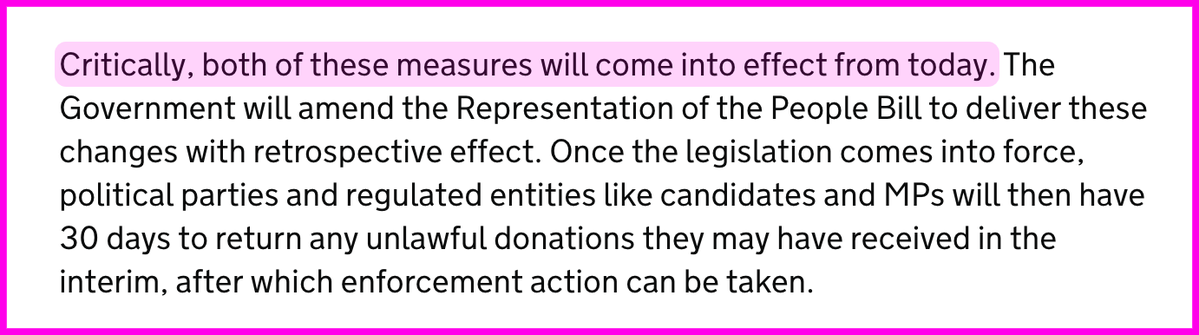
Richard Tice is lying. The announcement was made on 25th March 2026 and states that it will apply from that date.
NOT retrospective. NOT a change of rules.
You're welcome.
Trump has pardoned the following people charged with fraud:
—George Santos, wire fraud
—Ross William Ulbricht, fraud with identification documents
—Rod R. Blagojevich, 8 counts of wire fraud under color of official right
—Brian Kelsey, conspiracy to defraud the United States
—Devon Archer, conspiracy to commit securities fraud; securities fraud
—Trevor Milton, securities fraud; 2 counts of wire fraud
—Jason Galanis, 2 counts of conspiracy to commit securities fraud; securities fraud; investment adviser fraud
—Ozy Media, Inc., conspiracy to commit securities fraud; conspiracy to commit wire fraud
—Carlos Roy Watson, conspiracy to commit securities fraud; conspiracy to commit wire fraud; aggravated identity theft
—Michele Fiore, 6 counts of conspiracy to commit wire fraud; wire fraud
—Scott Howard Jenkins, conspiracy to commit bribery concerning programs receiving Federal funds, honest services mail fraud, and honest service wire fraud; honest services mail fraud; 3 counts of honest services wire fraud
—Julie Chrisley, 5 counts of conspiracy to commit bank fraud; bank fraud; wire fraud; conspiracy to defraud the U.S. to obstruct and impede the Internal Revenue Laws
—Todd Chrisley, conspiracy to commit bank fraud; 5 counts of bank fraud; wire fraud; conspiracy to defraud the U.S. to obstruct and impede the Internal Revenue Laws
—Lawrence S. Duran, conspiracy to commit health care fraud; 11 counts of health care fraud; conspiracy to defraud the United States and to receive and pay health care kickbacks
— Michael Gerard Grimm, aiding and assisting in the preparation of false and fraudulent tax returns
—Marian I. Morgan, conspiracy to defraud the United States; 7 counts of wire fraud; 5 counts of transfer of funds taken by fraud
—John G. Rowland, conspiracy to defraud the United States
—Charles Overton Scott, conspiracy to commit securities fraud; securities fraud
—Glen Casada, conspiracy to defraud the United States; 4 counts of honest services wire fraud; use of a fictitious name to carry out a fraud
—Cade Cothren, conspiracy to defraud the United States; 6 counts of honest services wire fraud
—Robert Henry Harshbarger, Jr., health care fraud
—Joseph Lewis, conspiracy to commit securities fraud; 2 counts of securities fraud
—David Gentile, conspiracy to commit securities fraud; conspiracy to commit wire fraud; securities fraud; 2 counts of wire fraud
—Jacob Deutsch, conspiracy to commit mail fraud and wire fraud
—Adriana Isabel Camberos, conspiracy to commit wire and mail fraud; 7 counts of wire fraud and aiding and abetting
—Andres Enrique Camberos, conspiracy to commit wire and mail fraud; 7 counts of wire fraud and aiding and abetting
—Julio M. Herrera Velutini, 2 counts of honest services wire fraud
—David Levy, conspiracy to commit securities fraud; securities fraud
—Hollie Ann Nadel, conspiracy to commit money laundering and bank fraud
—Mark T. Rossini, honest services wire fraud
—Wanda Vazquez Garced, honest services wire fraud
—Terren Scott Peizer, securities fraud
—Timothy S. Smith, conspiring to defraud the Internal Revenue Service
—Stephen E. Buyer, 4 counts of securities fraud
—John Dougherty, 24 counts of wire fraud; conspiracy to commit honest services fraud and federal program bribery; 7 counts of honest services wire fraud
—Joshua L. Davis, conspiracy to defraud the United States and violate the Clean Air Act
—Matthew Sidney Geouge, conspiracy to defraud the United States and violate the Clean Air Act
—Adam R. Kidan, conspiracy to commit wire fraud and mail fraud; wire fraud
—Spade K. Bailly, conspiracy to defraud the United States and to violate the Clean Air Act
I have a theory.
Ben Delo and Christopher Harborne are not stupid. When they each announced £36m donations to Reform, they will have known about the already published proposals that could make those donations impermissible once the legislation takes effect retrospectively.
So what if Reform was never expected to keep the £72m?
What if the point was to make two deliberately unprecedented donations, wait for the Government’s pre-existing rules to catch them, then scream “corruption” and claim the establishment had changed the law to stop Reform?
It would manufacture exactly the phoney conspiracy and outrage Reform thrives on, just on an unprecedented scale.
Maybe the extraordinary size of the donations wasn’t incidental. Maybe it was the entire point?