@elonmusk You could singlehandedly finance the next collider in the US for a fraction of what you paid for twitter or what it costs to get humans to Mars.
And it would be the first time we build a muon collider. A real shot at making history
X-ray imaging, PET scans, CT scans, and MRIs are various imaging techniques that are used to capture images of the inside of the body.
X-ray: detects bone fractures, certain tumors and other abnormal masses, pneumonia, some types of injuries, calcifications, foreign objects, or dental problems.
MRA: Magnetic Resonance Angiography uses a powerful magnetic field, radio frequency waves and a computer to evaluate blood vessels and help identify abnormalities.
MRI: Magnetic resonance imaging uses a magnetic field and radio waves to take pictures inside the body. It is especially helpful to collect pictures of soft tissue such as organs and muscles that don't show up on x-ray examinations
PET scan: Positron Emission Tomography may be used to evaluate organs and/or tissues for the presence of disease or other conditions. PET may also be used to evaluate the function of organs, such as the heart or brain. The most common use of PET is in the detection of cancer and the evaluation of cancer treatment.
CT scan: Computed Tomography is used to identify disease or injury within various regions of the body. For example, CT has become a useful screening tool for detecting possible tumors or lesions within the abdomen. A CT scan of the heart may be ordered when various types of heart disease or abnormalities are suspected.
[🎞️ World of Medics]
Here we see @LHCbexperiment’s Vertex Locator (VELO). This pixel detector, with its millions of microscopic pixels, can recreate particles’ trajectories at an unprecedented speed of 40 million times per second.
The VELO is located only 3 millimetres from the LHCb collision point. It surrounds the proton beams interaction region and is responsible for the reconstruction of the proton–proton collision, as well as the decay vertices of long-lived particles.
Find out more: https://t.co/punG8p7hU2
This could be an incredible revolution in Cosmology.
The Dark Energy model of the universe, which won a Nobel Prize in 2011, may be completely wrong.
The accelerating expansion instead is simply because time runs faster in the voids between galaxies.
Let me explain:
Talking about good news: the Atlas group at @_nikhef just heard from @NWOFunding that we received funding for our ENW-XL proposal aimed at studying di-Higgs boson production to study the Higgs potential. PI is Pamela Ferrari
NWO-website with all projects:
https://t.co/V0XRCfcQvs
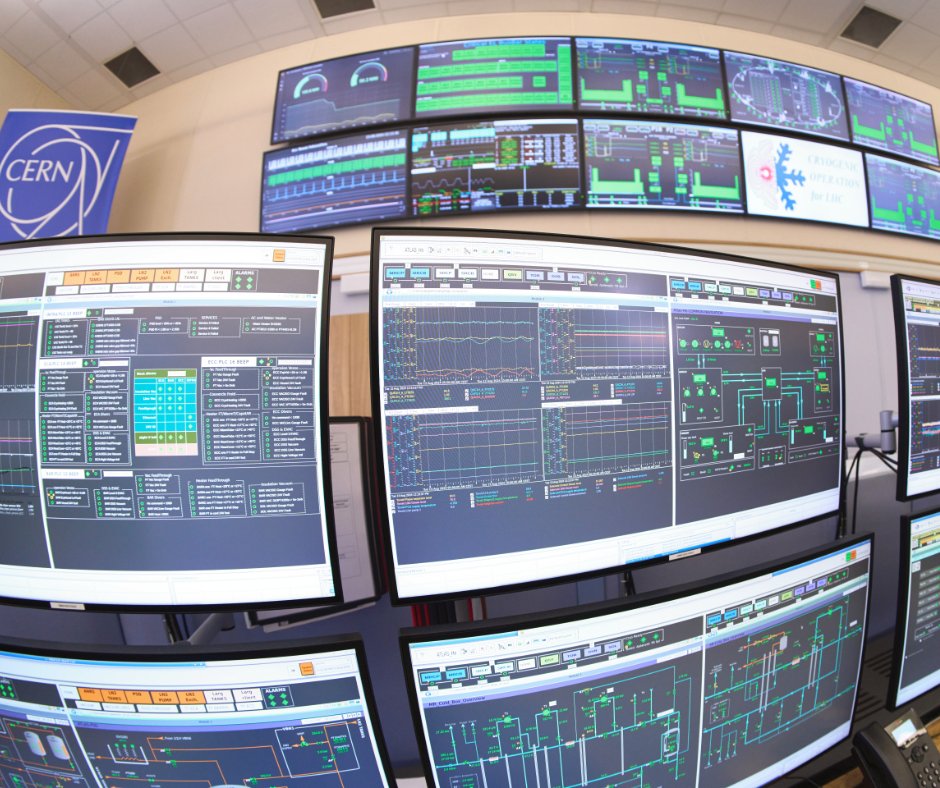
Here we see CERN’s Control Centre, also known as the CCC. Each corner of the room is an island of computer screens devoted to a specific machine, where different operations teams work in shifts.
In these pictures, we see the operator consoles that allow CERN engineers to monitor and command complex control systems such as #LHC Cryogenics or the CERN Technical Infrastructure.
The CERN Industrial Control Systems group of the Beams department provides support and software solutions for operating the general infrastructure (cryogenics, electricity, radiation protection, etc.), as well as controls for the experiments and associated institutes.
Find out more about what goes on in the CCC: https://t.co/dOYO951Sok
Three wonderful Christmas presents under the tree for Nikhef! ...NWO-XL grants for three groundbreaking research lines at Nikhef:
https://t.co/PfYRdYecrC
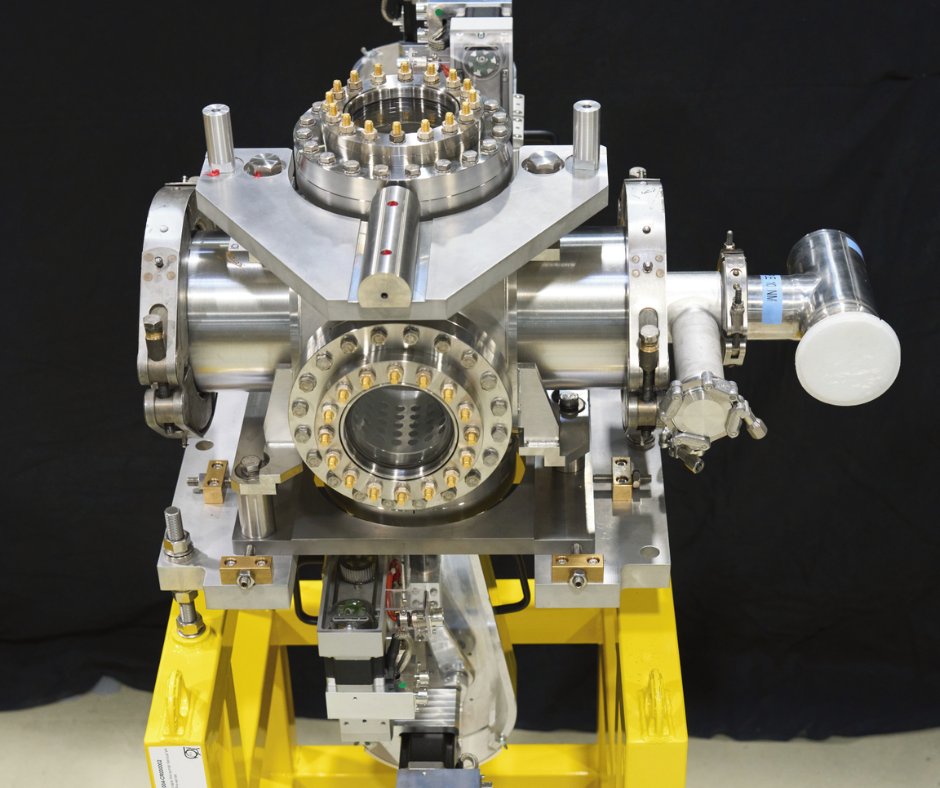
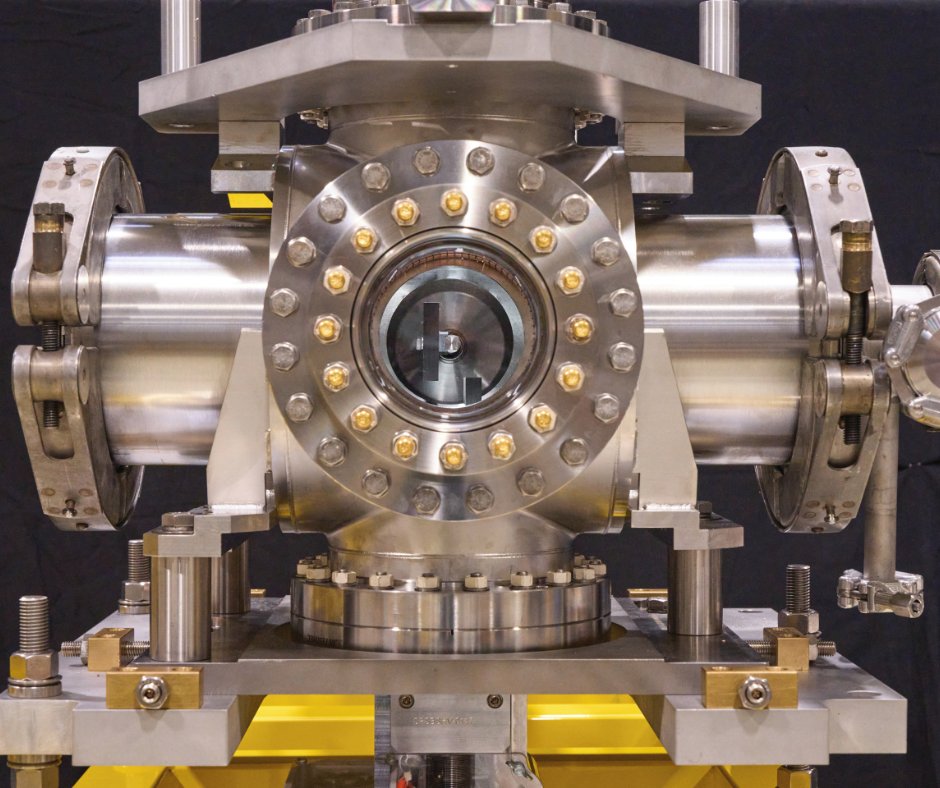
Here we see the new version of the Super Proton Synchrotron (SPS) scraper, a protection system that uses two movable graphite blades to scrape the halo of the proton beam – particles hovering outside the beam – before its injection into the Large Hadron Collider (LHC).
The high-luminosity upgrade of the LHC will result in brighter beams and thus will require improved injection protection systems. #HiLumiLHC
Find out more about CERN’s particle accelerators:
https://t.co/lEqlGqbgmz
Noble prize winner Bertrand Russell, born in 1872, talks about his grandfather John Russell, 1st Earl Russell and twice Prime Minister of the Uk, who had met Napoleon during his exile on Elba
Nearly a decade after the foundation of special relativity, Albert Einstein submitted his paper 'The Field Equations of Gravitation' for publication #OnThisDay in 1915, which gave the correct field equations for the theory of general relativity.
Our feature in the @CERNCourier is out: Patrick Koppenburg and Marco Pappagallo survey the 23 exotic hadrons discovered at the LHC so far.
https://t.co/x2ZFhsCdJz
In a universe with only baryons and hardly any anti-baryons it's bizarre that we don't find any CP asymmetry in baryon decays. Now we do. 👏 @lhcbexperiment.
https://t.co/WBvlSSIZbg
Le 1er octobre 2024, une cérémonie a été organisée à Genève pour marquer le 70e anniversaire du CERN. Plus de détails sur le projet CLOUD développé au CERN https://t.co/BL8zaWHyKV. #blogmeteosuisse#MétéoSuisse#meteo
Arguably the most intelligent photo ever taken:
Solvay Conference on quantum mechanics at the Institute International de Physique Solvay, Brussels, Belgium, in 1927. 17 of the 29 attendees were or became Nobel Prize winners. ✍️
As the global science race is on, I want Europe to switch gear.
@CERN’s story shows that European unity is our greatest asset in this.
We must put research and innovation at the heart of Europe’s economy ↓ https://t.co/6aJtWSgqVT
Did you guess Elisabeth’s profession?
Elisabeth works in the @LHCbExperiment, which investigates the difference between matter and #antimatter by studying the so-called "beauty quark", or "b quark" particle.
The LHCb detector is 21 metres long, 10 metres high and 13 metres wide, and weighs 5600 tonnes. This massive experiment requires a collaboration of proportional size to function. This includes the work of Elisabeth and thousands of other scientists, physicists and engineers.
In this year of #CERN70, join us as we highlight many of the different professions that help run an international Laboratory.
Find out more: https://t.co/RcrqqOUmFn
#CERN70 #ILoveCERN
[Communiqué de presse] @CMSExperiment apporte une contribution de poids à la mesure de la masse du boson W
Ce résultat représente la mesure la plus précise effectuée à ce jour auprès du LHC de la masse du boson W
En savoir plus : https://t.co/ibY614SEso






![Rainmaker1973's tweet photo. X-ray imaging, PET scans, CT scans, and MRIs are various imaging techniques that are used to capture images of the inside of the body.
X-ray: detects bone fractures, certain tumors and other abnormal masses, pneumonia, some types of injuries, calcifications, foreign objects, or dental problems.
MRA: Magnetic Resonance Angiography uses a powerful magnetic field, radio frequency waves and a computer to evaluate blood vessels and help identify abnormalities.
MRI: Magnetic resonance imaging uses a magnetic field and radio waves to take pictures inside the body. It is especially helpful to collect pictures of soft tissue such as organs and muscles that don't show up on x-ray examinations
PET scan: Positron Emission Tomography may be used to evaluate organs and/or tissues for the presence of disease or other conditions. PET may also be used to evaluate the function of organs, such as the heart or brain. The most common use of PET is in the detection of cancer and the evaluation of cancer treatment.
CT scan: Computed Tomography is used to identify disease or injury within various regions of the body. For example, CT has become a useful screening tool for detecting possible tumors or lesions within the abdomen. A CT scan of the heart may be ordered when various types of heart disease or abnormalities are suspected.
[🎞️ World of Medics]](https://pbs.twimg.com/media/Gft4ThFXsAA1FpS.jpg)


![CERNpress's tweet photo. [Communiqué de presse] @CMSExperiment apporte une contribution de poids à la mesure de la masse du boson W
Ce résultat représente la mesure la plus précise effectuée à ce jour auprès du LHC de la masse du boson W
En savoir plus : https://t.co/ibY614SEso https://t.co/qLDo331eql](https://pbs.twimg.com/media/GXqv4cIXYAAkU0L.png)


