A long-chased dream reaction, enantioselective nucleophilic C-H fluorination is unlocked by our ligand design under Pd catalysis, enabling rapid diversification of drug-like molecules and radiolabelling for PET. Huge thanks to @scrippsresearch and @bmsnews for continuous support!
The @YulabJin reports a one-step method to stereoselectively attach fluorine to drug-like molecules using low-cost fluoride. Published in @NatureCatalysis with first author @NikChekshin and @bmsnews, the approach uses fluorine-18 for PET imaging to track bioactive compounds and accelerate drug discovery. More: https://t.co/YfVLG8w8ZW
In the @YulabJin, @NikChekshin discovered & developed novel catalytic systems for selective C-H functionalization, unlocking access to new chemical space & enabling synthesis of structurally diverse libraries of bioactive molecules & medicinal targets.💻: https://t.co/fM0dsLsjut.
One of the most memorable moments of my PhD was the discovery of exceptional stereocontrol of MPASA ligands in asymmetric incorporation of nucleophiles into C(sp3)–H bonds. Excited to see first application published as the Editor's Choice Article @J_A_C_S
https://t.co/ZV4IpvcUA8
Our new breakthrough is out in @Nature!
Our ligand design for a cationic catalyst assembly unlocked C–H coupling, arylation, and oxidation of ketones and esters.
Congratulations to my collaborator Yi-Hao Li for driving this work with exemplary efficiency!
https://t.co/3csLrhkdKV
Today marks a monumental milestone: 100 years of pioneering science at Scripps Research. 🎉 On December 11, 1924, philanthropist and journalist Ellen Browning Scripps laid the foundation for what would become a globally renowned institute. Learn more at https://t.co/tsCxVsmpmY.
Honoured to receive the JM Award from IPMI!
I'm most thankful to my doctoral advisor Prof. Jin-Quan Yu and to Scripps Research for the tremendous support and the unparalleled opportunities to advance the frontiers of catalysis and work with the most brilliant minds in the field.
Congrats to doctoral researcher @NikChekshin on receiving the 2024 @PreciousIPMI@Johnson_Matthey Award for his work in Pd-catalyzed C-H functionalization—a method advancing sustainable practices in medicinal and materials chemistry. More: https://t.co/MMKMVCji5E
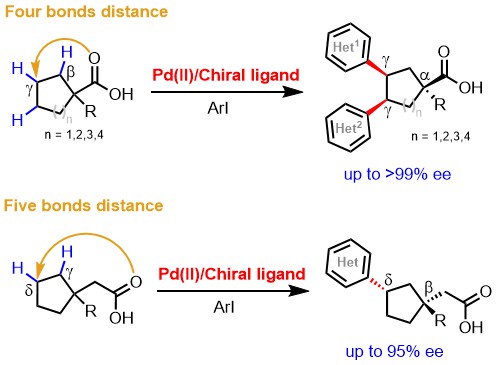
We broke 4 C-H bonds at once! This enantioselective cascade combines our earlier work on free acid dehydrogenation producing a norbornene equivalent in situ with Catellani-type polyarylation to construct 4 C-C bonds and 3 new stereosenters in a single step https://t.co/puznONhPYw
Yamada-Koga asymmetric lithiation is part of the inspiration for our first project on asymmetric CH palladation in 2002. This recognition is so special to my coworkers: CH activation is finally a significant member of the asymmetric catalysis family, huge potential to yet improve
In our new report, we discovered a dual-ligand system to overcome the intrinsic electronic bias in the olefination of protected phenols without directing templates - our ligand design controlled site-selectivity by altering reversibility of C-H palladation.https://t.co/gKsjvnanR5
Celebrating #HigherEducationDay! 🎓🌟 The @ScrippsGradPrgm is ranked among the nation's top 10 science graduate programs, according to @usnews. Our commitment to research and innovation inspires the next generation of scientists. Read more: https://t.co/8zoRdUbr02
We have now utilized the power of ligand control to achieve regioselectivity in β,γ-dehydrogenation of free carboxylic acids, providing a versatile platform for the downstream functionalization of complex molecules at remote γ-sites. https://t.co/LA2OE10KGb
Another big breakthrough in catalyst design by our group! Now employing Pd catalysis for aliphatic C-H diversification of alcohols for the first time. Congratulations to the entire team, excited for the upcoming discoveries.
In a synthetic chemistry feat reported in the journal @Nature, Scripps Research scientists devise a method for C-H activation of alcohols. https://t.co/hQKSOybDyt
Breath taking efforts from Pharma to find selective inhibitor for Sodium channels. Our CH editing of THF and THP scaffold in 2015 finds the the THF lead (vertex collaboration with Dean Stamos)optimized to give 30k fold selectivity. Medicine for acute pain, very much needed.
@mx_million Excellent overview! I remember looking for a thorough practical comparison and can't imagine it done better, congratulations Max and the rest of the team!
Our paper now in @acsJACS shows how ligand design enabled bromination of acids, featuring enzyme-inspired H-bonding mediated substrate anchoring via a proposed macrocyclic TS assembly. Congratulations to the entire Scripps team and all our collaborators! https://t.co/hwe2murF6N
With continuous molecular design of catalytic templates, we've now extended the power of precise structural editing and demonstrated regiocontrol in remote olefination of heterobiaryls. Excited to see this work published, congratulations to the entire team!https://t.co/3EFw7Y8FYP
Excited to have helped overcome long-standing issues of poor reactivity and substrate inhibition in unlocking the C-H functionalization of heteroarenes under Pd catalysis by designing a dual-catalyst system to tune Pd character. Congratulations to our team https://t.co/L8RC79HBdS