🔍 Klare Setups mit Struktur
📈 Aktien | Rohstoffe | Krypto
🧠 Saubere Trendlinien statt Overthinking
Kein Finanzrat | Keine Anlageberatung | Nur meine Meinung
$MLP.V @MLPotash
Interview out today - here are my top 10 quotes from Chairman Farhad Abasov.
Still milestones to deliver on, but not often you get a setup like this laid out on a silver platter.
"We will also show that we have full funding for the entire project."
"They've already expressed their interest and specific kind of intentions on how much and in what form and shape they will be helping us. We haven't made it public yet." (US DFC)
"We're talking to some large groups [potash producers] where they will come in as a strategic partner, not only with money, but they will also help us build and operate this thing and eventually if they want to take it out, that's fine."
"You will see that most of the money will come from non-equity sources or non-equity instruments."
"Between now and let's say full funding for construction, we actually don't need to raise capital."
"The entire port will be actually built by them. It will be funded by them as well."
"We will be able to ramp it up to 4 million tons whenever we want to."
"From India it's primarily in the offtakes... but from China actually for the project, for production."
"It may end up being a two-step process, meaning first strategic investment and then buyout."
"I think in the next few months with all the news and everything, I think that the stock will come back to where it should be."
https://t.co/Pwy1k7qy8e
And we are there, from Evercore:
"this is AI's first bailout — not of a balance sheet, but of the architecture supporting a trillion-dollar industrial buildout.... the U.S. government has become the implicit backstop of the AI industrial complex."
$MLP.V @MLPotash
Former Cargill Asia-Pacific Chair Ross J. seemingly can't get enough.
Open-market purchases ~$1.93M since mid-Oct.
This man led global commodity trade and financing at one of the world's largest agricultural giants at multi-billion $ scale.
Quite the signal.
🚨 Another major scandal is coming out of NVIDIA.
And this one has nothing to do with Jensen Huang's affairs.
According to a Wall Street Journal report, Nvidia was offering billions in financial guarantees to AI companies that could not afford its chips, so they could keep buying them.
Some of these deals were being pushed by Jensen's own son-in-law, Nico Caprez, who became a vice president in January. His team was telling small cloud companies and data center builders that Nvidia could arrange credit support for them within a couple of weeks.
The goal was simple: turn them into long term buyers of Nvidia GPUs.
And the size of Nvidia's commitments has exploded. Its own filing shows $530 BILLION in commitments and guarantees, up from $184 billion just one quarter earlier.
Inside the company, CFO Colette Kress was raising concerns. She kept asking how these guarantees were priced and what Nvidia was really getting back.
In an August meeting, Jensen cut her off and called her "a deer in the headlights."
She was also the one who cut Nvidia's guarantee on OpenAI's Ohio data center from $250 billion to $105 billion.
Now Jensen is gone, and the CFO who questioned these deals is running Nvidia.
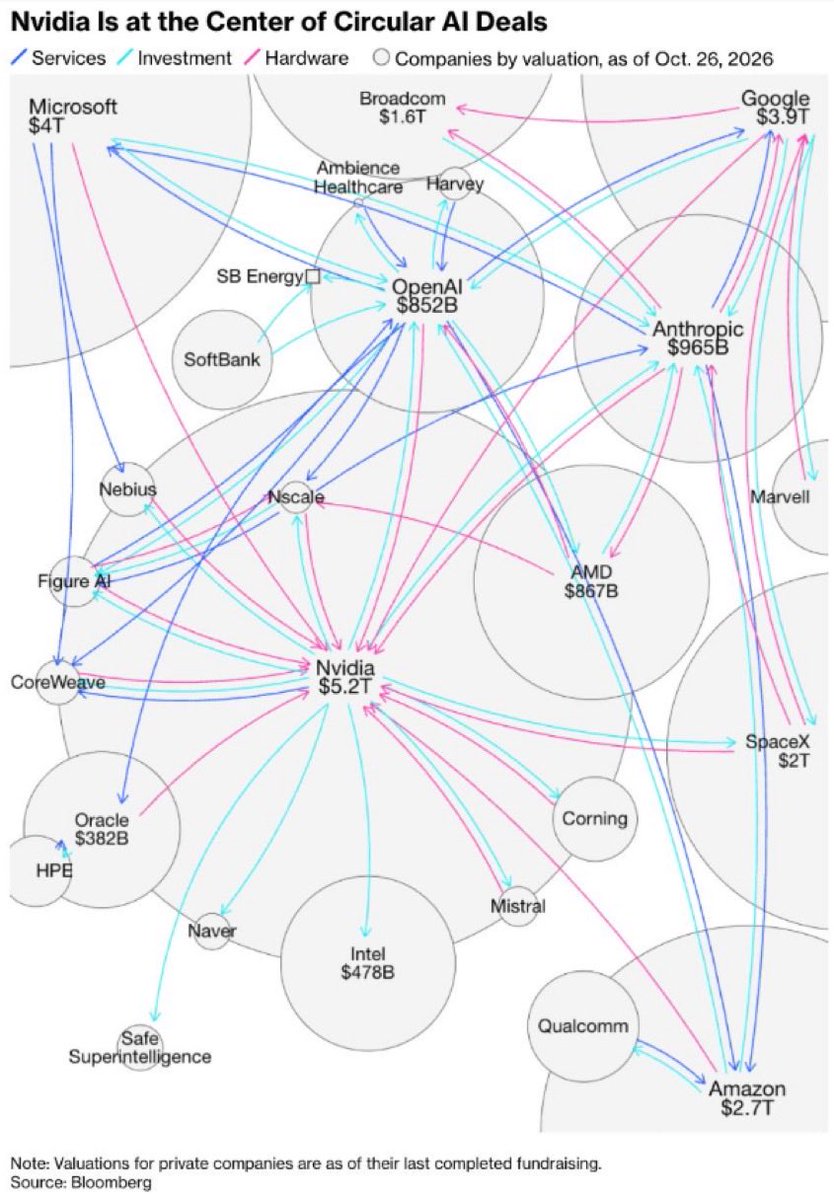
To understand why this is a big deal, you need to understand the AI funding loop.
Here is how it works:
1. Nvidia puts money into an AI company, or guarantees its loans and leases.
2. That company uses the money and credit to build a data center.
3. The data center is filled with Nvidia GPUs.
4. Nvidia reports those GPU sales as revenue.
5. If the company cannot rent out all its computing power, Nvidia agrees to buy the unused part.
SO NVIDIA IS THE INVESTOR, THE LENDER, THE SUPPLIER AND THE BACKUP CUSTOMER, ALL IN THE SAME DEAL.
The money goes out of Nvidia and comes back to Nvidia as sales.
CoreWeave is the clearest example. Nvidia owns a stake in it, sells it chips, and agreed to buy up to $6.3 billion of its unused computing capacity through 2032.
OpenAI is the biggest. Nvidia is guaranteeing up to $105 billion for its Ohio data center, supplying all the chips inside it, and invested $1.5 billion in the company building it.
Nvidia's own filing for the quarter ending July 26 shows where the money is tied up:
• Supply commitments for memory and chip wafers: $279 BILLION, up from $119 billion.
• Guarantee on the OpenAI Ohio data center: up to $105 BILLION.
• Deals to buy unused cloud capacity from neoclouds: $36 BILLION.
Nvidia's actual liabilities on its balance sheet: $91 BILLION.
That means the commitments outside the balance sheet are almost 6 times bigger than the debts on it.
Nvidia does not lose this money unless something breaks. A guarantee only costs Nvidia if a customer cannot pay.
But this is where it gets uncomfortable.
The WSJ says Jensen himself had started to panic. He warned executives that the biggest cloud companies were moving to their own chips to depend less on Nvidia.
At the same time, the wafers and memory Nvidia had committed to buy were coming at him like an "avalanche."
So the biggest customers were trying to leave, Nvidia was locked into buying huge amounts of supply, and smaller customers were being kept alive with Nvidia's credit.
And things were already starting to crack:
• Nvidia paused some of its financing deals in August.
• Nearly half of the $80 billion in data center bonds issued this year were rated junk.
• Neocloud stocks crashed this week, with Nebius down over 20% and CoreWeave down 17% at the lows.
• OpenAI raised less than it wanted, at a lower valuation.
And now Kress is the one deciding whether this continues.
If she pulls back on the financing, the companies that depended on Nvidia's money will have to borrow elsewhere, in a debt market that is already nervous.
If they cannot, they stop buying chips.
And if they stop buying chips, Nvidia's revenue drops.
That is the risk of a loop. It works perfectly when money keeps flowing, and it hurts on the way down.
Zwischen 1949 und 1961 verlor die DDR einen ganz erheblichen Teil ihrer Bevölkerung, vor allem jüngere und gut ausgebildete Menschen: Vor dem Mauerbau (13. August 1961) flohen rund 2,7 Millionen Menschen aus der DDR in den Westen — weil sie in der DDR, also im Sozialismus, keine Zukunft für sich sahen.
Und diese Fluchtwelle vor 1961 war einer der Hauptgründe für den Mauerbau, denn insbesondere Fachkräfte und junge Menschen verließen das Land, sie wollten nur raus und weg.
Volkswirtschaften, in denen die Menschen immer tiefer in die sozialistische Geisteshaltung abgleiten — wie es etwa in der Bundesrepublik Deutschland der Fall ist—, wird es letztlich so gehen wie der DDR: Talente und vor allem Kapital wandern ab in andere Regionen der Welt. Zurück bleiben Mangel, Not, Verelendung, Unterdrückung.
Übrigens: Sozialismus funktioniert nicht einmal, wenn man die Menschen einsperrt. Sozialismus führt immer und geradewegs in den Bankrott. Dazu lese man z. B. Ludwig von Mises "Die Gemeinwirtschaft": https://t.co/gQVwdx2ra5
BREAKING: Alphabet, $GOOGL, Meta, $META, Microsoft, $MSFT, Amazon, $AMZN, and Oracle, $ORCL, have now disclosed a record $3.3 trillion in future spending commitments.
These are off-balance-sheet commitments covering data-center spending, future equipment purchases, leases, and other obligations.
$GOOGL accounts for the largest amount at $1.06 trillion, with its disclosed commitments surging nearly +700% over the last year.
$META follows at $866 billion, with nearly half tied to data-center leases that have not yet commenced and payment periods extending up to 30 years.
Meanwhile, Microsoft, $MSFT, has $593 billion in commitments, followed by Amazon, $AMZN, at $453 billion, and Oracle, $ORCL, at $322 billion.
The AI infrastructure buildout is creating an unprecedented pipeline of future financial obligations.
When Israel-US bombings of Iran began last year, Mr. Merz hailed them.
"Doing Europe's dirty work"
100bn Euro is nothing compared to the Earth-shattering blow Iran's Powerful Armed Forces will deal against those who dare harm our people.
Red lines are a thing of the past.
BREAKING: Anthropic is now expected to receive a "high junk" rating from major credit rating agencies after its IPO, which could come as soon as November, per FT.
Details include:
1. Blackstone has told investors that Anthropic likely will not receive an investment-grade rating immediately after its IPO
2. Blackstone is working with banks that stumped up financing on selling the debt on to other investors
3. An investment-grade rating is "central" to Anthropic's ability to continue its AI buildout
4. The company says it expects to spend over $800 billion on computing infrastructure between now and 2045
Debt markets are increasingly in the spotlight as AI funding becomes less abundant.
This is a monthly chart of consumer staples ($XLP) relative to the cap weighted S&P 500 ($SPY). The bottom panel measures the yearly rate of change in that ratio.
When that line rises, staples are gaining momentum against S&P 500 index that is heavily influenced by big tech. Think defensive rotation.
Look at the highlighted periods: 2001, 2007, 2011, 2015, 2019 and 2022.
Now look at the sharp turn higher on the right.
It hasn’t cleared that interesting 5% line yet. But, if this keeps climbing, the shift toward safety deserves attention.
ZUSAMMENFASSUNG DER ERKLÄRUNG VON FED-CHEF KEVIN WARSH:
1. Leitzinsband bleibt unverändert bei 3,75-4,0 Prozent p. a.
2. Fed wird ab Herbst 2027 eine Stimmabgabe bei der Festlegung des Zinssatzes abschaffen 🤔
3. Fed erwartet für 2028 nur noch 6 Zinssitzungen im Jahr im Vergleich zu 8 derzeit
4. Überwältigender Konsens lautet, dass die „monetäre Medizin zu wirken beginnt“ 🤔
5. Warsh sagt, er sei „unwillig und unfähig“, Finanzbedingungen als straff zu bezeichnen 🤔
6. Warsh sagt, dass die Inflation in den USA weiterhin erhöht bleibt
7. Die Fed wartet auf weitere Informationen, um den geldpolitischen Pfad zu bestimmen
Fazit: Die Fed befindet sich nun im „Abwarten-und-Beobachten“-Modus (damit wird jede US-Konjunkturzahl zum Market-Mover) 🤔