It is with great pleasure that I announce that my work was awarded in the poster session of the #MetabolismCancer. We are among the 6 best of the 100 works presented at this productive conference. I would especially like to thank my #PhyCell team #ONCOLille and my collaborators.
Hey Twitosphere, please RT this exciting PhD opportunity with us @IMT_NordEurope (direction @VRiffault, S. Dusanter and myself) studying air pollution in Paris (#ACROSS) and Sao Paulo (#BIOMASP). #AtmChemAeroJobs
More info below, or just DM us.
https://t.co/eX5VcaMcah
Almost a year ago I had the pleasure to speak about #ClimateCrisis with Dr. Thelma Krug, outstanding Brazilian scientist, and one of the @IPCC_CH vice chairs for @AtmosTales.
Now that IPCC #AR6 is out, it's a chance to listen again!
Watch Dr Elom Aglago present a study on how regularly eating #fish affects a person's #ColorectalCancer risk. IARC estimates colorectal #cancer was the 3rd most common cancer on 🌏 in 2020, with almost 2 million new cases #ColorectalCancerAwarenessMonth https://t.co/yHWX6SDcbb
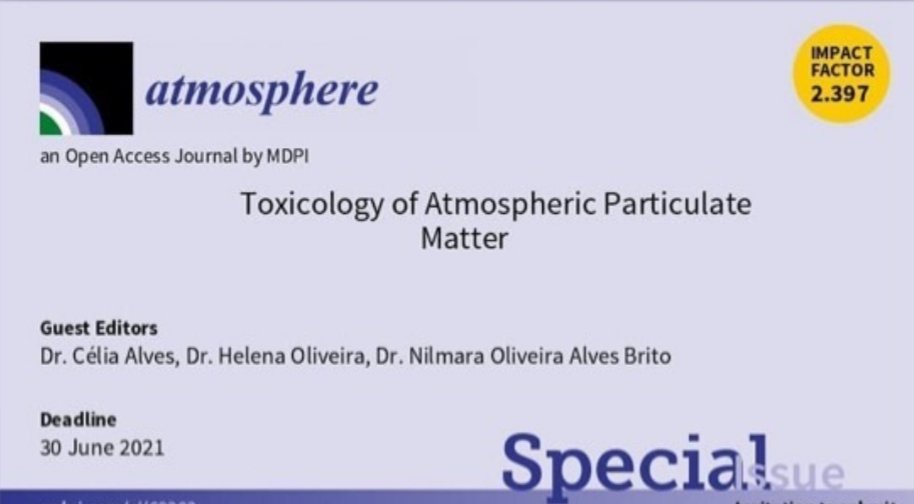
As Guest Editor of the journal Atmosphere, I would like to invite you to submit a paper to the Special Issue "Toxicology of Atmospheric Particulate Matter".
Details of the Special Issue can be found below: https://t.co/VYJzUbjNVF
Caros associados! Segue outra oportunidade de colaboração, agora referente ao periódico "Atmosphere". Dra Nilmara Oliveira de Alves Brito atuará como co-editora da edição especial! Excelente oportunidade para o início de 2021!!🤗
Which particulate air pollution poses the greatest health risk?
Here is a hint for you: wood combustion and road traffic have higher oxidative potential, therefore more harmful to health. 💀
#AirPollution#anapneism https://t.co/pAkpKUsWxG
It’s #CRISPR. Emmanuelle Charpentier and Jennifer Doudna ,who pioneered the revolutionary gene-editing technology, are the winners of this year’s #NobelPrize in Chemistry. #NobelPrize2020
https://t.co/I9uqEE41or
https://t.co/YPjIyMPCMW Queimadas na #Amazônia aumentam internações. Este ano, o #Inpe já registrou mais de 64 mil focos de #incêndio na Amazônia (11% a mais que 2019) e mais de 15 mil no Pantanal (aumento de 220% em relação a 2019), de acordo com dados atualizados em 14/09