You had me at Hello.
On a more serious note. Unlocking access to investment vehicles imo is one of the biggest superpowers crypto can offer, and there’s no one better suited than @kevtanggg and @wyattraich at the wheel. Pleasure building alongside you gents💯
Every Market. Everywhere
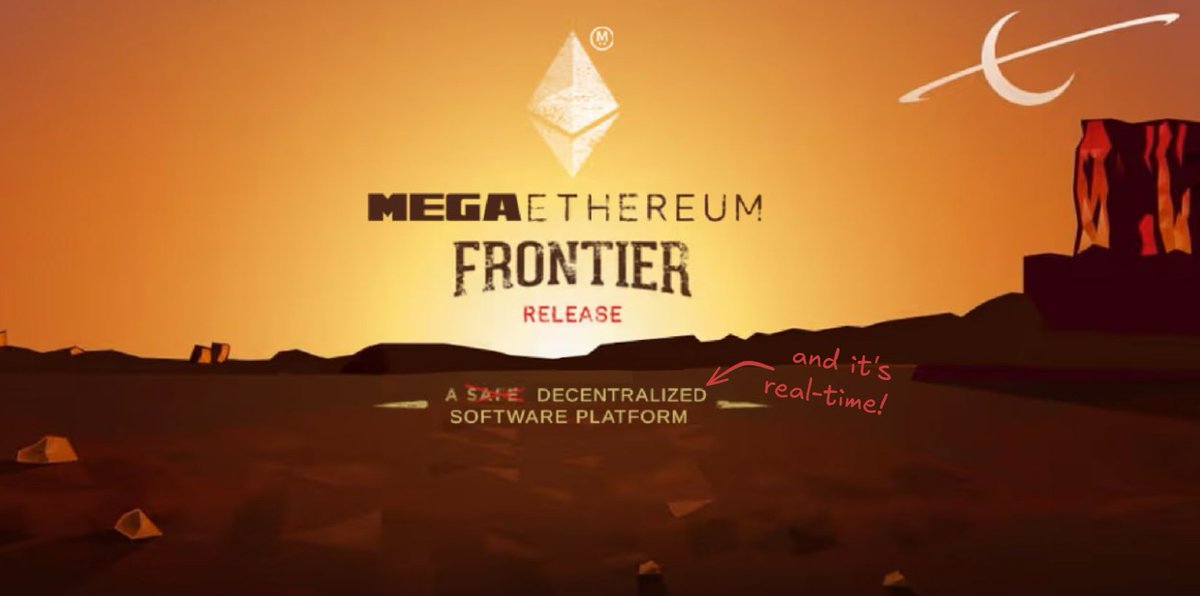
Introducing Frontier, the official release of Mainnet Beta.
Built for the Early Adopters. The Experimenters. The Ethereans.
It will be live for one month starting early December.
Get ready to experience real-time.
Wholeheartedly agree with this.
The curve is rapidly shifting with the ever-growing influx of institutions and 'tradfi' participants, both of whom have never immersed themselves in the web3 lore nor have the appetite to venture into these vapourware, merry-go-round metas. So these merry-go-rounds are getting shorter and shorter, paving way for web3 startups with truly tangible impact to truly emerge.
DePIN is the frontier.
Had this in my drafts and forgot about it...
The old crypto is dead.
It has taken a long time to finally arrive at a place where almost everyone who has spent some time in crypto is unwilling to hold tokens with no underlying fundamentals/credible growth story.
Maybe this seems obvious, but for most of crypto's history we operated with massive speculative premiums. We had people that believed tokens with egregiously inflated valuations would/might justify their market caps one day with adoption.
Each "meta" has produced smaller and smaller combined market caps since 2021, because more and more participants are aware that printing tokens out of thin air with nothing of substance behind them will end in the token going to zero.
You can't reprogram the world to believe in worthless tokens. You can't go back in time and erase the memories of everyone that has seen every vaporous alt coin go to zero.
We now know what has PMF, and which categories are adding value to the world, alongside a heap of ideas that essentially went nowhere (it turns out you can't just disrupt web2 by handing out worthless tokens).
We have cycled through every experiment to cement the use cases of value.
From here on out you get the post 2001 Amazon type winners. You may even see speculative discounts on good projects with actual fundamentals right now/in the near future.
This isn't a bad thing for the industry, I think it is especially good for investors that will find it easier to allocate to clear long term winners... and I believe we will have some giant winners.
This is a bad thing for those who haven't made it/arrived late under the premise that they will be handed easy quick 100x opportunities, and "keep clicking".
It will be very difficult for terminally online crypto bros who have become addicted to fast money games. I think this cohort are going to get rinsed, and slowly lose their minds and all of their money (if they haven't already).
There are a ton of sophisticated/skilled market participants that solely exist now in crypto to extract from the online crypto bros who are unemployable and can't do anything else.
The odd win here and there will keep people playing a game that they will never escape.
The speed with which participants are trying to offload worthless tokens onto someone else, who is also aiming to offload worthless tokens onto someone else, will continue to accelerate.
Treating crypto as a get rich slow scheme is in fact the right move going forward.
It's the end, but it's also the beginning.
Just like ICOs are getting retail familiar with VC processes, MegaMafia will get the Mega community familiar with startup life.
→ Lots of attempts
→ Many failures
→ Several ecosystem-defining apps
Undoubtedly the right path.
This is why we are building @Cilium_xyz.
The real-time spatial intelligence layer for the Autonomous Future. An open, visual foundation any autonomous machine can tap into + guardrails when navigating different environments.
The ambition here is huge, but so is the need.
If you’ve caught @elonmusk's recent podcast rounds, he keeps talking about “his robot army” and how he wants tighter control of Tesla to build it. 🤔
Ok I can’t be the only one who finds that… unsettling, right?
The idea of one company (or one person) owning millions of embodied machines with near-human dexterity and persistent memory sounds like the start of a Black Mirror episode.
It’s not that the vision is wrong, but the concentration of that much power in one system should make anyone pause.
@web3sg@Cilium_xyz We are building the real-time motion graph powering the autonomous future.
Robots. Cars. Humanoids. In a world of autonomous sensory blindness, Cilium lights the path forward.
Where perception becomes infrastructure.
Where vision itself learns to move.
Have 2 strong beliefs on this:
1) DePIN's incentive system as we know it simply does not work. Aggressive emissions early on does bootstrap supply, but collection data points are not well validated/defined, which leads to lagging demand, if it ever picks up at all. When they do need to pivot towards a different set of data points, such early emissions would be given out for nothing.
So we do need to refine the playbook:
1.1 reward based on meaningful, monetisable contributions, rather than participation
1.2 define/pinpoint what those data points are, while leaving room for iteration. This is crucial as most teams will have to play around with different data points until they achieve PMF, which is a reality they have to accept and ingrain as part of the incentive design.
2) extension to (1) as DePIN carries a lot of baggage, which is why many are leaning away from the sector towards their respective niches instead.
Many such cases within robotics (Auki, 375ai, PrismaX ,etc) where their operational model is can be categorised as "depin", but their positioning is elsewhere.
So perhaps DePIN as a sector was a case of flawed definition, where it should have been defined as a type of incentive system, rather than a sector.
AI embodiment is achieved through true cognition, which arises from, among other things, awareness and relativity.
A huge part of that is spatial, which is the next big unlock towards embodiment for all autonomous machines.
“Mind-body dualism is just not correct,” says Marc Andreessen.
Human cognition isn’t just rational thought in the brain. It’s a whole-body experience, shaped by our senses, hormones, and nervous system.
Today’s AI is still a disembodied brain. Robotics will connect thought to experience and show us how cognition works in humans and machines.
@pmarca