From the point of view of information theory, quantum systems are rather peculiar: on the one hand, an n-level quantum system can be in a continuum of definite states; on the other, basis measurements can only extract log2(n) bits of information, at the cost of forever erasing all remaining degrees of freedom of the quantum state. For a qubit, a 2-level quantum system, the space of states is the Bloch sphere, and basis measurements extract log2(2)=1 bit of information.
But measuring a quantum system in a fixed basis is not the only way to extract information from it: more generally, we can use procedures known as positive operator-valued measures (POVMs). Unlike a basis measurement, a POVM on an n-level quantum system can have more than n outcomes, at the expense of a loss of "sharpness": for some (or even all) outcomes, there is no quantum state which results in that outcome 100% of the time (for a basis measurement, each basis state does so for one of the outcomes).
So, a natural question arises: How much information can a quantum system actually store? The answer would be rather straightforward if basis measurements were the only way to extract information, but POVMs complicate things. Regardless, a celebrated 1973 result be Alexander Holevo [1] provides an analytic upper bound on the amount of information that can be extracted by POVMs, which can never exceed log2(n) bits for an n-level quantum system¹.
We might legitimately think: case closed, a qubit can store at most a bit of information. Let's brush it off and move on with our life. But then we dig a little more, and we learn about "super-dense coding". Published in 1992 by Charles Bennett and Stephen Wiesner [2], the super-dense coding protocol allows one party (call her Alice) to encode two bits worth of information into a single qubit, then send the qubit to another party (call him Bob) who can, without fail, decode the two bits with a single measurement.
One qubit carries two bits.
(╯°□°)╯︵ ┻━┻
How is this possible?
The catch, it turns out, is that Alice's qubit must already be entangled to a qubit in Bob's possession, prior to the encoding: Bob measures both qubits (specifically, in the Bell basis) to extract the information, so one bit of information per qubit was extracted overall, consistently with Holevo's bound.
Alice only has access to one of the two entangled qubits, but the qubit is not isolated, and the operations she performs modify the entangled state shared by both qubits (see e.g. Step 4 in the picture below). Bob cannot extract any of that information from his qubit alone, because of the constraints imposed by relativistic causality, but the information is already there, in the entangled state, and he can extract it once he receives the second qubit from Alice.
[1] https://t.co/oYwKUxIzQr
[2] https://t.co/35O0CRgZSd
[3] https://t.co/yekqx5y05a
¹ The bound is not tight, and variants have been derived in recent years. A very interesting one, based on graph theory, is given in a 2013 paper by Péter Frenkel and Mihály Weiner [3].
For more than 50 years, mathematicians hunted for a simple two-dimensional shape that tiles aperiodically. This year, a hobbyist in northern England found two shapes that helped unveil an infinite family of simple aperiodic tiles. @ericaklarreich reports: https://t.co/kpNhHZA9W3
For more than 50 years, mathematicians have sought an “einstein”--a simple shape that can only tile the plane nonperiodically. Now a retired print technician has found one! My latest for @QuantaMagazine https://t.co/UYlKQ5OFZ3
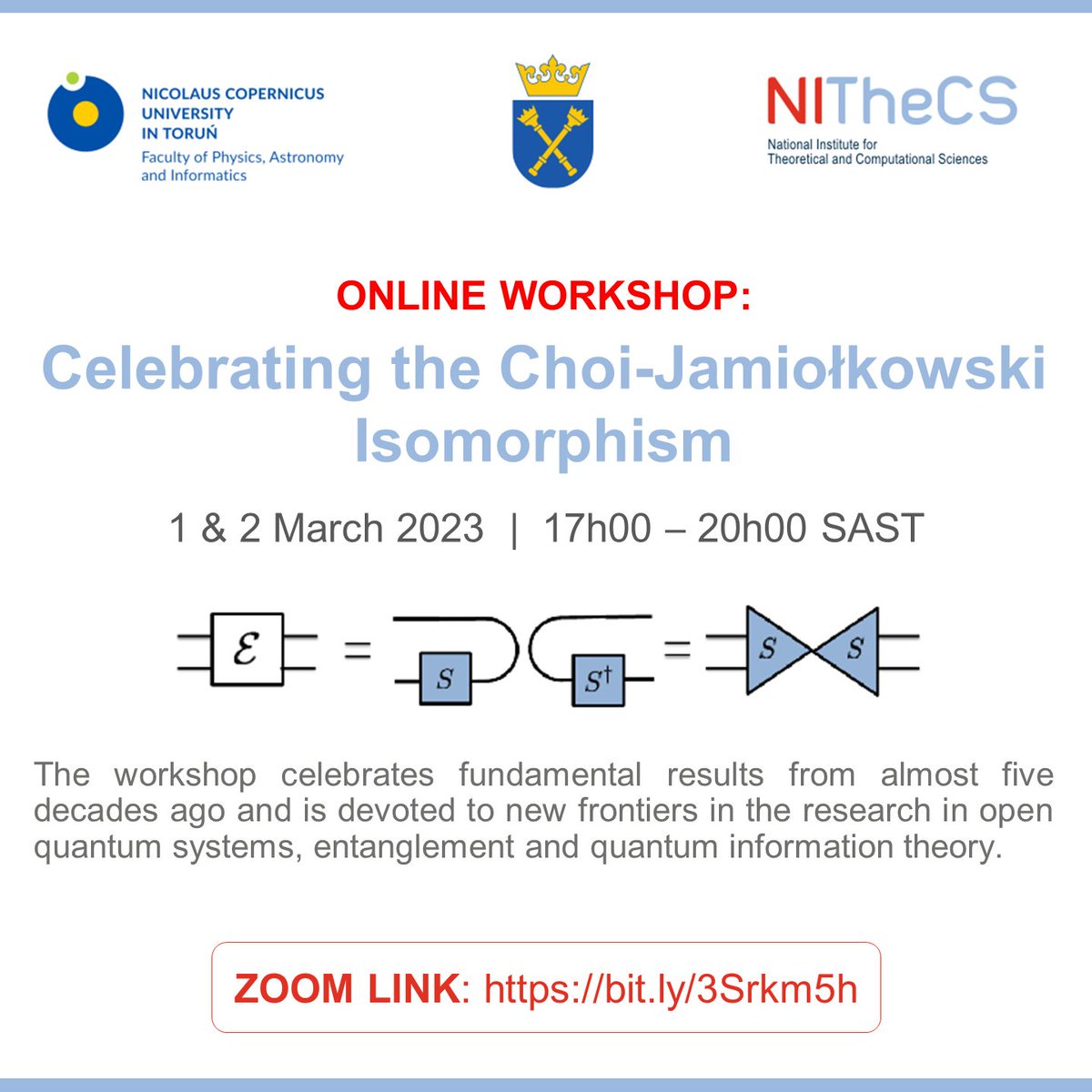
Workshop: 'Celebrating the Choi-Jamiołkowski Isomorphism' - 1-2 March 2023. Click on the Zoom link to attend online: https://t.co/JlacASESL7. https://t.co/hsqwLl82dr
#quantum#science#nithecs
If you've ever wondered what a workshop on quantum foundations looked like in 1982, check out the program for "The Quantum and the Foundations of Physics Conference” at the University of Texas in Austin, organized by John Wheeler. From Bill Wootters’ records.
@nicoleyh11@UMD_IPST Thank you for coming up with the contest! It was great fun coming up with characters that I fell in love with and a story that felt enjoyable to narrate. Hope you enjoy reading the submissions and looking forward to the many cool stories that come out on the other end :)
hey #quantum twitter! We are looking for 2⃣ postdocs to work with Paweł Horodecki in project entitled: Relativistic causality and information processing #postdocjobs#AcademicTwitter#quantumjobs https://t.co/XuwbUgoCjw
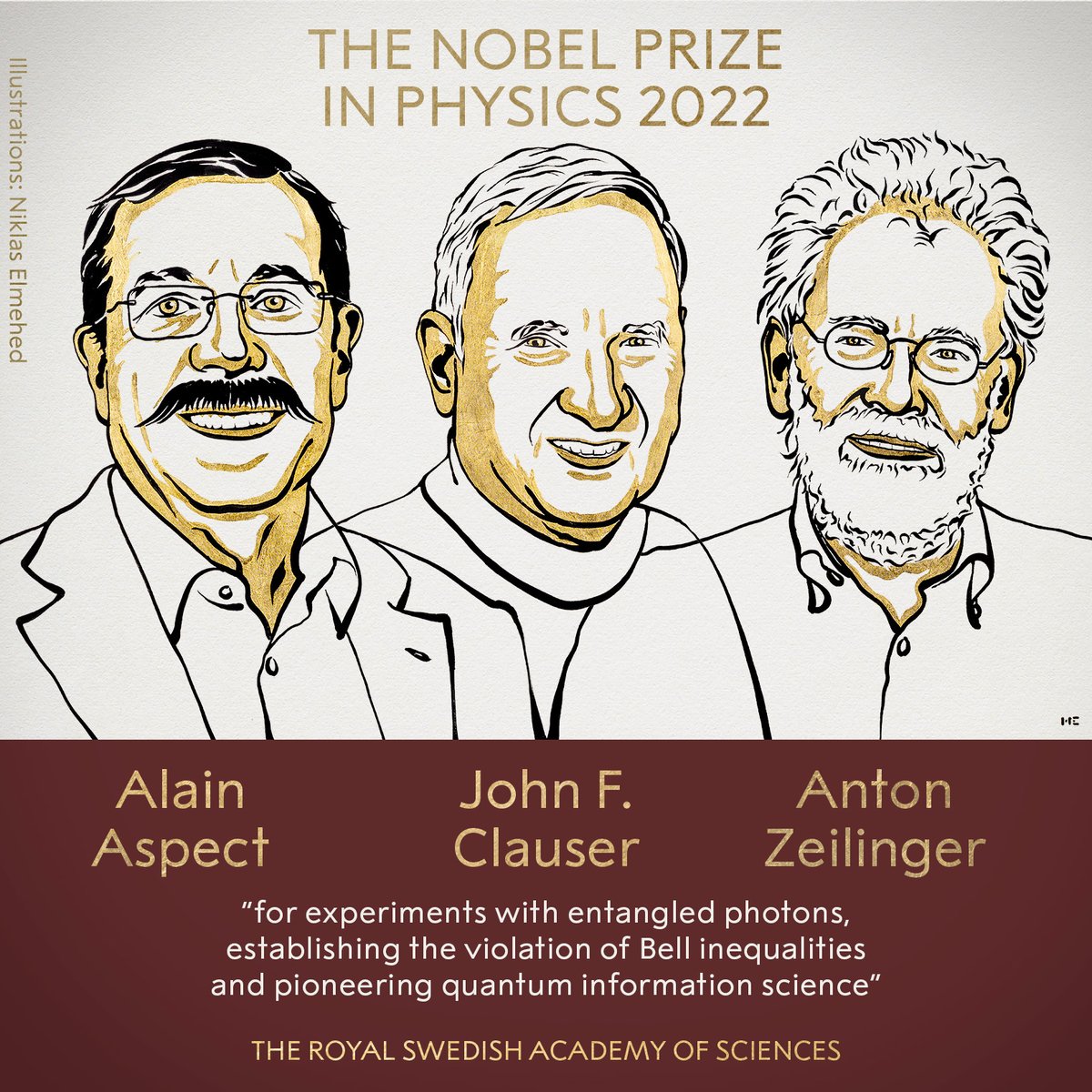
BREAKING NEWS:
The Royal Swedish Academy of Sciences has decided to award the 2022 #NobelPrize in Physics to Alain Aspect, John F. Clauser and Anton Zeilinger.
Have a gander at the replies to the tweet, and perhaps add your recommended essay to the list!
I went with John Bell's "Bertlmann's socks and the nature of reality"
@RuthxJackson "Bertlmann's socks and the nature of reality" by John S. Bell
(from the collection of papers"Speakable and Unspeakable in Quantum Mechanics")
[beware, Tweet contains book placement]
What happens if you combine the best experts in the field with hard-working and ambitious students? You get a Book. We’re excited to present “Modern applications of machine learning in quantum sciences”!
https://t.co/2t06ZgOOcG





![StefanoGogioso's tweet photo. From the point of view of information theory, quantum systems are rather peculiar: on the one hand, an n-level quantum system can be in a continuum of definite states; on the other, basis measurements can only extract log2(n) bits of information, at the cost of forever erasing all remaining degrees of freedom of the quantum state. For a qubit, a 2-level quantum system, the space of states is the Bloch sphere, and basis measurements extract log2(2)=1 bit of information.
But measuring a quantum system in a fixed basis is not the only way to extract information from it: more generally, we can use procedures known as positive operator-valued measures (POVMs). Unlike a basis measurement, a POVM on an n-level quantum system can have more than n outcomes, at the expense of a loss of "sharpness": for some (or even all) outcomes, there is no quantum state which results in that outcome 100% of the time (for a basis measurement, each basis state does so for one of the outcomes).
So, a natural question arises: How much information can a quantum system actually store? The answer would be rather straightforward if basis measurements were the only way to extract information, but POVMs complicate things. Regardless, a celebrated 1973 result be Alexander Holevo [1] provides an analytic upper bound on the amount of information that can be extracted by POVMs, which can never exceed log2(n) bits for an n-level quantum system¹.
We might legitimately think: case closed, a qubit can store at most a bit of information. Let's brush it off and move on with our life. But then we dig a little more, and we learn about "super-dense coding". Published in 1992 by Charles Bennett and Stephen Wiesner [2], the super-dense coding protocol allows one party (call her Alice) to encode two bits worth of information into a single qubit, then send the qubit to another party (call him Bob) who can, without fail, decode the two bits with a single measurement.
One qubit carries two bits.
(╯°□°)╯︵ ┻━┻
How is this possible?
The catch, it turns out, is that Alice's qubit must already be entangled to a qubit in Bob's possession, prior to the encoding: Bob measures both qubits (specifically, in the Bell basis) to extract the information, so one bit of information per qubit was extracted overall, consistently with Holevo's bound.
Alice only has access to one of the two entangled qubits, but the qubit is not isolated, and the operations she performs modify the entangled state shared by both qubits (see e.g. Step 4 in the picture below). Bob cannot extract any of that information from his qubit alone, because of the constraints imposed by relativistic causality, but the information is already there, in the entangled state, and he can extract it once he receives the second qubit from Alice.
[1] https://t.co/oYwKUxIzQr
[2] https://t.co/35O0CRgZSd
[3] https://t.co/yekqx5y05a
¹ The bound is not tight, and variants have been derived in recent years. A very interesting one, based on graph theory, is given in a 2013 paper by Péter Frenkel and Mihály Weiner [3].](https://pbs.twimg.com/media/F-1so3LXgAAT7Z0.jpg)


![MolecularRobot's tweet photo. [beware, Tweet contains book placement]
What happens if you combine the best experts in the field with hard-working and ambitious students? You get a Book. We’re excited to present “Modern applications of machine learning in quantum sciences”!
https://t.co/2t06ZgOOcG https://t.co/UCELeSOODX](https://pbs.twimg.com/media/FQDNgdXWUAIhldZ.jpg)


