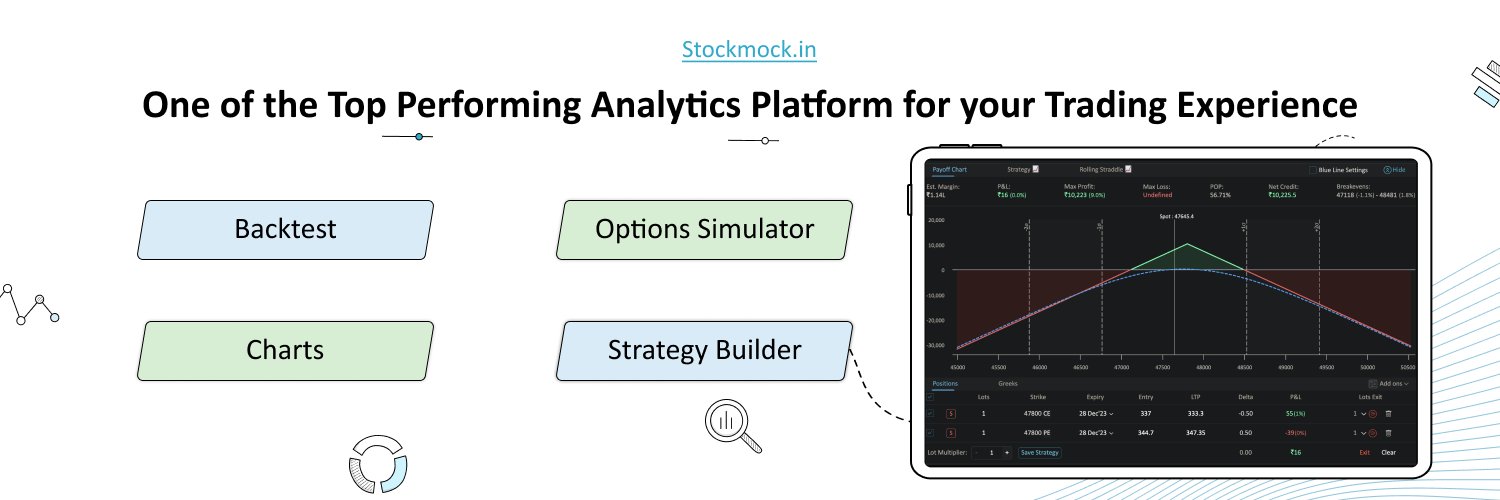
These Revised prices are going to stay for long, and is not for Limited Time 🔥
Get Unlimited backtesting at:
449/- 7 days
1299/- 28 Days
2999/- 84 Days
✨ #Backtest#PriceDrop ✨
We’ve always believed optimisation should benefit you—and today, it finally does! 🚀
After fine-tuning our backtesting systems, we’re excited to pass the savings straight to you.
🎉 Enjoy a 25% Price Drop on all Backtesting Plans, effective right now!
Smarter. Faster. Cheaper. 🔥
➡️ https://t.co/3M32wVeo3s
@ScholarTrading Bhai take break if needed. Mental peace should be priority. You’re doing this for larger audience and for good. Everyone faces it on their way upwards. Clearly signalling you’re on right track.
F&O Stocks are now live in the StockMock Simulator..
With the ₹250/month Analytics plan you get:
✅ Simulator – Index + Stocks
✅ Builder – Index + Stocks + Live Trading
✅ Option Chain
✅ Charts – Rolling Straddle, 4-in-1, OI, Multi Strategy
All in one plan.
https://t.co/NzDetpGGEp
@elonmusk Only way out is to Beat Ambanis at their own game. Try Offering Starlink for 500/- per month unlimited 100GBPS… 🔥
If not possible, stay out of it.
Thank you @_anujsinghal for raising CAS issues #CASKiAwaaz
Solution 1: Expire 0DTE options at 3:15 PM
Solution 2: Reduce the CAS band from 3% to around 0.3%
https://t.co/jbvwgeV6h2
CAS & Options — The Problem
🔴 What is happening?
CAS is creating a new problem for option traders.
Right now, options are starting to price CAS risk higher than overnight risk.
Think about that.
A 20-minute auction is becoming a bigger risk for an option seller than holding the position overnight.
That doesn’t feel normal.
⚠️ Why is CAS more complicated in India?
We cannot simply say that CAS works in other countries, so it should work the same way in India.
Our market is different.
1. Cash market vs F&O market
Our derivatives market is huge compared to the depth available in individual stocks in the cash market.
But ultimately, prices discovered in the cash market can impact settlement of a much larger derivatives market.
This creates an imbalance.
A relatively small amount of activity during CAS can potentially have a much bigger impact on F&O positions.
2. Short sellers are missing
In India, you cannot normally carry a short position in stocks overnight.
So an important group of sellers is effectively missing from the auction.
If buyers and sellers don't have the same freedom to participate, we should at least ask:
Is CAS really giving us the fairest possible closing price?
🔴 The bigger question — Why 3%?
This is the part I find difficult to understand.
Why has the CAS price band been kept at 3%?
Why 3% and not 1%?
Or 0.5%?
What data supports 3%?
Do these stocks normally move anywhere close to 3% in the last 20 minutes?
If the answer is no, then option traders are being forced to price a risk which normally doesn't even exist.
And that is exactly what we are seeing in option premiums.
As 3:15 approaches, sellers have to protect themselves against what could happen during CAS.
Naturally, premiums stay high and liquidity can reduce.
💡 Possible Solutions
I don't think CAS needs to be removed.
The problem can possibly be solved with much smaller changes.
Solution 1: Expire 0DTE options at 3:15 PM
Take the reference price at 3:15 PM and use that for settlement of expiring options.
After that, CAS can continue normally for the cash market.
This keeps CAS and 0DTE settlement separate.
OR
Solution 2: Reduce the CAS band from 3% to around 0.3%
If historical movement during these 20 minutes is small, why allow a 3% band?
A 0.3% band would make the maximum possible CAS movement much more predictable.
For option sellers, this makes a huge difference.
Once they know that CAS cannot suddenly create a very large settlement move, they will be more comfortable providing liquidity even after 3:15 PM.
And if sellers stay in the market, option premiums should also start becoming normal.
The Point
CAS itself may not be the problem.
The way CAS interacts with our derivatives market is the problem.
If a 20-minute auction carries more risk premium than holding a position overnight, we should seriously look at the design again.
CAS can stay.
But it should be designed around how the Indian market actually works.
The goal should always be simple:
Fair price discovery, without creating unnecessary risk for the derivatives market.
#CAS #Options #IndianMarkets #SEBI #Derivatives
@IRITA_india
The price discovery under CAS is so perfect that the very next day, the market has to undiscover the same price in the pre-open session.
Too fair a value, apparently.
#sebi#anujsinghvi#CASBAKWAS
CAS & Options — The Problem
🔴 What is happening?
CAS is creating a new problem for option traders.
Right now, options are starting to price CAS risk higher than overnight risk.
Think about that.
A 20-minute auction is becoming a bigger risk for an option seller than holding the position overnight.
That doesn’t feel normal.
⚠️ Why is CAS more complicated in India?
We cannot simply say that CAS works in other countries, so it should work the same way in India.
Our market is different.
1. Cash market vs F&O market
Our derivatives market is huge compared to the depth available in individual stocks in the cash market.
But ultimately, prices discovered in the cash market can impact settlement of a much larger derivatives market.
This creates an imbalance.
A relatively small amount of activity during CAS can potentially have a much bigger impact on F&O positions.
2. Short sellers are missing
In India, you cannot normally carry a short position in stocks overnight.
So an important group of sellers is effectively missing from the auction.
If buyers and sellers don't have the same freedom to participate, we should at least ask:
Is CAS really giving us the fairest possible closing price?
🔴 The bigger question — Why 3%?
This is the part I find difficult to understand.
Why has the CAS price band been kept at 3%?
Why 3% and not 1%?
Or 0.5%?
What data supports 3%?
Do these stocks normally move anywhere close to 3% in the last 20 minutes?
If the answer is no, then option traders are being forced to price a risk which normally doesn't even exist.
And that is exactly what we are seeing in option premiums.
As 3:15 approaches, sellers have to protect themselves against what could happen during CAS.
Naturally, premiums stay high and liquidity can reduce.
💡 Possible Solutions
I don't think CAS needs to be removed.
The problem can possibly be solved with much smaller changes.
Solution 1: Expire 0DTE options at 3:15 PM
Take the reference price at 3:15 PM and use that for settlement of expiring options.
After that, CAS can continue normally for the cash market.
This keeps CAS and 0DTE settlement separate.
OR
Solution 2: Reduce the CAS band from 3% to around 0.3%
If historical movement during these 20 minutes is small, why allow a 3% band?
A 0.3% band would make the maximum possible CAS movement much more predictable.
For option sellers, this makes a huge difference.
Once they know that CAS cannot suddenly create a very large settlement move, they will be more comfortable providing liquidity even after 3:15 PM.
And if sellers stay in the market, option premiums should also start becoming normal.
The Point
CAS itself may not be the problem.
The way CAS interacts with our derivatives market is the problem.
If a 20-minute auction carries more risk premium than holding a position overnight, we should seriously look at the design again.
CAS can stay.
But it should be designed around how the Indian market actually works.
The goal should always be simple:
Fair price discovery, without creating unnecessary risk for the derivatives market.
#CAS #Options #IndianMarkets #SEBI #Derivatives
@IRITA_india