@SubhadipNandy16 whats the point in comparing the cash volumes??....the real comparision should be options turnover of last wednesday to this wednesday
@fyers1@tejaskhoday
hi sir.... can u please bring a nice and easy feature on fyers??
please give a option to remove CAS period candles from the charts.....these CAS candles distort the indicator behaviour ....due to which false and unnessary signals are being created....
#rollbackCAS : Just a conversation in my mind
Textbook : A derivative derives its value from an underlying.
Me : Agreed. So what is the derivative deriving its value from between 3.15 pm and 3.20pm ?
Exchange : We don't know. You figure it out.
🚨 SPREAD THIS EVERYWHERE 🚨
Logic needs to be countered with logic.
They can't give vague answers like "With time it will improve"
No. It won't.
Coz the issue is structural.
We can't simply copy something without assesing suitability to our markets.
@skkkkumar68@TheNewspinch@Saurabh_Pinch Murkh logo ko apna muh band rakna hi badhiya mana jata hai...jis visay me jankari na ho uske bare me chup rahna jyada uttam hota hai...jao usi videshi sansthan me 1-2 din rah ke aao, phir batana ki wo astik bana rahe ya nastik...aur yah bhi janch kar lena ki paise kaha se aa rahe
There has been a lot of discussion about the sharp closing moves since the new Closing Auction Session went live.
CAS itself is not a bad idea. Most large global markets have some form of closing auction. A large amount of institutional activity, especially from passive funds and other benchmark-tracking investors, happens near the close. Instead of the closing price being determined based on the average traded price during the final 30 minutes, CAS brings these orders together in an auction to discover one closing price.
The goal of CAS is to enable better price discovery and make it easier to execute large orders without moving prices abruptly. But the price dislocations we have seen over the last few days highlight some of the structural problems that are specific to the Indian markets.
Closing auctions work well when there is deep liquidity and a large and diverse ecosystem of market participants, including market makers and arbitrageurs. Whenever prices diverge between the cash market, futures, ETFs, or different exchanges, participants step in and arbitrage the differences away.
This ability to arbitrage is much more limited in India.
For one, it is impossible to express a short view in the cash market. We have a securities lending and borrowing mechanism, but it isn’t deep or easy enough to use. Unless borrowing stocks and shorting them becomes easy, there is bound to be structural upward pressure in the markets.
Then there is the difference in the cost of trading an option versus a futures contract. In April 2026, STT on futures was increased to 0.05% of the entire contract value, while STT on options is charged on the premium. So even though the STT rate on options is higher, trading futures is more expensive.
Once you add STT, exchange charges, spreads, and impact costs, the trading opportunity has to be quite attractive before a futures arbitrage trade is worth doing. The same directional view can often be expressed more cheaply through options. This leads to traders preferring options over futures.
India has over 13 crore registered investors, but only about 20–30 lakh traders trade actively on any given day. That’s it. We don’t have a large enough committed ecosystem providing two-sided liquidity across the cash market, futures, ETFs, and closing auctions.
CAS is not the reason for these structural limitations, but it makes them more apparent. The timing of its rollout is also unfortunate, because the RBI’s new norms on capital-market exposure, which limit banks’ exposure to capital-market activities, are going live at the same time.
When one instrument is more attractive than another, or when participants cannot express both bullish and bearish views easily, distortions are inevitable.
There might be tweaks required in how CAS itself works. But the larger issue of our markets being shallow is a complicated problem to solve. It requires building an ecosystem that encourages all kinds of traders and investors, with different time horizons, to participate easily.
Making shorting and securities lending easier, reducing distortions between instruments, and encouraging genuine market-making would be a good place to start.
CAS is not new.
America, Germany, Europe, Hong Kong all run closing auctions.
One thing separates India from them.
Timing.
America: settles on the close, and stops trading at the close.
Germany: the auction starts, the expiring contract stops. Same second
Europe: the main index options settle on an index average taken around midday. Nowhere near the close.
Hong Kong: ran a closing auction, suspended it after a crash, brought it back seven years later in phases, and kept derivative products out of it entirely.
India: settlement forms in an auction between 3:15 and 3:35, and the expiring option trades right through it, and five minutes past it.
Everywhere I checked, the expiring contract stops before its own settlement price is formed. In India, it does not.
Was this the reason that caused the expiry chaos?
Sensex expiry runs on the same design.
On what basis was this designed at all?
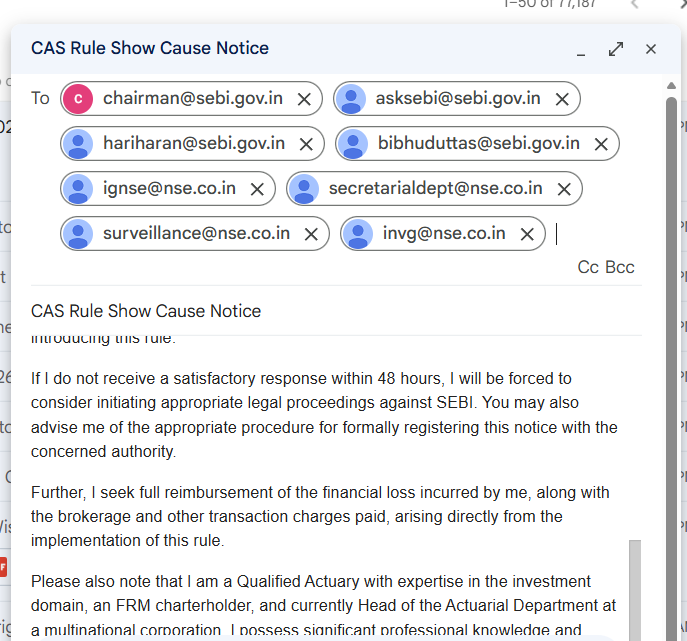
I have sent out a show cause notice to SEBI and NSE. I have given them 48 hours to respond.
At the same time, I am speaking to lawyers but yet to get a good one. Any good finance related lawyer in Mumbai reach out to me or please DM me the contact details
Looking at today’s expiry, it’s clear that if CAS continues, it’ll be the death of expiry trading.
And it’s not just traders that will get impacted.
The entire ecosystem, including brokers and exchanges, will get affected.
Request SEBI to review this urgently.
#RollbackCAS
1.Reduction of 0DTEs
2.Utterly stupid ELM
3.Choking of prop trading
4.Increasing STT, which itself is a redundant tax
Now this horrendous CAS.
SEBI seems to have lost it.
#rollbackCAS