@BigCheds Does the condition have predictive power?
- holds → resistance confirmed, potential reversal
- breaks → short squeeze, momentum continuation
- disappears → spoofing, real move opposite direction
Which on is the highest probability?
A couple reflections on the quantum computing breakthrough we just announced...
Most of us grew up learning there are three main types of matter that matter: solid, liquid, and gas. Today, that changed.
After a nearly 20 year pursuit, we’ve created an entirely new state of matter, unlocked by a new class of materials, topoconductors, that enable a fundamental leap in computing.
It powers Majorana 1, the first quantum processing unit built on a topological core.
We believe this breakthrough will allow us to create a truly meaningful quantum computer not in decades, as some have predicted, but in years.
The qubits created with topoconductors are faster, more reliable, and smaller.
They are 1/100th of a millimeter, meaning we now have a clear path to a million-qubit processor.
Imagine a chip that can fit in the palm of your hand yet is capable of solving problems that even all the computers on Earth today combined could not!
Sometimes researchers have to work on things for decades to make progress possible.
It takes patience and persistence to have big impact in the world.
And I am glad we get the opportunity to do just that at Microsoft.
This is our focus: When productivity rises, economies grow faster, benefiting every sector and every corner of the globe.
It’s not about hyping tech; it’s about building technology that truly serves the world.
https://t.co/mVNRa7jj3w
📢 #QANplatform propels AI and post-quantum readiness as an IBM Business Partner with the introduction of QAN Q-Cluster.
Kevin Redmond, Vice President IBM Technology Group commented: “AI is a prominent technology trend, and IBM stands at the forefront with our open-source AI models and enterprise platforms like IBM watsonx. It is encouraging to witness the integration of AI and quantum-resistant blockchain technologies to effectively process business data and tackle real-world challenges.”
This collaboration highlights our commitment to providing secure and innovative solutions that address real-world business challenges powered by IBM technology.
#QANplatform is proud to announce its partnership with IBM as an official IBM Business Partner. 🎉
We are introducing QAN Q-Cluster, a tamper-proof and self-auditing system that utilizes AI for log anomaly detection and incorporates quantum-resistant blockchain technology for provable durability and persistence.
Read more on our blog: https://t.co/e6SUeUuUta
Exciting news! The post-quantum signature algorithm QANplatform has been using since the beginning was selected as one of the three finalized PQC standards by NIST today! 🎉🔐
We are really proud that QAN not only identified but also implemented the post-quantum algorithm (CRYSTALS-Dilithium) in its #blockchain platform way before NIST had chosen it.
https://t.co/edRroN7lCw
What is NIST?
US based #NIST (National Institute of Standards and Technology) was founded in 1901. Its role is creating critical measurement solutions and promoting equitable technology standards for the world.
What did NIST announced on August 13, 2024?
NIST announced the first 3 quantum-resistant cryptographic algorithms which can withstand the attack of quantum computers that could potentially crack the security used to protect privacy in the digital systems we rely on every day.
Why is this a big milestone?
After 8 years, 4 rounds, 82+ submissions, the 3 selected encryption algorithms will become part of NIST’s post-quantum cryptographic standard and will play a key role in the next generation of our online cybersecurity: the post-quantum era.
Why do we need new cybersecurity standards?
Today's cryptographic algorithms (RSA, EC) used by the whole internet – including governments, banks, email providers, social media sites, blockchain platforms, etc. – will be cracked by quantum computers. Everyone needs to switch to post-quantum security.
Do we need to worry today?
Quantum computers are a threat even today, because hackers can steal data today and decrypt it later when quantum computers with enough power (qubits) arrive. This method is called "Store now, decrypt later".
How far are quantum computers?
From small startups to IT giants like Google, Honeywell or IBM, and governments – all of them are investing heavily to build quantum computers.
We are already having the wrong conversation in cryptography if we argue about whether we have 1, 3,or 5 years before quantum computers will break today's security algorithms. We must always be ahead of the curve when it comes to cybersecurity.
How can we switch to quantum-resistant security?
Centralized authorities like governments, companies can switch their IT security to post-quantum cryptography much easier than blockchain platforms.
Why is the blockchain technology the most affected by the quantum computing threat?
One of the most important points people forget is that blockchains are decentralized by design. Already running public blockchains (like Bitcoin, Ethereum, Solana, etc.) can not switch to post-quantum cryptography without massive sacrifices severely impacting users.
⚠️This threat affects blockchain technology as follows: all cryptocurrency wallets relying on Elliptic Curve (EC) cryptography which have at least one outgoing transaction will break. In short: hackers will be able to steal your cryptocurrency.
How can QANplatform be quantum-resistant?
QAN implemented a Lattice-based quantum-resistant algorithm called CRYSTALS-Dilithium in Go programming language in its security layer. It is already developed an exists in the QAN Enterprise Blockchain and in the QAN TestNet trough QAN XLINK protocol and will be used also in the QAN Public Blockchain.
Did you know?
First EU🇪🇺country already implemented QAN’s quantum-resistant technology. It protects government-owned cybersecurity infrastructure against quantum computing attacks.
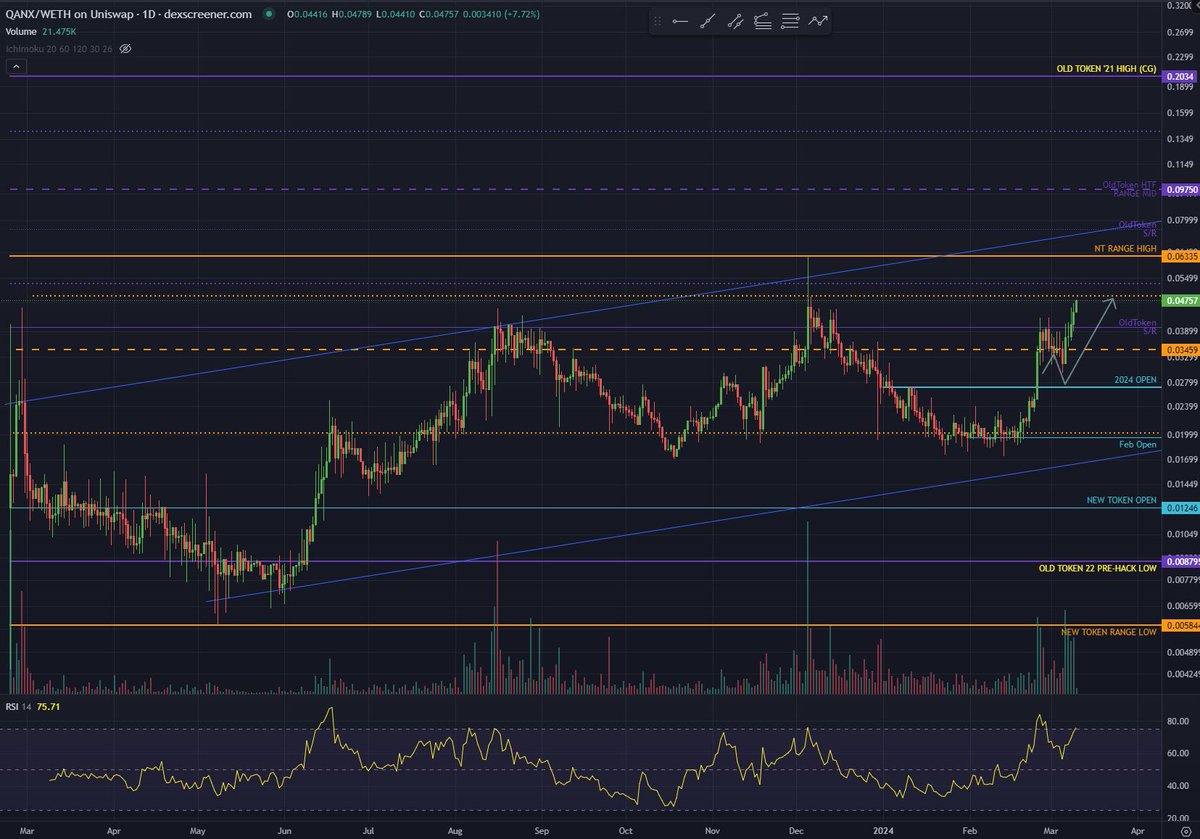
$QANX playing out. 4th knock on the supply wall at .05s. Needs to break through & sustain daily closes >.05. Ideally though, breaks up to .075, backtests .05s, and then moves higher to tackle HTF Mid at .10
@QANplatform#QuantumResistant#Ethereum $ETH #EVM-Compatible #Layer1
A $QANX weekly close today > yearly open would be a first step to confirm. Don't love the RSI action, but given liquidity levels, I can look past it.
Got $QANX? @QANplatform#QuantumResistant#Ethereum $ETH #EVM-Compatible #Layer1